
Every organization wants better visibility into what’s driving revenue and ROI, but visibility alone isn’t what changes performance. The real transformation happens when insights turn into action, and that action turns into visible results. That’s the essence of closed-loop reporting, and it’s where many teams can fall short.
Closed-loop reporting isn’t just a dashboard. And it most certainly is not a monthly recap email or a follow-up call. It’s an operating system. When it works, it creates clarity, alignment, and accountability across marketing and sales in a way traditional reporting never could.
Teams these days can’t afford loose ends of half-answered performance questions. Closed-loop reporting is how you finally connect strategy, execution, and results under one “roof” per se.
This blog post will help you understand what closed-loop reporting is, why it matters, and how to set it up for your business.
What is Closed-Loop Reporting?
Closed-loop reporting is the practice of feeding sales outcomes and customer insights back to marketing (ideally in real time). From there, teams can optimize campaigns based on what’s delivering true ROI.
In other words, it “closes the loop” between:
Marketing activity
Sales responses
Revenue outcomes
Closed-loop reporting basically operationalizes the flow of information in real time.
It answers important questions such as:
Are the leads we’re generating turning into sales conversations?
Are those conversations turning into opportunities?
Are those opportunities turning into revenue?
And if not, where is the breakdown happening?
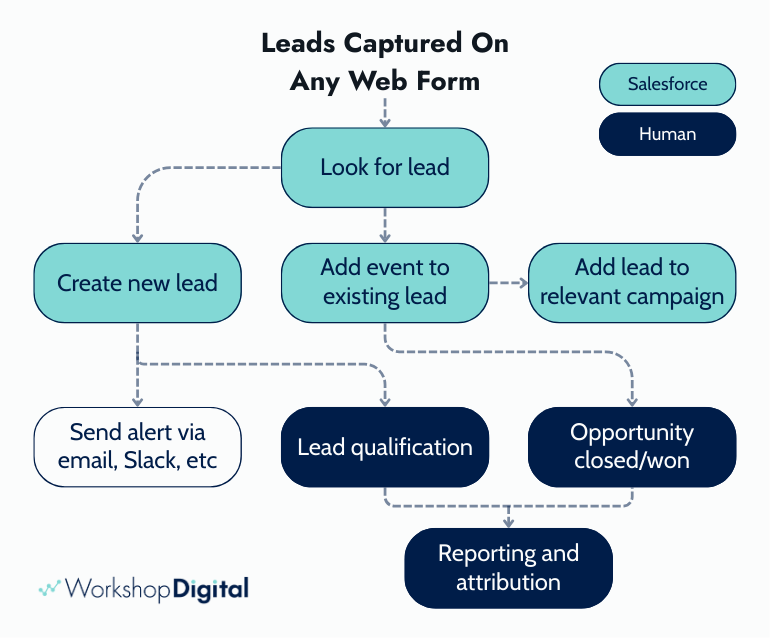
This type of reporting is about ensuring the right data returns to the right team so decisions can more easily be made.
Why Closed-Loop Reporting Matters for Marketing and Sales
Closed-loop reporting is the difference between guessing what’s working and knowing what’s moving the business forward. And in a world where customer journeys are no longer linear (with multiple touchpoints, channels, and decision-makers influencing a sale), having a true feedback loop between marketing and sales is the only way to understand how prospects actually move from interest to revenue.
Benefits of Closed-loop Reporting:
Clearer ROI: Closed-loop reporting shows which channels and campaigns actually influence revenue, not just which ones drive form fills. Instead of leads piling up in the CRM with no context, you get visibility into which efforts generate high-value opportunities and which ones aren't contributing to the pipeline at all.
Stronger Resource Allocation: When sales outcomes flow back to marketing, optimization becomes intentional. You start to see where to double down, where to pause, and where to reallocate budget. Campaigns become more efficient because they're guided by real feedback, not assumptions.
More Accurate Forecasting: With cleaner visibility into how leads progress (and where they convert), revenue projections become far more reliable. Closed-loop reporting helps teams set KPIs grounded in reality, and it strengthens the connection between marketing activity and future pipeline.
How to Set Up Closed-Loop Reporting
Closed-loop reporting becomes powerful when it’s built intentionally. The goal is to create a system that reliably answers: “What happened after marketing handed off the lead to the sales team?”
Below are the steps to consider when setting up your own workflow.
Step 1: Define Your Lifecycle Stages Clearly
Goal: Create a shared language so marketing and sales are measuring the same outcomes.
Before any data flows, teams need to agree on what each stage means: Lead, MQL, SQL, Opportunity, Customer, etc.
Tips & Tricks:
Keep the stage names simple and aligned with how your CRM is structured & it’s ok if your stages evolve as you start getting into a flow!
Add clear exit criteria (what moves a prospect from one stage to the next).
Document lost reasons: they’re incredibly valuable for optimizing your approach.
Most closed-loop systems fail here because a lack of clarity = bad data in, bad insights out.
Step 2: Establish Reliable Lead Source Tracking
Goal: Ensure every lead has a traceable origin that persists through the entire customer journey.
You need consistent UTM parameters, campaign tagging, and CRM rules to maintain source integrity. Ensure you align across teams on what those sources are and how to use them effectively.
Tips & Tricks:
Standardize your UTMs (don’t reinvent them every campaign). At Workshop Digital, we have a shared UTM builder tool that includes a “key” with all our standard tracking, so every team and person is aligned on what to use (see example below).
Create a hierarchy for lead source (Primary Source → Secondary Source → Campaign).
Lock fields in your CRM so the source cannot be overwritten. When there are multiple cooks in the kitchen, things can get messy!
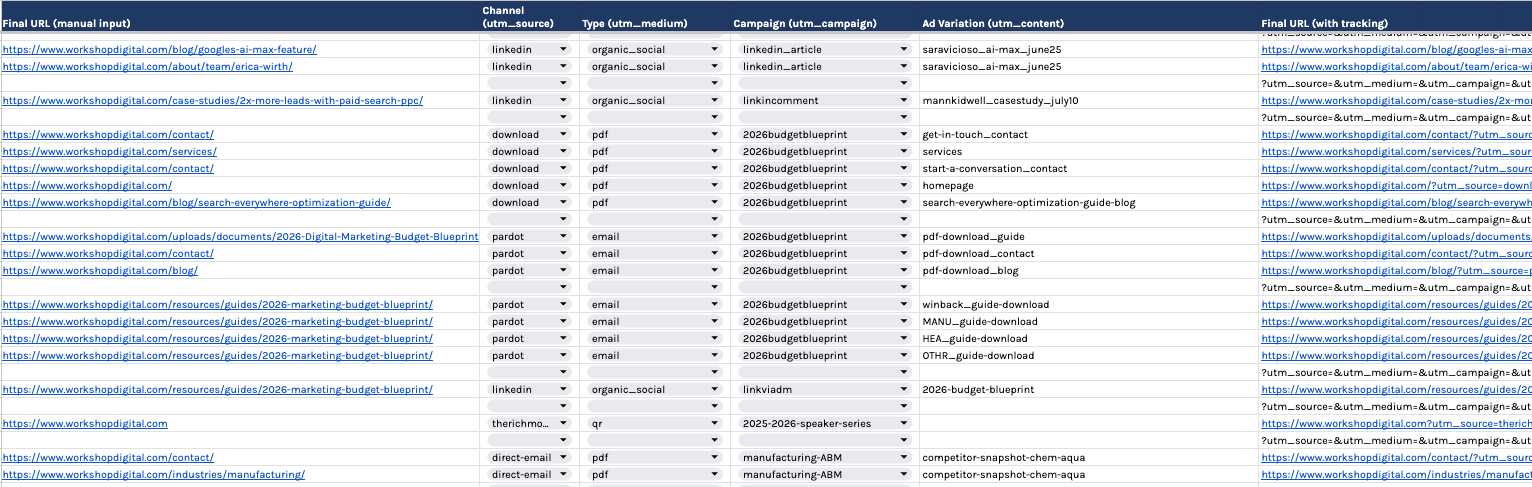
A loop can’t close if it starts with a blank field.
Step 3: Connect Your Systems for Two-Way Data Flow
Goal: Ensure marketing sees sales outcomes and sales sees marketing’s.
Your CRM and marketing automation platform should sync:
Lead status
Activity history
Opportunity creation
Revenue
Tips & Tricks:
Run a weekly sync audit to catch broken workflows early.
Use automation to update statuses instead of relying on manual entry.
Keep custom fields minimal – too many fields create confusion.
Leverage AI tools such as Zapier to automate as much as you can to ensure alignment.
Think of this stage as setting up your computer. Without the right connections, your computer won’t work effectively.
Step 4: Ensure Sales Logs Key Activities Accurately
Goal: Capture the insights that make closed-loop reporting valuable.
To properly “close the loop”, sales teams need to record:
- Follow-up attempts
In CRMs such as Salesforce, there is a “log email” option in platforms such as Gmail, so you don’t need to manually drop emails into Salesforce. With one click, it’ll automatically push that log under “activity”. Other CRMs have something similar, so don’t forget to look into how to make sales teams' lives easier.
Qualification notes
Deal stages
Outcomes
Lost reasons
Tips & Tricks:
Build CRM views that make it easier for reps to update records.
Use required fields on stage changes (but don’t overdo them).
Keep “lost reason” picklists clean and updated.
This step gives marketing the context needed to refine their strategy.
Step 5: Build the Feedback Loop Itself
Goal: Return outcome data to marketing in a way that drives optimization.
This is the “heart” of closed-loop reporting. Sales outcomes flow back into marketing dashboards so teams can evaluate performance in context. I’ve used tools such as funnel.io and Looker Studio (free tool) to push data into a dashboard automatically across all platforms, such as LinkedIn, Account Engagement (Pardot), Salesforce Lightning, Google Ads, Google Search Console, Google Analytics 4 (GA4), etc.
Tips & Tricks:
Compare lead sources not only by volume but by revenue contribution.
Map which campaigns consistently generate stalled or unqualified leads.
Review lost reasons monthly to refine messaging and targeting.
Identify channels that produce high-intent buyers.
Review these reports WITH both marketing and sales in the room. Identify potential pivot points or tests that can be executed to improve conversion rate (CVR).
Step 6: Create Action-Oriented Dashboards
Goal: Turn that raw data into insights that you can use.
Your closed-loop reporting dashboards should answer:
What’s generating the most revenue?
Which campaigns create qualified opportunities?
Where are the leads getting stuck?
What’s your conversion rate between each stage?
How fast is sales responding?
How long does it take for sales to close an opportunity?
What messaging is resonating with your target market?
Tips & Tricks:
Keep the report simple! It’s easy to overcomplicate these dashboards with a million charts and tables. That’s when the report is no longer useful. I recommend building a report that first starts with the “question”, then the data is the “answer” to that question, so it keeps the dashboard focused on the end goal.
Build views by channel, stage, and deal quality.
Highlight change over time to identify trends. This is specifically important because if you’re testing new approaches, you need to identify what’s causing the impact.
Keep a log of optimizations throughout the process that you make over time, so everyone knows what changed & when it changed to understand pre- and post-impact.
A good dashboard should clearly articulate what happened, when it happened, and what’s next.
Step 7: Review the Loop Regularly
Goal: Make closed-loop reporting a habit, not just a one-off project.
Consistency is where teams can see value. Make closed-loop reporting part of a regular cadence.
Tips & Tricks:
Hold monthly revenue alignment meetings.
Refresh your definitions quarterly.
Revisit UTM and lead scoring regularly.
Celebrate the wins!
Closed-loop systems only get more accurate (and more valuable) over time. I can’t begin to tell you how many times sales and marketing have adjusted definitions and flow.
Where to Go From Here With Closed-Loop Reporting
Setting up closed-loop reporting can be a tedious process. Start by mapping out all your platforms you want to see in a unified report, what data is housed in each, and which questions you’re ultimately looking to answer. It does require an effort by both teams: marketing and sales, but the payoff is 100% worth it in the end.
If your team is new to this process, start small. Choose one channel and follow it through the full lifecycle. Look at how many leads move, how sales responds, and what leads to closed won opportunities.
And if you’re ready to build a fully aligned, insight-driven reporting system, this is exactly the type of stuff we nerd out on! Whenever you’re ready to take the next step, we’re here to support you. Reach out to us to get your free consultation.
If you’re not QUITE ready to get started, we also have a bi-weekly newsletter that highlights that delivers insights directly to your inbox. We share news updates, helpful guides or blog posts, and just generic information that is relevant at that moment… all from our team of digital marketing experts.
→ You can sign up here or use the form below!