B2B sales cycles have a reputation for being long, complex, and slow-moving. That is not because buyers lack interest, but because they need time to research, validate options, and get internal buy-in before speaking with a salesperson. Most of that research happens long before a form fill or demo request, and much of it starts with a search.
SEO is often treated as a traffic or awareness channel, but that framing undersells its real impact. When done well, SEO supports buyers throughout the entire decision-making process. It helps prospects understand their problem, compare solutions, and answer important questions before sales ever enter the conversation. The result is better prepared leads that move through the pipeline faster.
Today’s B2B buyers expect to self-educate: they search for comparisons, pricing expectations, use cases, and implementation details on their own timeline. If your content is visible for those searches and actually delivers clear, useful answers, it reduces uncertainty and builds trust early. By the time a prospect reaches sales, much of the groundwork has already been done.
How Search Fits Into The B2B Buying Journey
Before a B2B buyer ever speaks to sales, they are already deep into the decision-making process. According to research conducted by Forrester, business buyers were largely born in the internet era and expect fast, intuitive, self-serve buying experiences. And 81% of buyers from the same research expressed dissatisfaction with the winning provider in a recent B2B purchase.
This means buyers turn to search to find answers on their own terms, and SEO becomes a way to meet them where they are in that process. Every search query reflects a specific question or concern, and those questions change as buyers move from awareness to consideration to decision.
At the awareness stage, buyers seek educational content that helps them name their problem, such as a blog or guide, and explore possible approaches. If your site appears in those early, exploratory searches and provides helpful answers, you begin shaping the buyer’s perception of solutions and vendors.
As buyers move into consideration, search behavior becomes more specific. Queries shift toward comparisons, vendor fit, case studies, and use cases. SEO content that clearly addresses those questions helps prospects evaluate options without needing a sales contact right away.
By the decision stage, buyers look for confirmation and reassurance. They search for proof points, pricing, implementation details, and compatibility information. When that content is easy to find and understand, it reduces friction and can help deals close more quickly.
Viewing SEO through this lens turns content into a tool for guiding prospects through their journey, not just a mechanism for generating traffic.
Mapping SEO Content to Sales Stages
Once you understand how buyers use search throughout their journey, your next step will be turning that insight into a strong content strategy. This is where many B2B SEO programs tend to fall short. Content is created in isolation, without a clear understanding of how it supports sales progression.
Shortening the sales cycle requires mapping SEO content directly to sales stages. Each piece of content should serve a purpose beyond just ranking in Google Search or LLMs (though it’s also important to gain AI visibility!). It should help move a buyer closer to a decision by answering the right questions at the perfect time of search.
At the top of the funnel, SEO content supports early education. Buyers are trying to define their problem and understand potential solutions. These searches tend to be broad, but they are still valuable. Educational content, such as a blog or resource section, industry explainers, or video walkthroughs, and problem-focused guides help establish credibility and ensure your brand is part of their initial research.
In the middle of the funnel, SEO begins to influence deal velocity more directly. Buyers search for comparisons, alternatives, and specific use cases as they narrow their options. Content here acts as a filtering mechanism. Clear explanations of who your solution is for, how it compares to others, and where it fits best help prospects self-qualify before sales engagement.
At the bottom of the funnel, SEO content focuses on reducing uncertainty. Buyers want confirmation that they are making the right choice. They look for pricing details, implementation timelines, technical requirements, and proof points. When this information is easy to find through search, it removes common blockers that delay conversations and deal-making.
Mapping content this way changes how SEO success is measured. Instead of focusing only on traffic growth, teams can evaluate how organic content actually supports improved sales conversations, higher-quality leads, and fewer stalled opportunities.
How User Experience Can Impact B2B Sales Momentum
Showing up for the right keywords or questions is only part of the equation. Once a buyer lands on your website, the experience they have determines whether SEO shortens the sales cycle or adds another stop along the way.
In B2B, poor user experience creates a bunch of friction. In fact, 88% of users are less likely to return to a website after a poor user experience. Pages that are hard to navigate or scan, are vague about who the product is for, or disconnected from next steps forces potential prospects to work harder to find the answers they are looking for. When that happens, deals tend to slow down or stall entirely… which is exactly what you want to avoid.
High-intent SEO content should be designed to help buyers move forward, not just consume a copious amount of information. This all starts with aligning page structure to purchaser intent. A prospective buyer arriving from an awareness-stage query needs context and clarity. A prospect arriving from a comparison or pricing-adjacent query needs specifics, reassurance, and direction.
Clear messaging plays a huge role here. Buyers should immediately understand what problem the content addresses, who it is for, and what they should do next. Supporting elements like internal links, on-page calls to action (CTAs), and logical content flow help guide users deeper into the journey without forcing a sales call upon them too early in their journey.
User experience also affects trust; that’s why it’s important to ensure you’re building that trust along the way. Well-organized content, fast load times, and transparent information signal credibility. When buyers feel confident in what they are seeing, they are more likely to continue researching on your website rather than restarting their search elsewhere.
When SEO and user experience work together, content can become a strong sales channel. Buyers find the right pages through search, get their questions answered quickly, and move closer to a decision on their own terms.
How to Measure SEO’s Impact on the Sales Funnel
One of the biggest challenges with SEO in B2B is proving its impact beyond sessions to your website and keyword rankings. To better understand whether SEO is actually shortening your sales cycle, measurement has to extend past surface-level metrics and connect search behavior to revenue outcomes.
This is where lead-to-sale mapping adds important clarity. Lead-to-sale mapping focuses on which SEO-generated leads turn into sales-qualified leads, which become opportunities, and which ultimately result in closed-won revenue. This creates a clearer picture of how organic search contributes to pipeline progression and deal velocity, better demonstrating the true ROI of the marketing efforts.
The first shift in getting there is moving away from viewing organic traffic as a single bucket. Not all SEO-driven visitors are equal. A buyer who lands on a high-intent comparison page or implementation guide is far more sales-ready than someone reading a broad educational post. Segmenting organic traffic by intent is important for understanding sales velocity.
Sales velocity can be measured by tracking how organic leads move through the funnel compared to leads from other channels. This includes time from first session to form fill, time from lead to sales-qualified lead, and time from first sales touch to closed deal. When SEO content is aligned with buyer intent, these timelines often shrink because prospects arrive with more context and fewer unanswered questions.
Content engagement is another important signal. Pages that consistently appear in deals that close faster are doing more than attracting clicks. They are helping buyers evaluate, validate, and make decisions. Tracking which SEO pages are viewed by opportunities that convert, and in what sequence, helps identify the content that actively accelerates sales.
In the example below, using Account Engagement (Pardot), we can see a detailed view of a prospect’s activity before converting. In this case, the prospect first engaged with the site on June 20, 2024, returned multiple times through organic search and other channels over several months, and ultimately became closed-won on February 27, 2025. This type of visibility is critical when working with sales teams. It shows that SEO is not just an initial touchpoint, but a recurring influence throughout the buying journey.
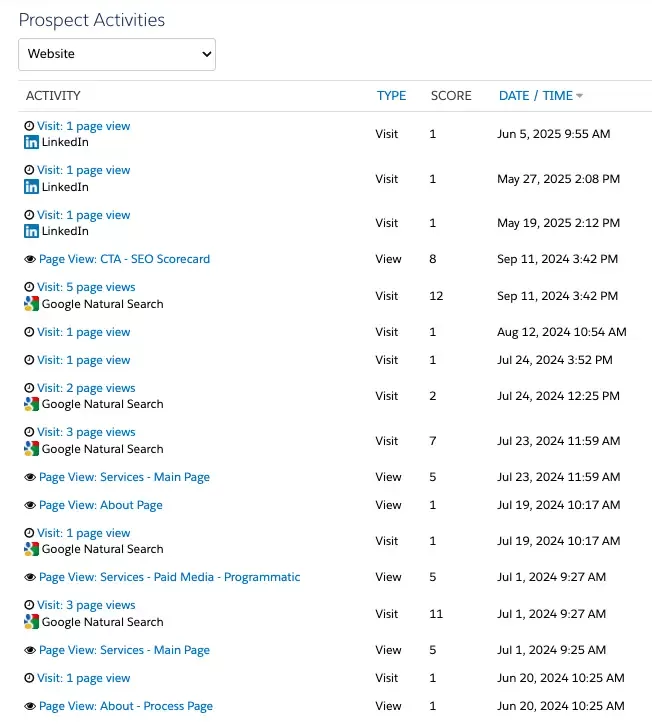
SEO data clearly becomes more powerful when paired with CRM insights, such as the engagements shown above. However, keyword themes can also be mapped to pipeline stages, allowing teams to see which types of searches tend to produce higher-quality leads. For example, leads originating from comparison or alternative content often require fewer sales calls than those coming from early-stage educational queries.
Finally, measuring SEO’s impact on velocity requires alignment between marketing and sales. When sales teams understand which organic pages prospects are consuming, they can customize their conversations accordingly. This reduces repetition, shortens discovery calls, and helps move deals forward more efficiently.
When SEO performance is evaluated through the lens of sales velocity rather than traffic alone, it becomes easier to justify investment and optimize strategy.
SEO Trends That Can Actually Speed Up Deals
Not every SEO trend helps shorten a B2B sales cycle. Many create more noise than impact. The trends that matter are the ones that make it easier for buyers to find relevant answers, understand fit, and move forward with confidence.
Today’s most effective SEO strategies focus less on chasing keywords and more on matching buyer intent, context, and behavior across search experiences.
AI-Driven Search and Content Discovery
Search is not just focused on ranking organically in the top 10 anymore… the SERP landscape has drastically changed over the past few years, pushing these blue links further down the search space. AI-powered results, summaries, and answer engines increasingly shape how buyers discover and evaluate solutions. For B2B marketers, this means content must be clear, structured, and authoritative enough to be surfaced and summarized accurately.
AI favors content that directly answers questions, explains concepts plainly, and displays strong expertise. Pages that are overly promotional or vague are less likely to appear in these AI-driven experiences. When SEO content is built around answering users' pain points and questions clearly, it helps prospects self-educate faster and reduces the time needed in early sales conversations.
Intent-First SEO Over Keyword Volume
One of the most direct shifts in today’s SEO is the move away from keyword volume as the primary success metric. High-volume keywords often reflect early curiosity, not buying readiness. Intent-first SEO prioritizes the searches that signal evaluation and decision-making.
Queries around comparisons, alternatives, pricing expectations, integrations, and implementation timelines may have lower search volume, but they often attract buyers closer to a decision. Ranking for these terms can bring prospects who need fewer touchpoints and move more quickly through the funnel.
By focusing SEO efforts on intent rather than reach, marketing teams can generate fewer but higher-quality leads that convert faster.
Conversational and Question-Based Search
B2B buyers increasingly search with full questions, especially when using AI tools and voice-enabled interfaces. These conversational queries often reflect very specific concerns, such as whether a solution fits a particular use case or constraint.
Optimizing for conversational search means structuring content around clear questions and answers. This includes using natural language in headings, addressing objections directly, and creating content that mirrors how buyers talk about their challenges internally.
When content matches the way buyers actually search and think, it reduces back-and-forth and helps them reach clarity sooner.
Structured Content That Removes Friction
Across all of these trends, structure matters. Clear headings, scannable sections, concise explanations, and internal links that guide buyers to the next steps all contribute to a smoother user experience.
Well-structured content not only performs better in search environments but also helps buyers find what they need without starting over. That reduction in friction can have a strong impact on how quickly deals move forward.
Contemporary SEO trends are most effective when they are grounded in buyer intent and usability. When content is built to answer real questions, support evaluation, and reduce uncertainty, SEO becomes a driver of faster, more efficient B2B sales cycles rather than just a source of traffic to your website.
Turn SEO Into a Lead and Sales Generation Engine
Shortening the B2B sales cycle is not about pushing buyers to move faster; it’s about removing the friction that slows them down in the process. SEO plays an important role in the process by meeting buyers where they already are, answering their questions early, and helping them evaluate their options.
When SEO is aligned with the buyer journey, supported by a strong user experience, and measured through lead progression rather than traffic alone, it becomes an important sales enablement tool. Buyers arrive at sales conversations more informed, better qualified, and closer to a decision. That alignment leads to shorter cycles, higher-quality opportunities, and clearer ROI.
If you want to understand how SEO is impacting your sales cycle and where it can be optimized to drive faster deals, we can help. Our team works with B2B organizations to connect SEO performance to qualified leads, opportunities, and revenue through lead-to-sale mapping and intent-driven strategy. Contact us today if you’re interested in seeing how your organic search strategy can support your sales team.