
For years, digital marketing for financial institutions has centered around one core factor: trust. As banks, credit unions, and other financial institutions compete for attention in a saturated market, those that build credibility and consumer confidence are more likely to succeed long term.
Today’s consumers are harder to win over. According to the 2025 Edelman Trust Barometer, trust has reached parity with price and quality as a primary driver of purchase consideration. They demand transparency, relevance, and consistency across every interaction. In financial services, where personal data and financial security are at stake, those expectations are even higher.
Financial institutions that align their digital marketing strategies with these expectations can strengthen trust at every stage of the customer journey, from omnichannel engagement to customer journey optimization and responsible data use.
What is Trust in Financial Services Marketing?
In financial services, trust is built through a series of consistent signals across the entire customer experience. It is not driven by a single message or campaign, but by how a brand shows up at every stage of the journey.
Several factors play a role in shaping that trust:
Clarity and transparency
Financial products can be complex, but marketing should not be. Clear explanations of rates, terms, and fees help reduce uncertainty and build confidence.
Consistency across channels
Customers move between search, website, email, and in-brand interactions. Consistent messaging and experience across these touchpoints reinforce credibility.
Security and reliability
Because customers are sharing sensitive financial information, even small usability issues or broken flows can undermine confidence.
Relevance and personalization
Messaging that reflects a customer’s needs, location, or life stage signals that the institution understands and can support them.
Trust in this context is cumulative. It is shaped by every interaction, from the first search query to ongoing account engagement.
Why Trust Matters in Financial Services
Trust matters in financial services because these decisions carry real weight. Customers often share personal data, commit to long-term products, or make choices that affect their future financial stability. This is not the same as buying an everyday product. People need to feel confident in their choice.
Without that confidence, many customers hesitate. Some keep researching. Others leave altogether. In a crowded market, trust is often what moves someone from consideration to action.
It can shape key moments throughout the customer journey, including:
Evaluation and comparison: When several institutions offer similar products, trust often becomes the deciding factor.
Form completion and onboarding: If an application feels confusing, frustrating, or insecure, users may abandon it before completing.
Sharing personal information: Customers need reassurance before providing sensitive details like income, identification, or financial history.
Product adoption: Opening an account, applying for a loan, or starting an investment relationship can feel like a big step. Trust helps reduce hesitation.
Long-term loyalty and retention: People are more likely to stay with brands that feel reliable, consistent, and easy to work with.
Referrals and reputation: Customers who trust an institution are more likely to recommend it to others.
As expectations rise and competition grows, trust becomes more than a brand benefit. It can be the difference between a customer moving forward or moving on.
The Role of Trust in Modern Financial Marketing
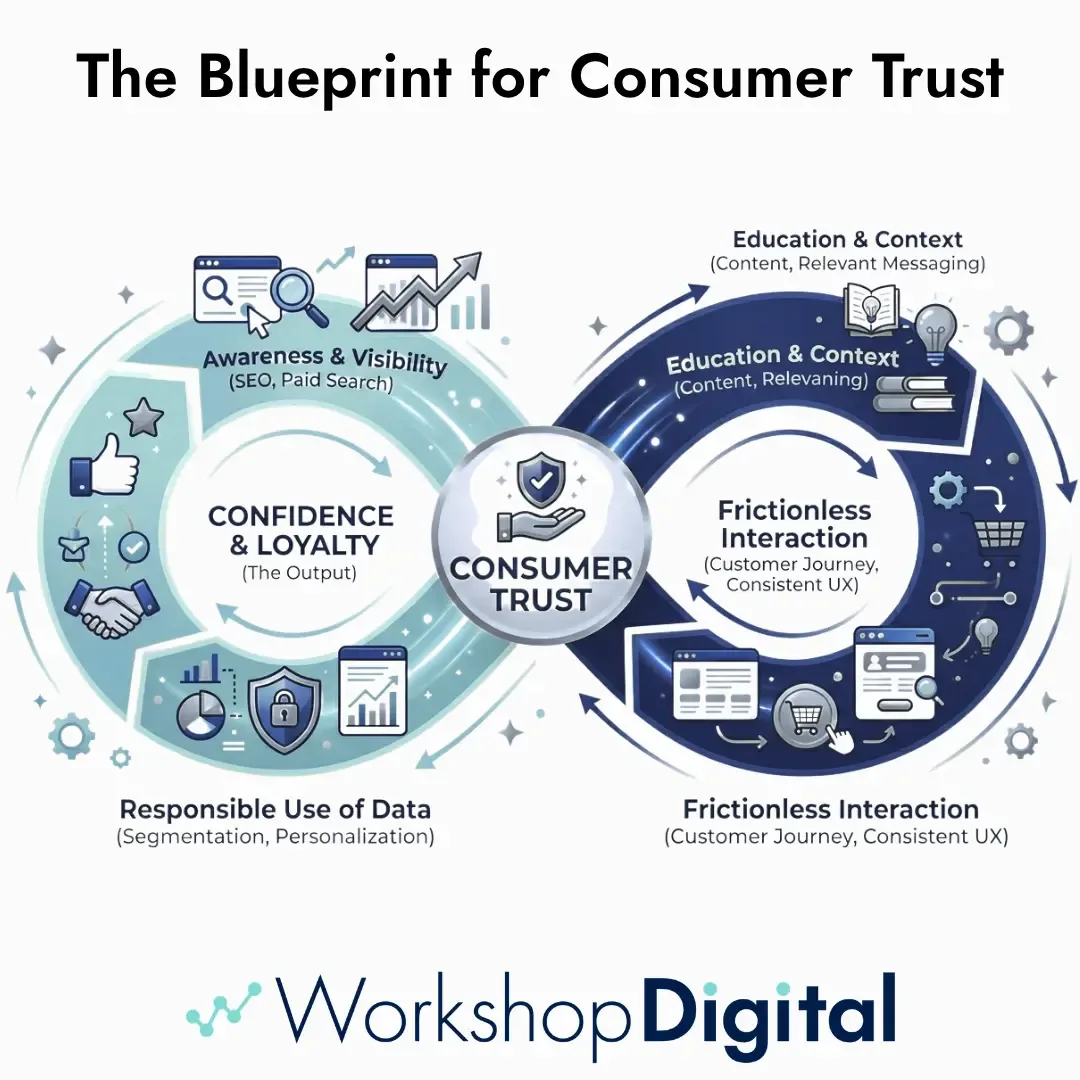
Trust has always been foundational in financial marketing, but in today’s environment, it is shaped more by experience than by messaging alone.
It is reflected in how customer data is handled, how relevant communications feel, and how consistently a brand shows up across channels. Small details, such as unclear targeting, inconsistent messaging, or friction in digital experiences, can quickly undermine confidence.
Modern financial marketing also requires balancing competing expectations. Consumers want personalization that feels helpful and timely, but not intrusive. They expect convenience and speed, but not at the expense of security or transparency.
How consumer expectations are changing
As marketing becomes more data-driven through segmentation, automation, and behavioral insights, expectations around data use have increased. Customers are more aware of how their information is collected and used, and they are quicker to disengage when experiences feel overly aggressive or misaligned.
When institutions use data thoughtfully to provide relevant, well-timed communication without overstepping, it reinforces credibility and strengthens long-term perception.
Why trust is built over time, not moments
Trust is not established through a single campaign or interaction. It develops through repeated, consistent experiences across the customer journey.
From the first search impression to onboarding and ongoing engagement, each touchpoint either reinforces or weakens confidence. Gaps between channels, inconsistent messaging, or friction in key moments can interrupt that momentum.
Over time, these interactions compound. Institutions that deliver consistent, reliable experiences are more likely to build durable trust and stronger customer relationships.
How the Customer Journey Impacts Trust
The customer journey plays a central role in developing trust. In financial services, it is rare for someone to convert after a single interaction. More often, customers research, compare options, return multiple times, and engage across several channels before making a decision.
Throughout this process, each interaction contributes to how credible and reliable a brand feels.
Common touchpoints in this journey include:
Paid search ads that introduce the brand
Website visits for research and comparison
Retargeting ads that reinforce familiarity
Email follow-ups that nurture consideration
Social content that builds ongoing awareness
Connecting touchpoints into a cohesive experience
Every interaction shapes how trustworthy a brand feels, whether it's a paid ad, a landing page, an email follow-up, or even a social post. When those experiences feel inconsistent or random, trust erodes quickly.
This is where digital marketing becomes less about individual campaigns and more about orchestrating connected experiences. With the right setup, financial institutions can connect those touchpoints into a more intentional journey. That might mean aligning messaging across channels, using CRM data to understand intent, or simply ensuring the experience feels consistent from first click to final conversion.
The goal is not to force a linear path, but to reduce friction and create familiarity as customers move through the decision-making process. When the experience feels cohesive, trust is reinforced at every stage.
How Omnichannel Marketing Strengthens Trust
Omnichannel marketing isn’t just about being present on multiple platforms. For it to be effective, those platforms need to feel connected.
Why consistency matters in Omnichannel marketing
As in human relationships, consistency is essential to building trust, and the same holds in marketing for financial institutions. A customer might first see a paid search ad, then visit the website, and later get an email or retargeting ad. If each of those experiences feels different or like they’re from different companies entirely, it can create friction and uncertainty.
On the other hand, when the messaging and tone feel aligned and consistent across channels, it creates a sense of reliability. People don’t have to try to refigure out the brand every time they interact with it. They know what to expect.
Strong omnichannel marketing brings together paid media, organic search, email, and CRM touchpoints so that they all tell the same story. The plot is clear. It’s not about telling it over and over; it’s about making sure each interaction feels like it’s supporting the storyline.
Consistency across channels typically shows up as:
Aligned messaging between paid ads, website content, and email communications
A consistent tone and voice across touchpoints
Similar visual and brand experience regardless of channel
Messaging that reinforces the same value proposition over time
A unified experience from first touch to conversion
For financial brands, that consistency is what turns scattered interactions into something more stable, familiar, and ultimately more dependable as a brand. In our experience, the biggest trust gaps usually appear when channels are misaligned, not when messaging itself is weak. So the question becomes: how do you actually operationalize that consistency across channels and teams?
Turning strategy into execution
From a practical standpoint, making consistency real requires visibility into how each channel is performing. Tools such as analytics platforms, CRM systems, and reporting dashboards help marketers understand what’s driving engagement and where customers interact along the journey.
At Workshop Digital, we take visibility a step further through Lead-to-Sale Mapping: connecting marketing touchpoints to what happens after a lead enters the pipeline. By aligning channel data, CRM activity, and sales outcomes, financial institutions get a clearer view of which campaigns are generating qualified opportunities, where prospects are dropping off, and how marketing is driving real growth.
That level of visibility is what turns omnichannel from a concept into something actionable. It allows financial institutions to refine campaigns, improve targeting, and better understand how customer trust is being built over time. Each interaction reinforces the same story as customers move through the journey.
Using Data and Segmentation to Improve Customer Trust
Data plays a huge role in building better customer experiences, but it only works if it’s used thoughtfully and intentionally. More importantly, when used well, it can help build trust.
At a basic level, data and segmentation help financial brands understand who they’re talking to. Not every customer is in the same place, and not everyone needs the same message.
For example:
Someone exploring their first savings account may need education and reassurance
Someone comparing loan options is likely focused on rates, terms, and speed
Someone managing long-term investments may be looking for consistency and ongoing insight
When financial marketers use that information well, it becomes easier to deliver messaging that actually feels relevant. Instead of broad, one-size-fits-all campaigns, audiences start to see content that reflects where they are in their journey and what they actually care about.
Receiving relevant messaging is a big part of building trust in financial services marketing. When communication feels helpful instead of generic, people are more likely to pay attention, stay engaged over time, and view the brand as more credible.
Naturally, this only works when the data is being used responsibly. In financial services, especially, there’s a fine line between personalization and overreach. The goal is to be useful, not intrusive.
When segmentation is done well, it helps financial institutions show up in a way that feels timely, respectful, and aligned with the customer’s context. That’s what ultimately strengthens the overall experience and reinforces trust.
How to Measure Trust in Digital Marketing
Trust can feel intangible, but in digital marketing, it manifests in specific behaviors that can be tracked across the customer journey.
Common indicators include:
Engagement signals such as time on site, repeat visits, and content interaction
Multi-touch conversions, where users engage across several channels before converting
Customer retention and repeat behavior, especially in ongoing financial relationships
Lead quality and pipeline progression, showing whether marketing is attracting the right audiences
Drop-off points in the journey, which can reveal where trust or clarity breaks down
When these signals are viewed together through analytics platforms, CRM systems, and reporting dashboards, they begin to tell a clearer story about confidence in the brand experience.
Financial Marketing Services That Support Trust and Growth
There’s no single tactic in digital marketing that builds confidence. Trust comes from consistency, how every channel, message, and experience aligns over time.
When SEO, paid media, content, and customer experience work together, each interaction reinforces the same narrative. That consistency reduces friction and uncertainty, which is critical in financial decision-making. When they do not align, gaps and contradictions create doubt and force users to do extra work to validate what they are seeing.
A strong strategy is not about doing more. It is about coordination. Search visibility should reflect the same positioning as paid campaigns. Content should answer the questions users are already exploring elsewhere. Landing experiences should match pre-click expectations. Ultimately, messaging should remain consistent throughout the entire customer journey.
As digital journeys become less trackable, especially with AI-driven discovery, this alignment matters more than ever. If you are evaluating your marketing, the real question is not which channels you are using, but how well they actually connect. Not sure where to start? Contact us, and we can help you get started.
For more perspectives on evolving measurement, attribution, and digital strategy, follow along with our Shop Talk newsletter.
This blog post was originally published on November 12, 2020, and was updated and republished on April 27, 2026.