
It’s hard to believe we’re more than a decade out from the 2008 financial crisis. The Great Recession may feel like it belongs in the rearview mirror, but its impact is still very much present in how consumers view financial institutions today.
While the banking industry has rebounded and grown significantly in the years since, the story hasn’t been a simple return to normalcy. Consumer confidence remains uneven, and shifting regulations alongside rapid technological change have reshaped the competitive landscape in lasting ways.
At the same time, banking behavior itself has fundamentally changed. Mobile banking has moved from convenience to default; over 54% of consumers now identify mobile apps as their primary banking channel. And it’s no longer just to check their balance. Consumers are researching financial products, comparing options, and completing applications entirely online. In fact, in 2025, Bank of America reported that over 55% of all new account sales from the prior year were completed through digital platforms rather than in person.
Unsurprisingly, fintech companies and digital-first platforms have flourished in this environment, setting new expectations for speed, simplicity, and experience. But this shift doesn’t just benefit the largest or most tech-forward players. Regional and community banks are also well-positioned to compete, especially when they combine their existing strengths in trust and relationships with a more modern digital experience.
4 Core Digital Marketing Strategies for Regional Banks
To compete with national giants and fast-moving fintechs, regional banks don’t need billion-dollar budgets; they just need a focused strategy built around local relevance.
While large institutions often win on scale, regional banks have a built-in advantage: proximity to their customers. Showing up in the right moments, with the right message, in the right local context can outperform broader, less targeted efforts.
Here are four pillars of a modern regional banking strategy:
1. Hyper-local SEO & Content Marketing
Regional banks can outperform larger companies by showing up in local search and winning the “bank near me” game. An optimized and active Google Business Profile (GBP) is foundational, but a broader local SEO strategy should support it.
This includes creating location-specific landing pages, maintaining accurate listings across directories, and consistently generating customer reviews. For example, optimizing for searches like “mortgage lender in Austin” or “small business bank near me” can drive highly qualified traffic.
Strong local visibility leads to more calls, branch visits, and high-intent website sessions from customers already looking for nearby financial services.
2. Search Engine Marketing (PPC)
Paid search helps you show up for high-intent queries like “best small business loans” or “high-yield savings accounts” in your local market.
A well-structured PPC strategy should focus on geographic targeting, keyword intent, and customized ad copy that reflects local trust and expertise. Using ad extensions like location, call, and sitelinks can further improve visibility and click-through rates.
When executed well, paid search delivers efficient customer acquisition by capturing demand at the exact moment users are ready to take action.
3. Data-driven Personalization
Regional banks already have access to valuable customer data. The opportunity lies in using that data to create more relevant and timely experiences.
Segment audiences based on life stage or financial needs, such as small business owners, first-time homebuyers, or customers nearing retirement. From there, customized messaging across email, website experiences, and digital ads to reflect those needs.
Personalization increases engagement, builds trust, and improves conversion rates by making communications feel more helpful and less generic.
4. Frictionless Digital Onboarding
A seamless, mobile-friendly account opening experience is essential. Customers expect fast, intuitive digital interactions that match what they experience with fintech platforms.
Reducing friction in onboarding can include minimizing form fields, enabling document upload from mobile devices, and providing clear progress indicators throughout the process. Integrating support options such as chat or call-back can also help prevent drop-off.
Improving the onboarding experience directly impacts conversion rates and sets the tone of the overall customer relationship.
How Banks Can Improve the Customer Experience
Because the way that customers interact with banks has changed significantly, the sales funnel has become increasingly complex, more self-directed, and less linear.
Gone are the days when consumers would open accounts at physical branches and remain loyal to a single bank for years. As the market becomes more specialized (and digitized), customer loyalty is challenged.
Today’s banking customers:
Research financial products across multiple platforms
Compare options before making decisions
Expect seamless transitions between devices
Move fluidly between devices and channels
While larger financial institutions are typically positioned to lead this transformation due to their significant financial and operational resources, regional banks still hold a strong advantage. Their strengths include:
stronger customer relationships
higher levels of local trust
more personalized service models
greater agility
The opportunity for regional banks is to translate these strengths into digital-first experiences. That means meeting customers with the same level of convenience and consistency they expect from larger competitors, while maintaining the personal touch that sets them apart.
Trust, Compliance, and Messaging in Banking
Banking decisions are naturally influenced by consumer trust, especially in a digital-first environment where customers make important financial decisions online. Because financial services fall into “Your Money or Your Life” (YMYL) categories, accuracy, transparency, and responsible communication are critical in every marketing interaction.
For regional banks, this is an advantage rather than a limitation. Clear, transparent messaging not only supports compliance requirements but also builds long-term trust with customers who are evaluating products that directly impact their financial well-being.
Digital marketing strategies in this space should prioritize:
Clarity over complexity
Transparency in product terms, rates, and conditions
Consistency across all channels and touchpoints
Alignment with regulatory and compliance standards
While trust and compliance shape how banks are perceived broadly, they also play a direct role in how financial institutions perform in organic search.
SEO Considerations for Regional Banks (YMYL, Trust & Local Authority)
In SEO, financial services fall into “Your Money or Your Life” (YMYL) categories. Trust, accuracy, and transparency are not just brand considerations; they directly influence organic search performance.
Google applies a higher standard of scrutiny to YMYL content, meaning messaging quality, credibility, and consistency can directly impact search visibility.
For regional banks, this requires a more deliberate approach to content. Pages should clearly communicate rates, terms, and product details, include visibility author or institutional credibility signals, and be regularly updated to reflect current information. Consistency across listing and digital properties also reinforces trust signals.
Beyond accuracy, demonstrating expertise and authority is very important. Education content, such as financial guides, FAQs, and local market insights, can help establish credibility while addressing real customer questions.
Local authority is a differentiator. Regional banks can strengthen their visibility by earning backlinks from local organizations, maintaining strong review profiles, and creating content customized to their communities, such as regional housing trends or small business resources.
By focusing on accurate and trustworthy communication, regional banks can differentiate themselves while ensuring customers feel confident in their financial decisions.
The Role of Local Search in Regional Banking
Capitalizing on the foundation of local trust and community connection, local visibility is still an important advantage for regional and community banks. Many customers searching for financial services include location-based intent, such as “bank near me” or “best small business bank in [city].”
This makes local SEO an important part of a digital strategy. It ensures that banks appear when customers are actively looking for nearby financial institutions.
Key areas include:
Optimizing Google Business Profiles for each branch, including services, updates, and accurate location details
Managing reviews and reputation signals, including responding to customer feedback and generating consistent reviews
Creating location-specific landing pages customized to local services, audiences, and search intent. If you want to see how this looks in practice, our team has applied these same principles to our own Richmond SEO services page, where we balance local relevance with broader service expertise
Capturing “near me” and high-intent local searches across both branded and non-branded queries
Beyond visibility, local strategies should also focus on conversion. Well-optimized location pages, clear calls to action, and mobile-friendly experiences help turn local searches into account openings, appointments, and long-term customer relationships.
For regional banks, this is where they can outperform larger institutions. By combining strong local SEO with personalized, community-driven messaging, they can win high-intent searches and build deeper connections with customers in their markets.
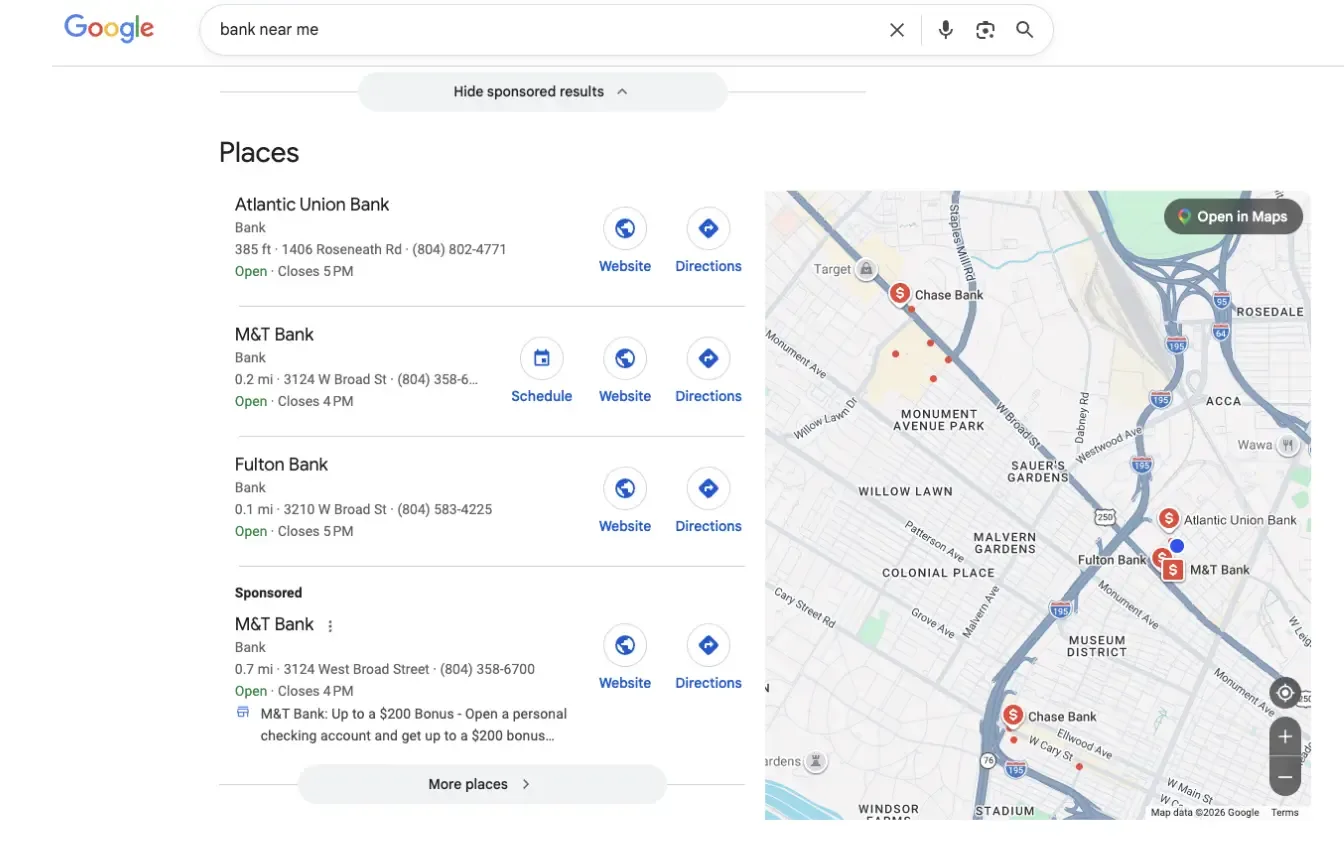
Below is what strong local visibility looks like in practice. When users search for terms like “bank near me,” Google prioritizes nearby, well-optimized profiles in the local map pack.
The Benefits of Digital Marketing for Regional Banks
For regional banks, digital marketing is about competing more effectively against national institutions while making smarter use of limited budgets and strong local relationships.
Digital marketing improves important performance drivers such as customer acquisition cost (CAC), long-term customer value (LTV), and overall deposit and loan growth by making marketing efforts more targeted and efficient.
More specifically, it enables regional banks to:
Reach high-intent audiences at important decision-making moments
Deliver more relevant messaging based on location, behavior, and lifecycle stage
Create consistent, connected experiences across channels such as SEO, paid media, and email
Improve conversion efficiency by reducing wasted spend and increasing qualified traffic
In practice, this means regional banks can compete on precision rather than scale. By prioritizing relevance over reach, regional banks can generate stronger returns from every marketing dollar.
Leveraging Data and Resources Through Digital Marketing
Beyond acquisition, digital marketing also helps banks make better use of the data they already have. Banks typically leverage first-party data from CRM systems, account relationships, and website behavior, alongside channel-level signals from paid media platforms and analytics tools.
With these data inputs connected, banks can:
Identify and prioritize high-value customer segments using CRM data, account history, and behavioral signals (e.g., product usage, website activity)
Improve messaging across the customer journey by aligning content to intent signals from search, email engagement, and site behavior
Optimize conversion rates on key products like checking accounts and loans using performance data from paid search, analytics platforms, and on-site user behavior
This turns raw data into actionable marketing decisions that directly improve conversion rates, customer acquisition efficiency, and downstream outcomes such as applications, funded accounts, and loan volume.
For regional banks, this is especially powerful because they often operate with cleaner datasets, closer customer relationships, and less fragmented systems, making it easier to activate insights quickly. The result is more precise targeting, stronger ROI, and more efficient customer acquisition overall.
Bringing it All Together for Regional Banks
The banking landscape has permanently shifted. While large institutions continue to lead in scale and technology investment, regional banks still hold a powerful and durable advantage: trust, proximity, and relationships.
When those strengths are supported by modern digital marketing and a seamless customer experience, they become a true competitive edge.
The opportunity is no longer simply about keeping up with larger competitors; it’s about standing out in the ways that matter most to today’s customers.
For regional banks, success comes down to execution… connecting data, improving visibility across local and digital channels, and delivering experiences that feel relevant, personal, and easy to engage with.
If you’re exploring how to strengthen your digital strategy, the team here can help you take the next step. If you aren't quite ready to chat, make sure you don't miss out on our bi-weekly insights by subscribing to our Shop Talk newsletter.
This blog post was originally published on May 05, 2019, and was updated and republished on April 24, 2026.