SEO performance should be measured across three layers: visibility, engagement, and business impact, not keyword rankings alone.
SEO reporting used to be simple: pick keywords, watch them climb, and celebrate when they hit page one. But search has changed. Today, discovery happens across AI Overviews, Reddit, video platforms, and branded search, often long before a user ever touches your website.
When the journey isn't linear, simplistic rankings become a diagnostic indicator rather than a definition of success. To answer "Is our SEO working?", we need to track the entire journey from visibility to business impact.
Rankings Are Useful. They Just Aren't the Main Goal.
Let's start with the metric most closely associated with SEO: keyword rankings.
Rankings still have a place in an SEO report. They can help identify opportunities, diagnose changes in search visibility, and show whether a page is moving in the right direction for an important query.
The problem comes when a ranking becomes the main goal itself.
A number-one ranking doesn't tell you whether anyone clicked your result, whether the traffic was qualified, or whether those visitors became customers. And today's search results make the relationship between ranking and visibility even less straightforward. A page can rank first organically while appearing below an AI Overview, paid media ads, a local pack, videos, or other SERP features.
And this isn't just because the SERP looks more crowded. More searches are ending without a click altogether. According to recent research from Datos and SparkToro, 68% of Google searches ended without a click in early 2026. That means even a strong organic ranking doesn't guarantee a visit to your website, and it certainly doesn't guarantee a conversion.
In other words, visibility can matter even when it doesn't result in a click. Your brand can influence a searcher through an AI Overview, featured snippet, knowledge panel, or another SERP feature. We explored this shift in more detail in The Rise in Zero-Click Searches: A Deep-Dive.
On the other hand, a page ranking seventh for a highly relevant, high-intent query might generate significantly more business than a page ranking first for a keyword that never converts.
Rankings are most useful as mid or top-funnel KPIs rather than true performance indicators. A true key performance indicator needs to measure actual business results, not just search engine placement.
So, if rankings alone aren't enough, what should you measure?
We think about SEO performance in three layers: visibility, engagement, and business impact.
Visibility: Are People Finding You?
Before someone can visit your website or become a customer, they have to encounter your brand.
That's where visibility metrics come in. They help you understand whether your SEO strategy is expanding your presence in the searches that matter, not just whether a handful of keywords moved up or down.
Organic Impressions
Search impressions tell you how often your pages appeared in search results, whether or not someone clicked.
That's useful because visibility often increases before traffic does. A page that starts appearing for a broader range of relevant queries may generate thousands of additional impressions before it earns enough rankings to produce a significant increase in clicks.
But more impressions aren't automatically better. If those impressions come from irrelevant searches, they aren't particularly valuable.
The goal is to build visibility that actually matters.
Non-Branded Search Visibility
There's an important difference between someone searching for your company and someone searching for a problem your company can solve.
A person searching for “Workshop Digital” already knows we exist. Someone searching for “how to measure SEO performance” may be looking for an answer without having any particular company in mind.
Non-branded visibility gives you a better sense of whether SEO is helping you reach people who haven't already decided to find you.
For many businesses, that's where the real growth opportunity lies.
For instance, ranking number one for a broad, low-intent term like "SEO checklist" might net you thousands of clicks from students and casual researchers who will never buy. Meanwhile, sitting at position six for a high-intent commercial query like "enterprise SEO reporting solutions" puts you directly in front of buyers ready to talk contract.
Search Visibility and Share of Voice
Rather than obsessing over individual positions, it can be more useful to look at how visible your brand is across a group of relevant searches, and how that visibility compares with competitors.
For example, moving from page two to page one across dozens of commercially important queries may be a much bigger win than moving from position three to position two for one keyword. Tools like Semrush can help you track this broader visibility, compare your share of voice against competitors, and identify where you're gaining or losing ground across important topics.
And increasingly, that visibility extends beyond traditional organic results. AI platforms can mention your brand, cite your content, or recommend your business without sending a click to your website. Semrush's AI Visibility Toolkit can help you monitor these appearances, compare competitor visibility, and identify the topics and sources where your brand has opportunities to improve. For a deeper look at how to audit AI visibility using Semrush, check out our blog How to Audit Brand Visibility on LLMs Using Semrush.
The goal isn't to eliminate rankings from your reporting. It's to put them in context: individual rankings show how specific pages perform, while search visibility and share of voice show whether your brand is gaining ground across the broader search experience.
Engagement: Are You Earning Attention?
Being visible is only half the battle. Once someone encounters your brand in search, you want to know what happens next.
Click-Through Rate
Click-through rate (CTR) tells you how often people click your result after seeing it.
If impressions are climbing but clicks aren't, that's worth investigating. Your pages may be appearing for queries that aren't a strong match; your rankings may still be too low to attract worthwhile traffic, or another search feature may be capturing attention above your listing.
Your title and meta description can matter, too. Even when you have a strong ranking, you still have to give someone a reason to choose your result.
CTR is most useful when you consider it alongside impressions, rankings, search intent, and the broader search arena, not as a standalone score.
Organic Traffic
Organic traffic remains an important metric, but it needs context.
More traffic creates more opportunities to engage potential customers, but traffic isn't inherently valuable simply because it's traffic. Twenty thousand visits from people who have no interest in your products or services aren't necessarily more valuable than 2,000 visits from highly qualified prospects.
That's why we care about what kind of traffic SEO is generating, not just how much.
Landing Page Performance
SEO doesn't happen at the domain level. It happens on individual pages.
Looking at your organic landing pages can tell you which content is attracting searchers, which pages are converting, and where opportunities may exist. It can also be helpful to group landing pages by where they sit in the buyer journey:
TOFU: Blog posts and other educational content designed to build awareness
MOFU: Downloadable guides, resources, and other content that helps prospects evaluate their options
BOFU: Service, product, and contact pages designed to drive action
Looking at performance by these buckets gives you more context than looking at page-level traffic alone. A TOFU blog post may generate significant organic traffic but fewer direct conversions, while a BOFU service page may attract less traffic but generate more qualified leads.
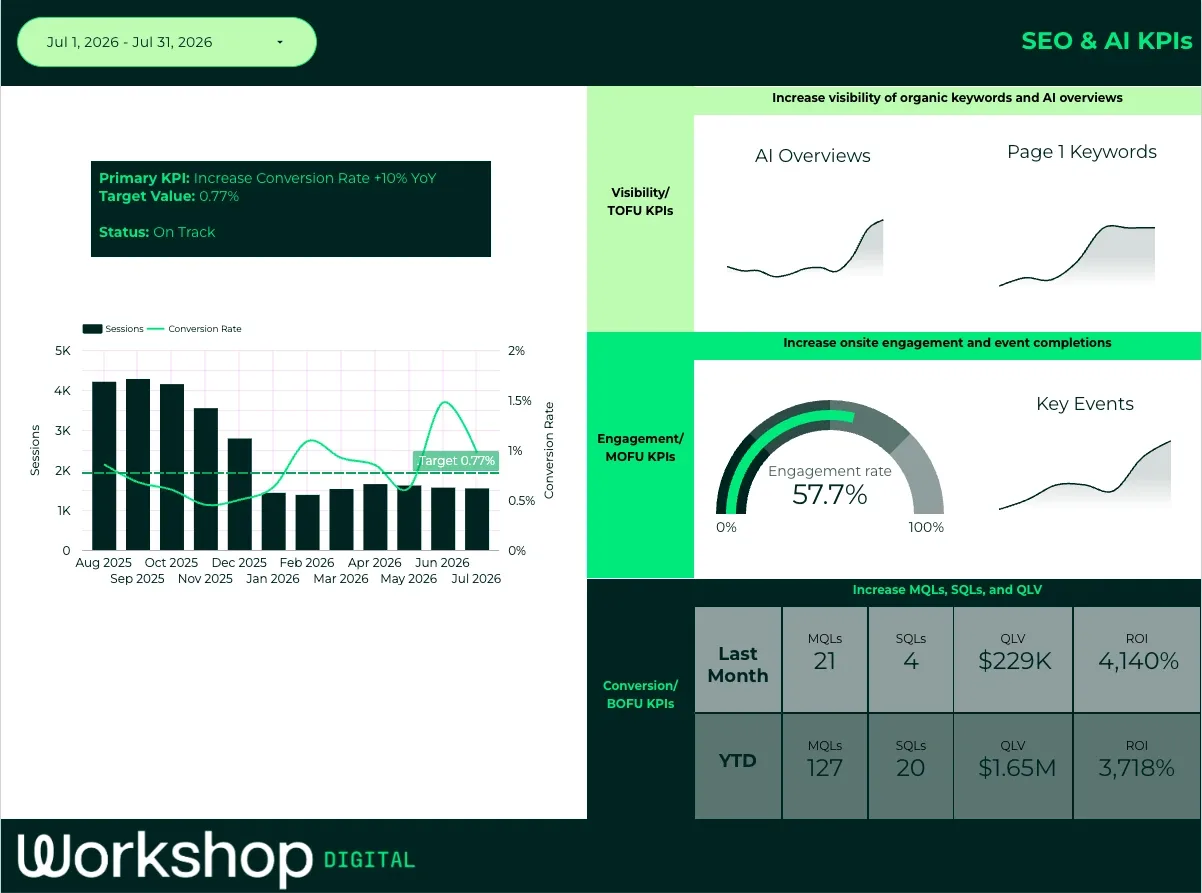
A page that gets significant organic traffic but generates no meaningful engagement may need a better match to search intent. A page that converts extremely well but receives little organic traffic could be a strong candidate for additional optimization and content support.
This is where SEO and the broader website experience start to overlap, and where looking at metrics in isolation can cause you to miss the bigger picture.
Business Impact: Is SEO Actually Driving Growth?
This is the layer that matters most to the business.
Your website has a job to do. Maybe that's generating leads, selling products, booking appointments, supporting a sales team, or driving another action that ultimately creates revenue.
Your SEO reporting should connect to that job.
Organic Conversions
A conversion is the action you want a visitor to take that signals progress toward a business goal.
Depending on the business, that might be:
A form submission
A phone call
A demo request
A purchase
An appointment
A download
An account creation
Tracking conversions allows you to move the conversation from “SEO generated 10,000 visits” to “SEO generated 300 leads at a 3% conversion rate.”
That’s a much more useful conversation because it tells you whether organic traffic is actually driving the actions that matter to the business.
Conversion Rate
Conversion rate (CVR) adds another layer of context.
Imagine organic traffic increases 30%, but organic conversion rate falls to 15%. That's not necessarily a bad result, but it raises a question: Where did the additional traffic come from, and is it the kind of traffic we want?
The reverse can be just as interesting. A relatively modest increase in traffic accompanied by a strong improvement in conversion rate may represent a significant business win.
We see this shift regularly in practice. When we helped a B2B software firm move away from broad, high-volume keyword targets to focus strictly on high-intent commercial terms, their overall organic session count changed, but their performance shifted dramatically, ultimately exceeding their target lead goal by 116%. The raw traffic volume went down, but the actual business impact went up.
In other words, quality and quantity need to be evaluated together.
Qualified Leads, Pipeline, and Revenue
If your organization can connect marketing activity to CRM data through what we call lead-to-sale mapping, you can take SEO measurement beyond conversions and connect it to business outcomes.
A form submission isn't necessarily a qualified prospect, and a qualified prospect isn't necessarily a customer. Following organic leads through the sales funnel helps you understand how many leads SEO generates, how many become qualified opportunities, and ultimately, how many turn into customers.
For example, if organic search generates 300 leads and 20% become customers with an average value of $5,000, that represents $300,000 in revenue tied back to organic search.
This is where SEO reporting becomes especially useful beyond the marketing team. Leadership may not care that 47 keywords moved onto page one. They care whether their investment in SEO is contributing to pipeline, revenue, and growth
How AI Is Changing SEO Measurement
AI has introduced a new wrinkle into an already complicated state of search: visibility doesn't always result in a click.
Someone can ask an AI-powered search engine a question, receive an answer that references your company or content, and move on without ever visiting your website. They might remember your brand, research you somewhere else, and eventually come back through a branded search.
That creates a measurement problem. Traditional analytics are designed to track what happens after someone reaches your website. They aren't necessarily equipped to capture every influence that happened before that visit.
As AI-powered search becomes a larger part of how people research, marketers should start thinking about AI visibility as another layer of search visibility. Tools like Semrush can help track how brands appear across AI-generated results, including which queries and topics trigger mentions, how often competitors appear, and which sources AI platforms cite.
Another important concept is query fan-out: the way AI search can take one broad question and expand it into multiple related searches or subtopics to build an answer. This means your brand may need to be visible across a broader set of related queries and topics, not just one target keyword.
That can include questions such as:
Is our brand appearing in AI-generated answers?
Is our content being cited as a source?
Which topics and questions are we associated with?
How often are competitors being mentioned instead?
Are AI platforms sending referral traffic to our site?
Are we seeing changes in branded search as our visibility expands?
The way we measure performance is still developing, and we shouldn't pretend there is a perfect, universal way to quantify AI visibility today. But ignoring it entirely would be just as shortsighted.
The important shift is recognizing that search influence can happen even when a click doesn't.
The Search Journey Isn't Linear Anymore
This is one reason SEO attribution is becoming more difficult.
A prospect might search for an answer, encounter your brand in an AI-generated response, see your company mentioned in a Reddit discussion, return to Google several days later, search for your brand name, visit your website directly, and eventually submit a form.
Which channel gets credit?
Depending on the attribution model, the answer could be organic search, direct traffic, AI referral traffic, or some combination of channels.
That's not a reason to give up on measurement. It's a reason to be more careful about what individual metrics can and can't tell you.
SEO can influence a buying decision without being the final click.
That’s always been true to some degree. AI and increasingly fragmented search experiences are just making it harder to ignore.
SEO Metrics That Can Mislead You
None of this means traditional metrics should disappear from your reports; they just require context.
| Metric | What it can tell you | Where it can mislead you |
| Keyword rankings | How pages perform for specific queries | Rankings don't necessarily translate to traffic or business results. |
| Organic traffic | How many visitors search is driving | More traffic isn't necessarily better traffic. |
| Impressions | How often you're appearing in search | High impressions can come from irrelevant queries. |
| Average position | Broad ranking trends in Search Console | It isn't a precise representation of what every searcher sees. |
| Bounce rate | Whether visitors leave without taking another tracked action | A high bounce rate isn't automatically a sign of poor content. |
| Pageviews | How much content people are consuming | More pageviews don't necessarily mean more business value. |
SEO KPIs You Should Actually Track
There isn't one universal SEO dashboard. The right metrics depend on your business model, objectives, sales cycle, and ability to connect marketing activity to outcomes.
But a useful starting point is to make sure your reporting covers all three layers:
Visibility
Organic impressions
Non-branded visibility
Search share of voice
Keyword coverage
Indexed pages
Engagement
Organic sessions
Click-through rate
Engaged sessions
Engagement rate
Landing page performance
Business Impact
Organic conversions
Conversion rate
Qualified leads
Pipeline
Revenue
Assisted conversions
ROI
You don't need to report on every metric every month. The best dashboards are focused enough to help people make decisions.
A good SEO report should answer three simple questions:
Are the right people finding us?
Are we earning their attention?
Is that attention contributing to business growth?
If you can answer those questions, you're doing more than reporting SEO performance. You're demonstrating its value.
Measuring SEO in an AI-First Search Environment
Search will continue to change. New AI experiences will emerge, existing platforms will transform, and the way people discover information will keep getting less predictable.
Two decades of SEO metrics are still worth keeping. They just need to serve a wider, more modern definition of success.
Rankings still matter. Traffic still matters. Clicks still matter.
But none of them, on their own, tell you whether SEO is working.
The better question is whether your brand is becoming more visible, useful, and influential among the people you're trying to reach, and whether that visibility ultimately contributes to business outcomes.
Search is changing quickly. Keep up with the latest shifts by subscribing to Shop Talk, or connect with our team to start tying your organic visibility directly to your pipeline.
This blog was originally published on February 19, 2011 and was updated on August 17, 2026.