Why Smart Companies Still Invest in Paid Search Despite AI and Changing Search Behavior
 |
|

The conversation has changed, but the question hasn’t.
I've spent the past twenty years in search, both paid and organic.
When I started in digital marketing, SEO and paid search (Google Ads and Microsoft Ads) were often viewed as separate disciplines. One focused on earning visibility, and the other focused on buying it. And they are separate skills with different levers and techniques for success. But, over time, I've learned to focus more on how to connect with customers at the moment they're looking for answers, products, or services. This still happens via search, though the way people search and the platforms they use have continued to evolve.
As CEO and Co-Founder of Workshop Digital, I've spent more than 15 years helping organizations adapt to changes in search, digital marketing, and customer acquisition. During that time, I've watched consumer behavior, search platforms, and marketing technology continue to shift, forcing businesses to rethink how they attract and engage customers.
Today, search looks very different from what it did even a few years ago. AI-generated answers are changing how information is discovered. Search behavior is becoming more fragmented. Some people begin their research on Google. Others turn to AI tools, social platforms, industry communities, or marketplaces. The path to purchase is less linear than it once was. What hasn't changed is the need for businesses to show up when buyers move from exploration to evaluation and from evaluation to action.
With so much change, it's fair to ask whether paid search is still worth the investment. The short answer is yes.
Not because paid search hasn't changed, but because the underlying business challenge remains the same. Companies still need a reliable way to reach potential customers, capture demand, and measure the impact of their marketing investments.
That's why many of the most successful organizations continue to invest in paid search, even as search continues to change around them.
Why Business Leaders Continue to Invest in Paid Search
Despite significant changes in how people discover information online, paid search continues to play an important role in many organizations' growth strategies. While the tactics, platforms, and technology behind paid search have evolved over time, the business case remains remarkably consistent.
Business leaders are always trying to grow brand awareness, capture interest in their products or services, ward off competitors, expand into new markets, and drive the most effective and efficient use of marketing dollars. Paid search continues to help address those challenges by creating opportunities to engage high-intent audiences, capture existing demand, and better understand how marketing efforts contribute to business performance. And with paid search, marketing and business leaders can get a clear view into ROI, something that isn’t possible with other marketing initiatives like print, TV, PR, or branding work.
For many business leaders, that's what makes paid search worth the investment.
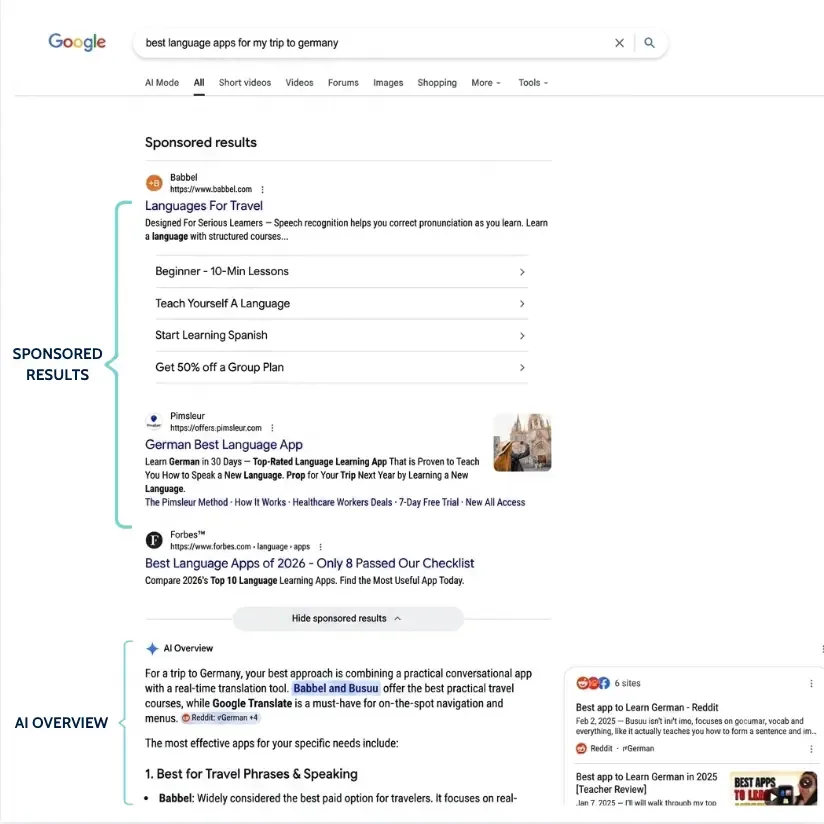
Paid Search (PPC) Connects Businesses With High-Intent Customers
One of the primary reasons paid search continues to earn a place in marketing budgets is that few channels provide the same opportunity to engage prospective customers at critical moments in the decision-making process - right at the moment when they are searching.
Every day, people turn to search engines to research products, compare providers, evaluate solutions, and gather information before making a purchase. Some may be early in their journey, while others are much closer to taking action. Regardless of where they are in the process, search often serves as a valuable indicator of what matters most to them at that moment.
Unlike many marketing channels that rely on capturing attention, paid search allows businesses to appear when potential customers are actively seeking information. This creates opportunities to engage prospects when interest is already established, and the likelihood of action is often greater.
That dynamic becomes especially important during periods of economic uncertainty or increased competition. When organizations are evaluating where to invest resources, the ability to connect with prospective customers at key decision points can provide a meaningful advantage.
This is before we factor in remarketing, which allows advertisers to serve ads to prospective customers who have engaged with ads or visited a website but not completed an action like becoming a lead or making a purchase. Paid search allows us to build remarketing audiences for those potential customers to keep brand messaging and calls-to-action front and center - helping create additional conversions downstream. That’s powerful stuff.
For many businesses, the value of paid search extends beyond generating traffic. It helps organizations participate in important conversations when prospective customers are evaluating options and making decisions.
Demand Generation Creates Interest While Paid Search Helps Capture Existing Demand
One of the biggest mistakes organizations make is treating demand generation and demand capture as competing priorities. In reality, the strongest marketing strategies rely on both.
Many marketing investments are designed to increase awareness, build trust, and strengthen brand recognition over time. Content marketing, public relations, social media, events, and brand campaigns all play an important role in introducing potential customers to a company and influencing future purchasing decisions.
Paid search serves a different function within the marketing mix. Rather than focusing on awareness, it helps businesses connect with prospective customers who have already moved into an active research or evaluation phase. In many cases, paid search helps ensure that organizations remain visible when potential customers are narrowing their options and preparing to make a decision.
The relationship between demand generation and demand capture is often overlooked. Businesses may invest heavily in creating awareness, only to lose opportunities when prospective customers begin actively evaluating solutions. Likewise, relying exclusively on demand capture can limit long-term growth if future demand is never created.
The most effective organizations recognize that both strategies serve an important purpose. Building awareness helps create future opportunities, while capturing demand helps convert existing interest into customers, sales opportunities, and revenue.
Connecting Marketing Investment to Business Results
Every organization must decide where to invest marketing budgets to grow the business. Whether evaluating new initiatives, expanding into new markets, or increasing marketing spend, leaders need confidence that investments are contributing to broader business objectives.
One of the reasons paid search continues to earn a place in many marketing strategies is its ability to provide insight into how marketing efforts influence customer acquisition and revenue generation. While no channel operates in complete isolation, paid search often offers a clearer view into the relationship between investment and performance than many other marketing activities. In many cases, a straight line can be drawn from marketing investment directly to sales. This isn’t easily done with other marketing channels.
Today, there is a greater expectation that marketing will drive sales and positive ROI. There’s less of a delineation between marketing and sales teams. In my experience, organizations have become increasingly focused on outcomes that extend beyond traditional marketing metrics. Traffic, impressions, and clicks can provide useful context, but they rarely tell the full story. As executive teams place greater scrutiny on marketing spend, the ability to connect advertising investment to leads, sales opportunities, and revenue has become increasingly important. Understanding how marketing contributes to these outcomes creates a stronger foundation for decision-making.
This is particularly important during periods of economic uncertainty, when marketing budgets often face greater scrutiny. Leaders are expected to make informed decisions about where resources should be allocated and which initiatives deserve continued investment.
When approached strategically, paid search can help organizations make those decisions with greater confidence by providing strong insight into performance and business impact.
Gaining Insights to Inform Other Marketing Investments
Beyond the increased visibility, fine-grained targeting controls, and ROI tracking capabilities of paid search, an often-overlooked benefit is the knowledge sharing that can come from paid search efforts.
Paid search wins can help inform page redesigns by learning what pages and what messaging best resonate with prospective buyers. Ad copy tests can reveal a lot about what works - and doesn’t work - when trying to capture attention and convert it to action.
Paid search keyword data can positively impact SEO efforts. By identifying top-performing keywords and underperforming keywords, paid efforts can help direct SEO efforts to focus on keywords that are more likely to convert. Improving organic visibility can drive down the reliance on paid, but often, paid ads running alongside organic listings drive even better results.
Paid search campaigns can function as a real-time testing environment for broader marketing initiatives. Messaging, offers, geographic expansion plans, service positioning, and landing page experiences can all be evaluated before larger investments are made elsewhere. Paid search efforts can be an effective way to experiment with product, service, geographic, or feature expansion in a controlled and relatively low-cost manner. By testing ideas with a targeted audience, organizations can gather meaningful data and validate assumptions before committing tens or hundreds of thousands of dollars to larger-scale initiatives.
Setting Paid Search Up for Success
Investing in paid search (PPC), whether through Google Ads, Microsoft Ads, ChatGPT Ads, or any other search platform that emerges, isn't inexpensive. And if care isn't taken, it can fail. Here are several recommendations that will help:
1. Choose an experienced agency or in-house team member.
Look for an agency with 5-10+ years of experience coupled with Google Premier Partner status (ensure it’s current). Bonus points if they’ve won industry awards for great work.
If you plan to hire a paid search expert and bring paid search management in-house, look for someone with a similar level of experience, ensure they are certified, and have them audit your account or explain exactly how they’d structure your account to achieve your business goals.
2. Understand and set a realistic budget.
Often, clients have no budget or a random budget set aside for paid search. Sometimes the budget can be too large, and often it’s way too small. Have your agency or in-house expert conduct research to influence adequate budgeting and create crawl, walk, run scenarios so stakeholders understand the tradeoffs between investment levels, expected lead volume, and growth potential.
3. Set a realistic timeline for evaluation.
My recommendation is to evaluate performance over at least six months, though twelve months often provides a more complete picture. This is particularly true for businesses that are new to Google and Microsoft Ads or have an account that needs a complete rebuild. It takes time to get good, clean data flowing into an account.
Often this takes months of testing, tweaking, and refining. Results may improve slowly at first, but I’ve seen business owners pull the plug too soon and miss the big upside right around the corner.
4. Tie paid search efforts directly to sales.
Businesses should hold their agency or in-house expert accountable for connecting paid search efforts directly to sales. This may require additional up-front cost to connect the Ads platform to a CRM, but it’s a worthwhile investment.
The person running the Ads account should build reporting dashboards that give key stakeholders direct access to this information, so performance can be evaluated regularly.
Ensure conversion tracking is configured correctly from the beginning. Inaccurate or incomplete tracking can lead to poor optimization decisions, wasted spend, and misleading performance reports. Before evaluating results, verify that leads, phone calls, form submissions, purchases, and other key actions are being tracked accurately.
The Business Challenge Hasn't Changed
The question business leaders should ask isn't whether paid search still works.
The better question is whether their organization has a strategy for connecting with prospective customers when purchase decisions are being made.
Paid search isn't the only answer to that challenge, but it remains one of the most effective tools available for engaging potential customers, supporting growth, and informing business decisions.
The tools may change, but the need to connect with customers when they're actively looking for answers, products, and services remains as important as ever.
Curious how your paid search strategy compares to others in your industry? Explore our paid search resources or connect with our team for a conversation.
This blog post was originally published on October 8, 2024, and was updated and republished on June 11, 2026.