
It’s time to say bye-bye-bye to the days of search engines simply matching ads to search queries. It’s just not that simple anymore. Search engines, along with social platforms and LLMs, are going beyond keywords and are now interpreting context, conversation, search history, and intent.
How marketers plan, execute, and optimize paid media campaigns is being rapidly redefined by AI across every major advertising platform. From Google and Meta to Amazon, Microsoft/Bing, TikTok, and LLMs like ChatGPT and Perplexity, new levels of automation, insight, and efficiency are being infused into these advertising platforms.
Google’s AI Mode and AI Overviews in search are reshaping how ads are displayed and how users find answers. These AI-powered experiences are surfacing results and blurring the lines between organic and paid placements by relying on more contextual signals.
At the same time, large language models (LLMs) and other AI-driven assistants are becoming new gateways for information discovery. As users turn to conversational AI for answers, paid media strategies will need to evolve beyond traditional search ads to meet audiences in these new contexts. It’s only a matter of time before ChatGPT or Perplexity announces ads within their platforms.
It sounds like a lot, I know. But there’s no need to panic! I’ll walk you throughsome of the changes we’ve seen with AI, and then I’ll share what you can do to succeed in this new era of paid media strategies.
What’s Changed with AI and Paid Media?
AI is taking on many tasks that were once manual in campaign planning, from selecting audiences and keywords to structuring campaigns and allocating budgets. On platforms like Google Ads and Meta Ads, algorithms now optimize who sees an ad, when, and for how much, often in real time. Marketers are increasingly relying (whether they want to or not) on AI-driven tools to forecast performance and manage budgets dynamically, rather than static upfront planning.
AI-Optimized Campaign Types
Google’s Performance Max is a prime example. Advertisers simply provide creative assets, budget, and goals, and Google’s machine learning does the rest. It decides what channels to use to which audiences to target and how to allocate spend. Google reports that Performance Max campaigns achieve, on average, 18% more conversions at a similar cost-per-action by letting AI find additional customers across its network.
Meta’s equivalent, Advantage+ campaigns, similarly allows Facebook and Instagram advertisers to consolidate targeting and placements and let Meta’s AI expand to find the best conversions. Meta even allows you to convert manual campaigns into Advantage+ with one click, giving complete control over targeting and budgets to the algorithm.
Over on TikTok, there are fully automated Smart Performance Campaigns. With machine learning, they handle audience targeting and bidding “with less manual input required” so marketers can focus on more creative content.
You might notice a common theme with these campaign types. There are fewer and fewer levels to pull, and they require advertisers to put a lot more trust in the ad platform’s black-box AI to figure out optimal campaign structure and delivery. However, this gives us marketers more time to focus on the strategy behind the campaigns.
Smarter Audience Targeting & Budget Allocation
Another area AI-driven platforms excel? Digesting vast amounts of data signals and using that information to refine who should see an ad, when, and how much budget should be distributed. Google and Microsoft Bing both use automated bidding strategies, such as Target CPA, Target ROAS, Maximize Conversions, etc., that analyze dozens of signals from user behavior to the advice used or time of day, and adjust bids for each auction in milliseconds.
Meta’s Advantage+ suite similarly uses AI to manage budgets between ad sets and finds the best audience segments, even allowing one to set preferences as “guidance” instead of a rigid constraint for targeting purposes. If you give Meta a broad audience “hint,” its AI will expand and find additional users likely to convert, optimizing spend along the way.
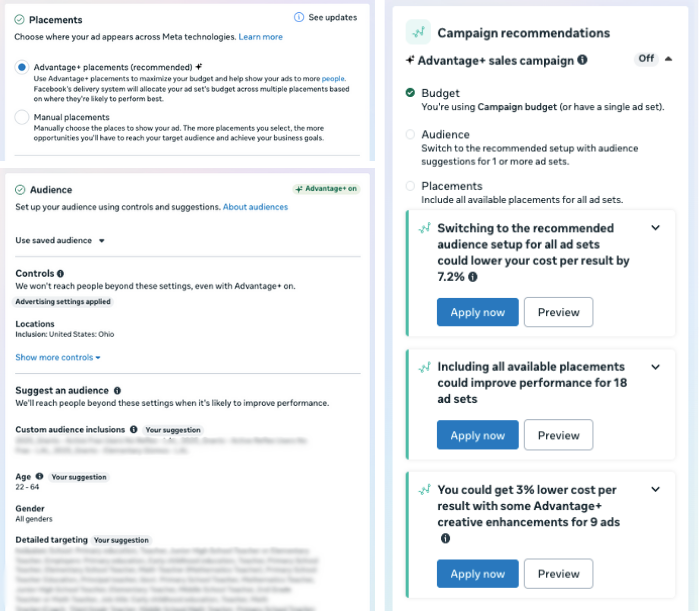
With its wealth of shopping data, Amazon launched similar predictive tools like Performance+ in its DSP (demand-side platform) that continuously analyze real-time signals to predict which shoppers are most likely to convert now or even at a later time.
These AI-driven campaigns ensure budgets are always flowing to the highest-value opportunities, something that is impossible to achieve manually at scale. Overall, AI is adjusting bids and budgets on the fly based on data, and rather than micromanaging campaign settings, frees up us humans to focus on strategy.
AI-Driven Analytics and Performance Measurement
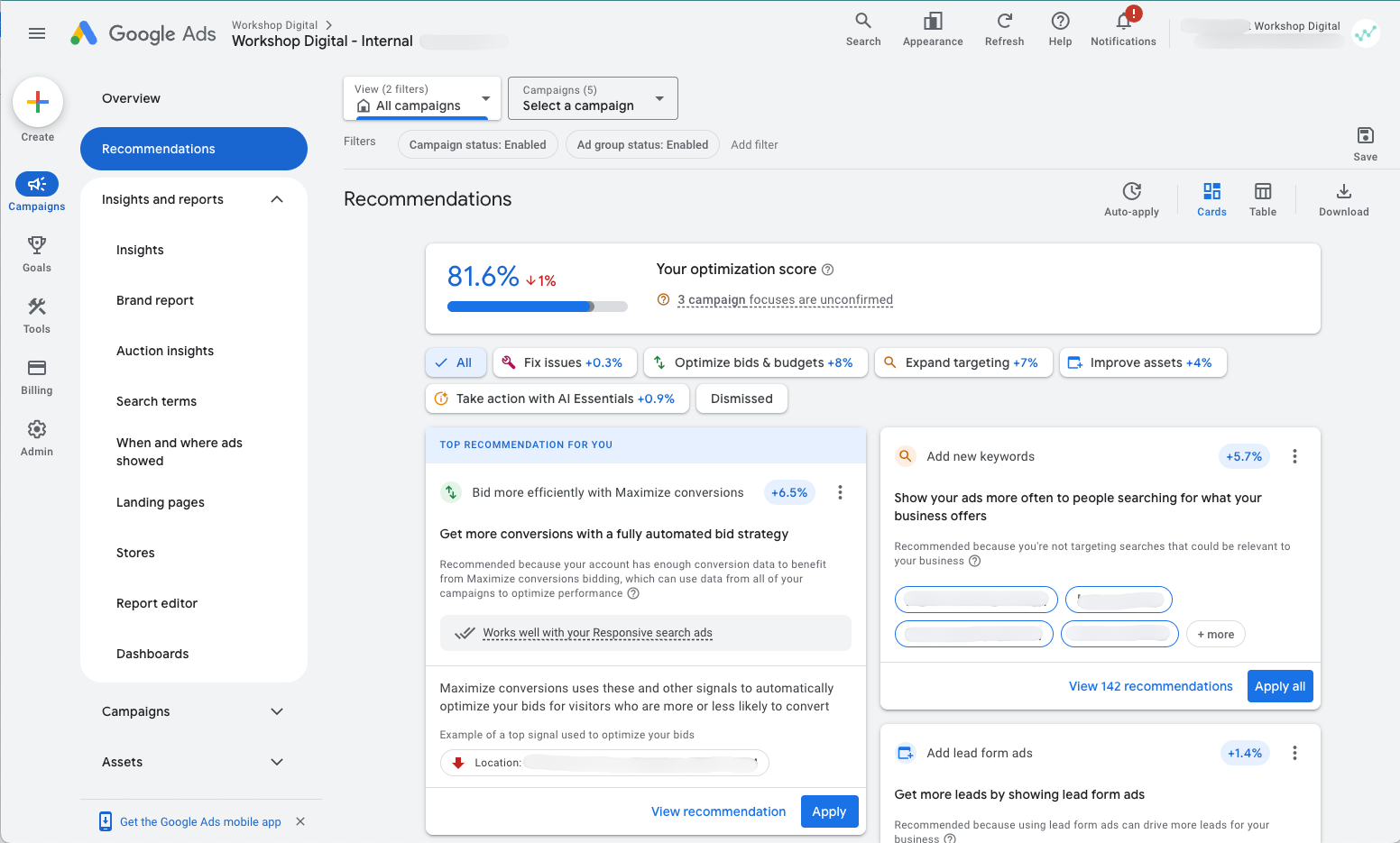
Many platforms are leveraging AI to automate insights, attribution, and optimization decisions. AI is adept at looking for patterns and outliers in performance data that even the best strategists can miss. Instead of manually reading through dashboards and data, advertisers can receive proactive insights from AI. For example, Google Ads has Insights and Reports and Recommendations tabs powered by AI that can flag significant changes and suggest actions. If there is a sudden surge in certain search queries, it can suggest adding new keywords or raising the budget if demand is up. Google Analytics 4 (GA4) uses machine learning to identify trends and even fill measurement gaps.
AI is also improving marketers’ long-standing challenge: attribution. With consumers now interacting across several channels, crediting the correct ad or touchpoint for a conversion is as complicated as ever. But machine learning models can analyze conversion paths at scale and determine which interactions have the greatest probability of driving results. Take Meta’s modeled conversions, for instance. It measures outcomes even when some data are missing by filling in the blanks, providing a more complete picture of ad performance. Amazon’s AI is trained on shopper behavior, finding otherwise invisible links between ads and sales by attributing downstream purchases to ad exposures across the web.
Additionally, machine learning algorithms aren’t just reporting data, they can act on it—and fast. Ad performing poorly? AI systems can automatically pause or redistribute budgets to better performers before you even notice an issue. Certain audience segments or creative resulting in higher conversion rates? AI can funnel more impressions in their direction. Optimization happens continuously and in real-time.
It’s even making reporting more accessible. Marketers can leverage tools to generate summaries of performance, saving time and allowing teams to focus on interpretation and strategy adjustments.
Deeper Audience Insights
Quite possibly one of the most powerful aspects of AI in advertising is its ability to deliver richer audience insights. AI can translate mountains of user data—search queries, browsing behavior, purchase history, social connections—and turn them into actionable insights about who your audience really is and what they want.
Marketers are able to get far more granular audience segmentation than with traditional demographics because AI is deriving signals based on real behavior, not assumptions. For instance, instead of a broad segment like “fitness enthusiasts,” AI can surface “frequent runners interested in trail shoes” based on clustering signals reflecting intent and interest from search and browsing data.
Ever get the feeling Google is reading your mind with the ads it presents to you before you even search for the thing? Google’s AI looks at search history and site interactions a user has to predict their intent more accurately, which allows advertisers to target based on what someone is likely looking for, not just the literal keyword they typed. Google’s new AI Max for Search takes this even further, automatically optimizing campaigns with AI-driven bidding, targeting, and creative recommendations designed to match intent signals in real time. Same with Meta’s algorithm. It similarly leverages engagement data (posts liked, videos watched, etc) to infer deeper interests—this is essentially how lookalike audiences work. And with its wealth of first-party commerce data, Amazon’s AI can build audiences of users who have shown signals of “being in market” for a product before they even searched for it explicitly. Kind of creepy? Also fascinating.
Search engines like Google and Bing are also getting better at understanding the nuances of search. For example, they can recognize that a search for “best budget 5k tv” implies that the user is comparison shopping and can then serve an ad highlighting a value deal. While intent isn’t as obvious on social platforms, AI can analyze signals like what content someone lingers on or what products they’ve interacted with—TikTok’s algorithm is famously adept at this. For advertisers, TikTok’s machine learning based targeting means that if your ad content is relevant and engaging, the platform will automatically find the viewers who will resonate best with your content. AI-based targeting with true intent signals is leading to more relevant ads and less wasted spend on audiences who are unlikely to purchase.
These richer audience insights are, as the old mantra goes, enabling the right message to reach the right person at the right time, all through machine learning. And they only get better over time. Over the lifetime of a campaign, algorithms learn which users actually convert or engage and continuously refine their models. It can even surface new demographic or interest groups that you may have previously not considered!
What Do These AI and Paid Media Changes Mean For You?
The nature of the job is changing fast. Marketers and companies that once thrived on manual control are now being asked to feed the algorithm with signals, assets, and, more importantly, their trust. It’s no longer just about tweaking bids or adjusting keyword match types in a vacuum. It’s about orchestrating entire systems that span multiple platforms, creative formats, and audience signals.
Sure, as we previously discussed, AI can now automate targeting, bidding, and even creative generation. But that doesn’t mean it’s replacing marketers—far from it. No AI tool can perfectly define your brand voice, guide your messaging, or interpret nuanced business outcomes. No AI tool can ensure your messaging won’t sound exactly the same as your competitors. Sticking with my orchestra analogy, there will always be a need for a (human) conductor to lead the “band.”
4 Tips to Succeed in the Age of AI-Automated Ads
1. Supply High-Quality Creative Inputs
The more formats and variations of images, videos, headlines, or copy you provide, the better the algorithm can learn and perform. AI thrives on rich input data. But human judgment is still needed to ensure AI-generated ads reflect brand voice, resonate emotionally, and differentiate from competitors. It will take your experience and intuition to fine-tune AI suggestions into a successful campaign.
2. Focus on Strong Conversation Signals
Say it with me: AI algorithms depend on good data. It needs clear, reliable outcomes to optimize toward. Whether that’s purchases, leads, or engagement metrics, poor tracking will only result in poor results. Consider it your responsibility to tell it was success looks like and guide its learning.
3. Budget for Learning Cycles
Campaigns require ramp-up time for AI to learn which users actually convert or engage, especially with Performance Max, Advantage+, and AI-powered ad delivery. And over the lifetime of a campaign, the algorithm will continuously refine its models for the best results. Make sure you bake that time into your campaign timeline before you deem an AI-powered campaign unsuccessful.
4. Rethink Performance Reporting
Let AI look for patterns and outliers in performance data, sure, but don’t let it take the reins entirely. Start with guardrails in place, monitor recommendations closely, and expand trust over time. Your instincts and market knowledge still matter more than just an AI interpreting data.
The New Mindset of AI and Paid Media
Success in this environment isn’t about giving up control entirely. It’s about knowing when to lean in and when to let the machine work. In the age of AI-powered ads, your strategy (your brain!) is still the most important thing that AI can’t replace. Platforms can automate the mechanics, but they can’t replace the strategic thinking, creative direction, and brand management that only a human can provide.
If they’re smart, agencies and marketing departments that want to keep up (and get ahead) need to invest in upskilling their employees so that strategists fully understand AI algorithms and concepts. Staying up-to-date on the latest platform features and obtaining a willingness to pilot new tools will make all the difference. “We are eager to learn and willing to be wrong,” is a Workshop Digital core value for a reason!
TL;DR? Paid media strategists aren’t going anywhere. It just means they need to play a more strategic, cross-channel role. One that considers ecosystems as a whole, not just isolated campaigns.
If you are looking for help navigating all of these advancements, get in touch. Our team of experts can build a custom paid media strategy that keeps your business in front of your target audience—wherever they’re hanging out online.