How a B2B fintech brand turned Google’s automation into a qualified growth engine without increasing media spend.
The Challenge
With no additional media budget approved, the client needed to reverse declining lead quality and volume from legacy search campaigns. As SERP behavior changed, leadership required proof that a new approach could deliver qualified, sales-ready leads without sacrificing efficiency or control.
The Outcome
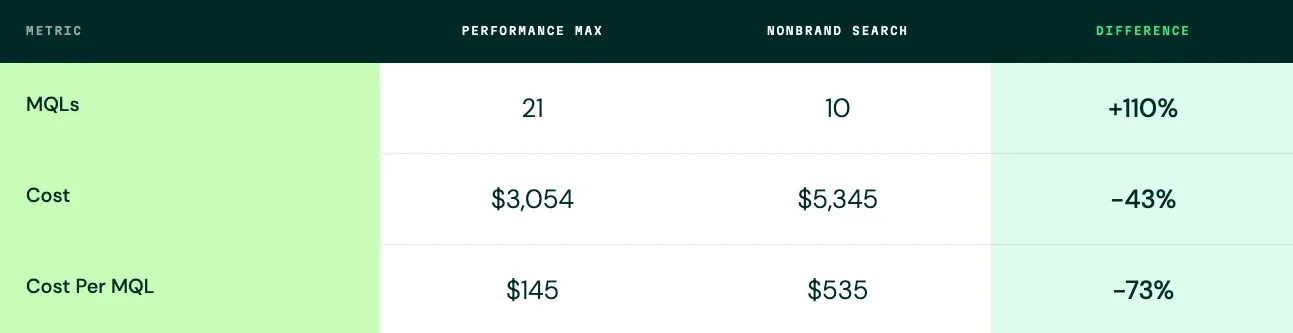
By shifting Performance Max optimization from raw leads to offline marketing-qualified leads and customers, the campaign delivered 110% more MQLs on 42% less spend, resulting in a 73% lower cost per qualified lead. What began as a limited test evolved into a scalable, revenue-focused growth engine.

The Story
With no additional media budget approved for the year, the client faced a familiar constraint: how to drive growth without increasing spend. At the same time, existing search campaigns were showing signs of fatigue, and their leadership team needed proof that new approaches could deliver higher-quality leads, not just more volume.
To overcome the “no new funds” hurdle, the client partnered with Workshop Digital to launch a Google Performance Max (PMax) campaign using $5,000 in previously unspent budget. The goal was to test whether automation and stronger data integration could drive incremental value while maintaining efficiency.
From the outset, success was defined by more than surface-level metrics. The client needed to understand whether PMax could deliver qualified, sales-ready leads and ultimately contribute to new customer growth. This test set the stage for a broader shift in how campaigns were measured, optimized, and evaluated, laying the foundation for the strategy and results that followed.
The Opportunity
The client was experiencing a decline in qualified lead volume from their traditional search campaigns, which correlated with the rise in AI Overviews on Google. While paid and organic search had historically been reliable drivers of demand, performance began to plateau and then erode as user behavior changed to reflect the new SERP.
This challenge created both a reactive need and a proactive opportunity. In the short term, the client needed to address declining efficiency and restore lead volume and quality to support revenue goals. At the same time, it became clear that reliance on conventional search strategies alone was limiting growth.
The Approach
The engagement began with the launch of a Google Performance Max (PMax) campaign to promote the client’s payroll card product. Initially, the campaign optimized toward raw lead actions, including form fills and inbound phone calls, allowing the team to establish baseline performance and gather early signals. To ensure full visibility into lead sources and intent, UTMs were implemented, and hidden fields were leveraged within the client’s Unbounce forms to capture important details such as campaign name, keyword, and GCLID.
We then collaborated with the client’s Salesforce team to map these fields into the CRM, creating a closed-loop reporting framework. This 1st-party data strategy enabled a direct feedback loop between marketing and sales, ensuring both teams could identify which leads met qualification criteria and which ultimately converted into new customers.
Early results revealed that lead volume was high, but quality was poor. The PMax campaign was falling into the trap of optimizing towards a few initial spam lead submissions. To address this, the strategy had to evolve to better leverage 1st-party data. To accomplish this, we built a custom conversion framework that shifted campaign optimization away from raw leads and toward marketing-qualified leads (MQLs) and confirmed new customers. These high-value conversion events were uploaded into Google Ads as offline conversions through Salesforce integrations and close collaboration with the client’s marketing and sales teams.
By feeding real revenue and qualification data back to train Google’s automation, the PMax campaign was able to prioritize higher-quality leads and refine bidding decisions to avoid spam clicks and form submissions. This approach transformed the campaign from a lead-generation channel into a true growth driver, aligning media investment with downstream business outcomes rather than upper funnel metrics.
The Outcome
By partnering with Workshop Digital’s sales and marketing teams, we improved both the quality and efficiency of their lead generation, transforming Performance Max from a high-volume, low-quality channel into a reliable driver of revenue-ready demand. The work earned a coveted Silver W3 Award for Best Use of Data-Driven Marketing in 2026.
After shifting optimization away from raw lead volume and toward marketing-qualified leads (MQLs) and new customers, Performance Max delivered strong gains compared to traditional non-brand search:
+110%
More MQLs from PMax vs. Nonbrand Search
-43%
Less Spend
-73%
Improved Cost Per Qualified Lead
Quality Improvement Over Time (MoM)
Early performance highlighted a critical issue with lead quality. From November 6, 2025, to November 13, 2025, when Performance Max was optimized toward raw lead actions, the campaign generated a high volume of spam submissions:
89% of leads (8 of 9) were identified as spam
These results should give any savvy marketer some heartburn. Unfortunately, there are still plenty of marketing teams out there celebrating top-line lead volume. Based on the prevalence of spam in recent years, this should be an immediate warning sign for any business owner. Lead quality must be validated, and AI must be trained on high-quality data for PMax campaigns to be effective.
Following our strategic shift to optimize exclusively toward offline MQL and customer conversions, lead quality improved immediately:
From November 13, 2025, to November 17, 202,5 and from December 18, 2025, to December 29, 2025, Performance Max recorded 0% spam leads
This improvement persisted despite a brief pause in ads due to nonpayment, reinforcing that the gains were driven by strategy rather than spend volume.
Business Impact
By integrating CRM data, offline conversion uploads, and sales feedback directly into Google Ads, Workshop Digital enabled Google’s AI to prioritize future customers instead of low-quality form submissions. The result was tighter alignment between marketing investment and real business outcomes.
Performance Max ultimately outperformed legacy search efforts across lead quality, efficiency, and scalability, demonstrating the value of a conversion strategy built around downstream revenue signals rather than surface-level conversions.
Afterall, AI is only as good as the data you train it on.
Interested in learning more? Check out our paid media services and contact us today.