
When ChatGPT Ads first launched, we had plenty of questions. How would targeting work? What would costs look like? Would people actually click on an ad within a ChatGPT conversation? And, especially relevant for us, could this become a viable channel for B2B advertisers?
For anyone less familiar with the platform, ChatGPT Ads allow advertisers to place sponsored content within the ChatGPT experience, with ads appearing alongside relevant conversations. Rather than the traditional keyword or audience targeting options you may be familiar with from platforms like Google Ads, advertisers can provide “context hints” to help indicate the types of conversations where their ads may be relevant. An example of an ad is shown below:
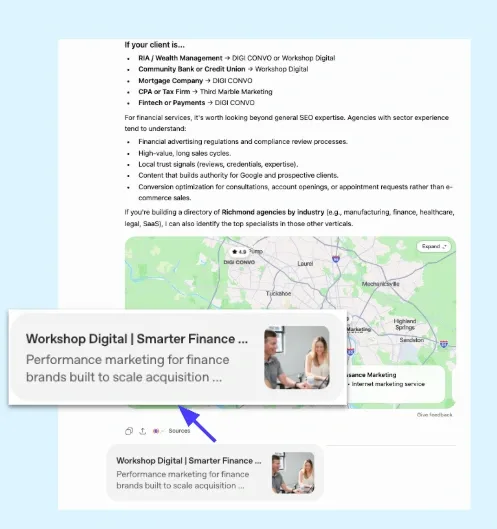
We covered more about how the platform works, its targeting options, and what advertisers should know in our first look at ChatGPT Ads. But there’s only so much you can learn about a new advertising platform without actually putting some money behind it.
So, once we had access, we put some of Workshop Digital’s own budget behind the test.
We ran campaigns across Digital Marketing Services, Manufacturing, and Financial Services audiences, testing different targeting hints, headlines, and creative along the way. After more than ~69,000 impressions and ~700 clicks, we started to see a few interesting patterns.
While we didn’t generate a qualified lead, it’s far too early to write off ChatGPT Ads as a B2B marketing channel. This is still a young advertising product; OpenAI is adding new capabilities quickly, and our results reflect one advertiser’s experience at one point in the platform’s development.
For now, we’re treating this as an early test that gives us a better idea of what gets people to engage, what we’d do differently next time, and what other B2B advertisers may want to consider as they start experimenting with ChatGPT Ads.
How We Tested ChatGPT Ads
As part of our ChatGPT ad testing process, we split our campaigns across three focus areas: Digital Marketing Services, Manufacturing, and Financial Services. This allowed us to see whether performance varied by industry while also testing some of the controls currently available within the ads platform.
Within those campaigns, we experimented with:
Context hints: Keyword-based vs. conversational queries
Headline structure: Leading with the brand name vs. leading with the messaging
Creative: Industry-specific imagery, lifestyle photography, and more general branded graphics
Across the test, we spent $2,319 and generated 69,630 impressions and 739 clicks, resulting in an overall 1.1% CTR and $3.14 CPC.
While clicks are useful for understanding engagement, we were more interested in what happened after those clicks. Which audiences responded? What context hints performed better? Did the way we wrote or designed the ad make a difference?
That’s where we started to find some useful takeaways.
Takeaway #1: Performance Was Fairly Consistent Across Industries
One of the first things we wanted to understand was whether ChatGPT Ads would perform differently based on the industry we were trying to reach.
Across our three campaigns, the results were fairly consistent:
| Campaign | Spend | Impressions | Clicks | CTR | CPC |
| Manufacturing | $585 | 17,318 | 190 | 1.1% | $3.08 |
| Financial Services | $434 | 14,543 | 126 | 0.9% | $3.44 |
| Digital Marketing Services | $1,300 | 37,769 | 423 | 1.1% | $3.07 |
Manufacturing and Digital Marketing Services performed almost identically from an engagement and cost perspective, both generating a 1.1% CTR with CPCs just over $3.
Financial Services was the slight outlier. CTR dropped to 0.9%, while CPC increased to $3.44. One possible explanation is greater competition or broader financial-related conversations influencing the auctions we entered, but we don't have enough visibility into ChatGPT's auction mechanics to know exactly what caused the difference.
For us, the bigger takeaway was how similar the performance was across three fairly different audiences. At least in this initial test, we didn't see any clear evidence that one industry was significantly better suited for the platform than another.
Takeaway #2: Keyword-Based Context Hints Outperformed Conversational Queries
One of the bigger questions we had going into the test was how much our context hints would influence performance.
ChatGPT Ads allow advertisers to provide hints that help the platform understand the types of conversations where an ad may be relevant. We tested two approaches: specific keywords related to our services and target industries, and broader conversational queries that reflected how someone might actually interact with ChatGPT.
Here’s how they performed:
| Context Hint | Spend | Impressions | Clicks | CTR | CPC |
| Keyword-Based | $1,318 | 35,512 | 421 | 1.2% | $3.13 |
| Conversational | $1,001 | 34,118 | 318 | 0.9% | $3.15 |
The CPC difference was negligible, but engagement wasn't. Keyword-based hints generated a 1.2% CTR compared to 0.9% for conversational hints, along with 103 more clicks on a similar number of impressions.
Our initial read is that specificity helped. Giving ChatGPT high-intent terms tied directly to a service or industry may have provided a clearer signal about the types of conversations we wanted to appear alongside. Broader conversational queries left more room for interpretation, which could have resulted in less relevant placements.
We wouldn't take this as a reason to abandon conversational hints after one test. But if we were building another campaign today, we'd lean more heavily into specific, high-intent terms and continue testing from there.
Takeaway #3: Leading With Our Brand Name Improved Engagement
We also tested whether including the brand name at the beginning of our headline had any impact on performance.
The difference wasn't huge, but the brand-first approach came out ahead:
| Headline Type | Spend | Impressions | Clicks | CTR | CPC |
| Brand Name | $1,636 | 48,756 | 532 | 1.1% | $3.07 |
| No Brand Name | $683 | 30,874 | 207 | 1.0% | $3.30 |
Ads leading with our brand name generated a slightly higher CTR and a lower CPC. The brand-first ads came in at $3.07 per click compared to $3.30 without the brand name, a roughly 7% difference.
There is an important caveat here: our company name happens to include the word “Digital.” Someone seeing “Workshop Digital” in an ad already gets a small clue about the type of company behind it. That could help establish relevance in a way that a less descriptive company name wouldn't.
So, we wouldn't walk away from this test saying every advertiser should put their brand name first. We would say brand placement is worth testing, especially in an ad format where users may have limited space to quickly understand who is advertising and why the ad is relevant to their conversation.
Takeaway #4: More Relevant Imagery Performed Better Than General Graphics
We tested three types of imagery across our ads: general branded graphics, industry-specific images, and lifestyle photography.
| Image Type | Spend | Impressions | Clicks | CTR | CPC |
| General Graphic | $401 | 12,560 | 119 | 0.9% | $3.37 |
| Industry-Specific Image | $423 | 11,736 | 138 | 1.2% | $3.07 |
| Lifestyle Photo | $1,494 | 45,334 | 482 | 1.1% | $3.10 |
Industry-specific imagery generated the highest CTR at 1.2%, followed closely by lifestyle photography at 1.1%. General graphics trailed at 0.9% and also had the highest CPC at $3.37.
Our initial thought is that imagery with a clearer connection to the audience or subject of the conversation gave people another signal that the ad was relevant to them. For example, a manufacturer seeing an image that reflects their industry may be more likely to notice the ad than they would a general branded graphic.
Lifestyle photography also performed well, which gives us another direction we'd like to explore. There may be value in imagery that feels more natural within the AI platform experience rather than something that immediately looks like an ad.
For our next round of testing, we'd continue prioritizing industry-specific and lifestyle imagery while experimenting with how closely the creative can match the audience and message of each campaign.
Takeaway #5: Front-Load Your Most Important Message
One thing the performance data doesn't show is how little room advertisers have to get their point across.
During our test, we noticed that headlines and descriptions could truncate earlier than we expected (refer to the image earlier in this post), even when our copy fell within the platform's stated character limits. That means a message that looks perfectly fine while you're building the ad may not appear in full once it's served.
For B2B advertisers in particular, that makes the first few words of your copy pretty important. We found it helpful to prioritize three things early in the message:
Who the ad is for
What you're offering
The most relevant reason someone should click
In other words, don't rely on the second half of your headline or description to explain what the ad is actually about.
As we continue testing, we'll be paying closer attention to how our copy appears once ads are live rather than treating the available character count as space we need to fill.
Takeaway #6: Use Your Ad Copy to Qualify Audience
One of the current challenges with ChatGPT Ads is the level of targeting control. Compared to more established ad platforms, advertisers have fewer options for narrowing down exactly who they want to reach.
That puts more responsibility on the ad copy itself.
We found that being explicit about who the ad is for can help set expectations before someone clicks. For example, there’s a big difference between a broad headline like “Improve Your Digital Marketing” and one that says “Digital Marketing for B2B Manufacturers.” The second gives the user a much clearer indication of whether the ad is relevant to them.
For B2B advertisers, where a click from the wrong audience can quickly eat into your budget, we'd rather sacrifice some broad appeal if it means attracting traffic that more closely matches who we're trying to reach.
Until ChatGPT Ads gives advertisers more granular targeting options, we'll continue using the pieces we can control, including context hints, headlines, descriptions, and creative, to make the intended audience as clear as possible.
How Did ChatGPT Ads Compare to Google Search
Since Google Search is already an established part of our paid media strategy, we also wanted to see how our early ChatGPT Ads results compared to what we're accustomed to seeing there.
It's not a direct comparison. Someone searching on Google is actively looking for information, a service, or an answer, while a ChatGPT ad is introduced within an ongoing conversation. The intent behind the click can be very different.
Still, comparing CPC and CTR gives us a useful benchmark for understanding what we're paying for engagement across the two platforms.
| Channel | CPC | CTR | MQLs |
| ChatGPT Ads | $3.14 | 1.1% | 0 |
| Google Search | $6.76 | 5.2% | 2 |
| Delta (%) | -54% | -79% | -100% |
Looking strictly at the numbers, Google Search delivered significantly higher engagement and drove all of our qualified leads. But ChatGPT delivered clicks at less than half the cost.
The difference largely comes down to intent and control. Google Search captures declared, bottom-of-funnel intent from someone actively searching for a solution they’re ready to consider. ChatGPT Ads operate more like a hybrid of search and social, reaching users who are actively researching a problem or exploring potential solutions but may not be ready to commit.
That balance will also look different depending on the industry. In categories with longer sales cycles, complex buying decisions, or a heavier research phase, ChatGPT could play a larger role in influencing buyers before they ever reach the point of conducting a traditional Google search. In industries where decisions happen quickly, or search intent is already highly transactional, Google may continue to have a much clearer advantage.
The targeting works differently, too. Google gives us much more control through keyword match types, while ChatGPT relies on broader context hints to determine where our ads are relevant. That wider net can help explain the lower CPC, but it also means less control over exactly where our ads appear.
For now, Google Search remains our primary channel for capturing high-intent demand. But ChatGPT’s lower CPC and placement within active research conversations make it an interesting opportunity to build awareness and influence consideration earlier in the buying journey. How valuable that opportunity becomes will likely depend heavily on the industry, buying cycle, and how customers research before making a decision.
What's Next for ChatGPT Ads?
Our first test gave us plenty to think about, and probably just as many things we want to test next.
ChatGPT Ads is still an early advertising product, and the platform continues to add new capabilities. The results we saw today may look very different as targeting, bidding, measurement, and ad formats become more sophisticated.
For now, we're going to keep testing. We'll use what we learned from this first round to inform the next one, keep an eye on how the platform develops, and share what we find along the way.
If you're curious about ChatGPT Ads or trying to figure out where emerging advertising channels fit into your paid media strategy, get in touch with our Paid Media team. We'd be happy to talk through what we're seeing and whether testing ChatGPT Ads makes sense for your business.