
OpenAI has been inconsistent (and at times contradictory) about its stance on advertising in ChatGPT. For nearly two years, leadership publicly dismissed ads as a “last resort.”
Now, they’re here.
Understandably, both users and marketers are asking the same questions:
-
What do ChatGPT ads actually look like?
-
How are they triggered?
-
Are they embedded into conversations?
-
Do paid users see them?
-
Is this Google 2.0, or something entirely different?
As of May 2026, ChatGPT ads are here (well, geographically dependent) and ready for everyday marketers.
Below is the full timeline, what launched, how it works, and what it means for your marketing stack.
Important Timeline & Evolution of ChatGPT Ads
For most of OpenAI’s life, leadership was publicly opposed to advertising. Sam Altman regularly framed ads as a suboptimal business model and suggested they would only be considered if absolutely necessary.
Over the past 2 years, that position has changed. Not dramatically at first, but gradually, as the economic realities of operating generative AI at a global scale became clearer.
In my view, this shift was less about ideology and more about pressure. Competitive dynamics intensified. Infrastructure costs continued climbing. And the gap between free user growth and paid subscriber revenue became harder to ignore.
Below is a quick timeline to catch us all up on the volatility:
Late 2024: Firm Public Rejection of Ads
Throughout late 2024, OpenAI leaders consistently signaled that advertising was not part of the company’s roadmap.
CFO Sarah Friar stated there were “no active plans” for an ad-supported ChatGPT.
Sam Altman described advertising as a “momentary industry” and something he considered a “last resort."
At this stage, the company wanted the world to believe ChatGPT would grow without ad dollars.
Early-Mid 2025: The First Signs of a Shift
Behind the scenes, cracks started to form in the anti-ad narrative.
Leaked internal financial models projected $1 billion in 2026 revenue from “free user monetization.”
OpenAI quietly began hiring former ad-tech and monetization talent from companies like Meta and Google.
These moves suggested that (despite earlier dismissals) OpenAI was actively exploring advertising as a steady revenue stream.
November 2025: Altman Opens the Door
In interviews later in the year, Altman acknowledged that ChatGPT would “likely try ads at some point,” though he claimed to have “no idea” what the actual implementation might look like. This was the clearest public signal yet that ads were no longer off the table.
Late November 2025: Evidence in the Code
Not long after those comments, developers dissecting the ChatGPT Android app beta (v1.2025.329) discovered references to:
an “ads feature”
“bazaar content”
“search ad” formats
a “search ads carousel”
These findings strongly suggested that ad-related infrastructure was already under development.
December 2–3, 2025: Development Hits Pause (“Code Red”)
Just days after ad-related code surfaced, OpenAI paused the initiative.
Instead, the company announced a renewed focus on:
Personalization
Speed
Reliability
Broader answer coverage
This wasn’t simply a shift in priorities; in my opinion, it was a defensive move. With Anthropic, Google Gemini, and Meta’s Llama ecosystem accelerating, OpenAI couldn’t risk shipping ads that damaged user trust.
February 9, 2026: ChatGPT Ads Are Live... in Beta!
OpenAI officially began testing ads inside ChatGPT for United States users on the Free and Go tiers.
The scope of the test is narrow, but definitely a shift:
-
Limited to logged-in adult U.S. users
-
Plus, Pro, Enterprise, and Education plans remain ad-free
-
Ads appear below the AI’s response and are clearly labeled
-
Ads are matched to conversation topics
-
Advertisements do not alter or influence the AI’s answers
From a privacy perspective, OpenAI has drawn firm boundaries:
-
Advertisers do not receive access to chat history, memories, or personal identifiers
-
Reporting is limited to aggregate metrics such as impressions and clicks
How ChatGPT ads are charged:
-
Reported CPMs are approximately $60, roughly three times the typical social platform averages
-
Brands reportedly must commit between $200,000 and $250,000 to participate in the beta
OpenAI is reportedly rolling out self-serve tools in April 2026 that remove the minimum commitment requirement, opening access to mid-market advertisers for the first time
March 26, 2026: ChatGPT Ads Are Expanding
OpenAI announced plans to expand its ad pilot beyond the United States into additional markets, including Canada, Australia, and New Zealand. The company signaled that broader global rollout would follow throughout 2026, indicating growing confidence in both performance and user tolerance for ads.
April 2026: Self-Serve Access is On Track to Open for Mid-Market Advertisers
OpenAI is on track to launch self-serve ad tools that eliminate the $200,000+ minimum commitment, opening access beyond large enterprise brands and making the platform viable for mid-market advertisers.
At the same time, the company is beginning to introduce cost-per-click (CPC) pricing alongside its initial CPM model, signaling a shift toward more performance-driven advertising and bringing ChatGPT ads closer to established digital ad ecosystems. Early data from the beta shows low ad dismissal rates and no measurable impact on user trust metrics, suggesting that OpenAI is successfully balancing monetization with user experience...at least in the early stages.
Learn more about ChatGPT Ads here.
May 7, 2026: ChatGPT Ads Are Expanding... again
OpenAI announced another expansion outside of the one at the end of March. This is telling me that the ad experience is continuing to demonstrate success for them. This time, they are expanding into the United Kingdom, Mexico, Brazil, Japan, and South Korea. They mentioned that the pilots are meant to see what works in different regions so they expand... smartly.
We assumed ads would come to ChatGPT and other chatbots. But now that OpenAI has shown the world how they plan to roll ads out, new ethical and moral concerns have arisen.
Zoë Hitzig, a researcher at OpenAI, quit and published a scathing guest essay in the New York Times, saying, "I once believed I could help the people building artificial intelligence get ahead of the problems it would create. This week confirmed my slow realization that OpenAI seems to have stopped asking the questions I'd joined to help answer."
Troubling, coming from inside the walls of OpenAI.
And Anthropic's Claude clapped back with a series of Super Bowl ads, like this one, which show the potential harm caused by ads being integrated into personal conversations by AI.
That tightrope between privacy and relevant ad targeting is something we marketers have always walked. 'Conversational ads' have the potential to knock marketing off-balance, blurring the lines too much between advertising and advice, and increasing the potential for manipulation and harm. We'll be watching closely, as always, and testing before we make any sweeping recommendations on this new ad technology.Brian Forrester, Co-Founder and CEO
How ChatGPT Ads Will Differ from Traditional Advertising
Before you picture banner ads cluttering your chat window, it helps to step back and look at how this model differs from the digital advertising playbook most marketers are used to.
Traditional advertising online is built around interruption and scale. Social feeds insert sponsored content into scrolling environments. Display networks distribute banners across thousands of sites. Search platforms monetize by ranking paid listings above or alongside organic results.
ChatGPT’s early ad model operates differently.
To start, the answer comes first. Sponsored content is placed separately, below the AI’s response, and clearly labeled. The monetization layer sits adjacent to the advice layer, not inside it.
That structural separation matters. In traditional search, paid placement competes directly with organic results for visibility. In ChatGPT, the AI delivers its recommendation before the sponsored inventory appears. The product is designed to preserve the perception that the assistant’s reasoning is not influenced by advertiser spend.
Below is an example ad pulled from OpenAI:
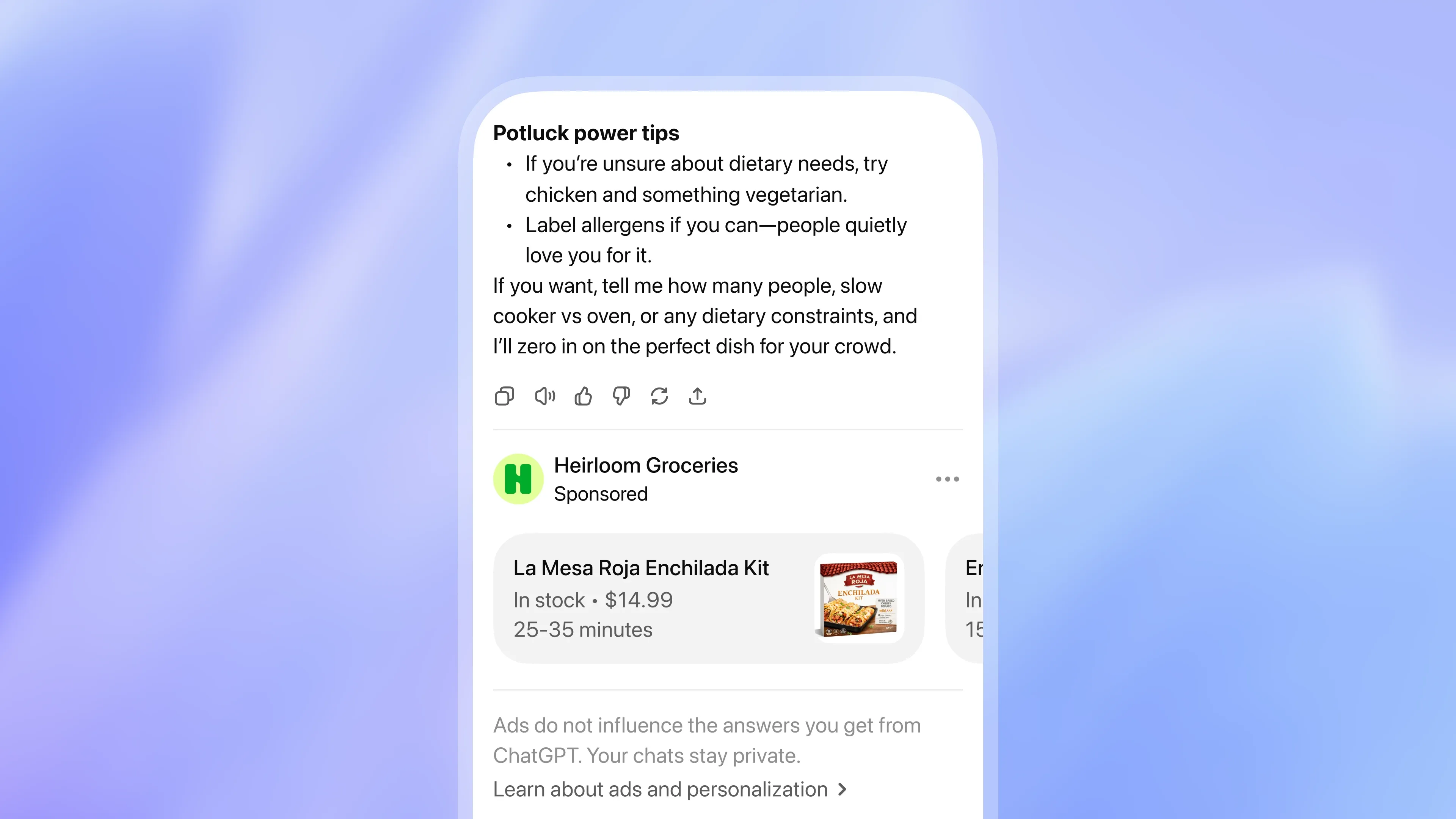
Second, targeting is contextual rather than behaviorally aggressive. Ads are matched to what the user is actively discussing, not layered with years of cross-platform tracking data. Advertisers receive aggregated performance metrics, not detailed user-level reporting. That limits optimization flexibility, but reinforces the privacy posture OpenAI is trying to maintain.
Third, this is being positioned as premium, not purely programmatic. Early CPMs around $60 and high minimum commitments signaled a focus on controlled, high-intent exposure rather than mass reach. With the introduction of self-serve access and CPC pricing, the model is beginning to open up, but the emphasis still leans toward quality of intent over scale.
Finally, the tone of the environment changes expectations. In a social feed, users expect advertising. In a conversation with an AI assistant positioned as an advisor, expectations are different. The tolerance for perceived bias is much lower, which forces a higher standard for how ads are presented and how clearly they are separated from recommendations.
In short, traditional digital advertising monetizes attention at scale. ChatGPT is attempting to monetize intent within a trust-based interface.
Whether that balance holds will determine whether this becomes a new category of performance media or simply another channel competing with search and social.
The Business Pressure
ChatGPT now serves roughly 920 million weekly users, up from 100 million in November 2023. Yet only a small fraction of those users pay for subscriptions.
OpenAI's annualized revenue has grown from $2 billion in 2023 to $6 billion in 2024 to more than $20 billion in 2025, according to reporting from The Information and statements from CFO Sarah Friar. By February 2026, that figure had reached a $25 billion annualized run rate. That level of growth is significant and underscores the scale of capital required to operate frontier AI systems.
Training advanced models, running inference at a global scale, and expanding infrastructure all require sustained investment. Even with rapid revenue growth, long-term projections suggest that subscriptions and enterprise contracts alone may not be enough to close the gap.
At this scale, there are only a few monetization levers available:
-
Increase subscription prices
-
Expand enterprise penetration
-
Monetize the free user base
Advertising is one of the most scalable ways to monetize hundreds of millions of free users without restricting access or significantly raising prices.
Why the Caution Before Launch
The December 2025 pause was not about abandoning ads, but about sequencing. Leadership prioritized strengthening the core product first, including personalization, speed, reliability, and broader answer coverage.
The logic was straightforward. If ads are introduced before the experience feels dependable and neutral, users are more likely to interpret monetization as bias. Once that perception forms, it is difficult to reverse.
Now that ads are in beta, that decision looks deliberate. OpenAI improved the core experience before introducing monetization in a controlled environment. The trust risk remains, but the company is now testing it carefully instead of speculating.
What This Means for Users
The tier separation tells you everything about strategy. Paid plans such as Plus, Pro, and Enterprise remain ad-free. That protects subscription revenue and reinforces the idea that premium tiers deliver a clean experience (does this remind you of the Netflix ad model reimagined... or is it just me?).
Free and Go users are now the testing ground for monetization.
For users, the tradeoff is becoming clearer. Free access at a global scale requires some form of revenue. The question is not whether ads exist. It is whether they remain clearly separated from the advice layer.
So far, OpenAI appears intent on maintaining that boundary.
What This Means for Marketers
The dynamics for marketers are shifting quickly. When the beta launched in February 2026, access came with high minimum commitments, premium CPMs, and limited entry through agency partners. That created a first-mover window with low competition and curated inventory.
That window is closing. With self-serve tools rolling out in April 2026 and minimum commitments being removed, access is expanding to mid-market advertisers. At the same time, the introduction of CPC pricing signals a move toward more performance-oriented buying models. Early previews of the ad manager also suggest that conversion-based optimization may be on the roadmap, pointing to a more mature performance ecosystem over time.
Early participation in high-intent platforms has historically produced outsized returns. Google Ads, Facebook Ads, and Amazon Sponsored Products all rewarded advertisers who learned the systems before they matured.
The difference here is measurement. With limited tracking and aggregated reporting, brands cannot rely on traditional performance playbooks. This environment favors companies that maintain clean product data, communicate clear value propositions, align landing pages closely with intent, and approach messaging as part of a recommendation rather than an interruption.
If commerce-focused queries continue to shape early ad placements, structured product feeds and metadata quality will play a direct role in performance. Shopping-style integrations are likely to emerge as one of the first scalable formats.
The broader takeaway is simple. The monetization model is no longer theoretical. It is being tested at premium price points within a trust-sensitive environment. How brands adapt will determine who captures the most value as this channel matures.
Ads in ChatGPT are going to challenge marketers’ expectations of perfect data. We will have to get comfortable with less visibility and fuzzier attribution, especially in the early days. OpenAI still has a long road ahead to compete with Google’s moat in digital advertising, but more competition is good for marketers and ultimately good for consumers.
Andrew Miller, Co-Founder and VP of Strategy
The Bottom Line on ChatGPT Ads
For months, the question was whether ChatGPT ads would happen. Now we have an answer.
OpenAI has begun testing ads in the U.S., starting with Free and Go users, at premium price points, and under tight controls. The limited rollout and curated advertiser access signal how carefully the company is managing the trust equation.
This was never just about whether ads would exist. At this scale, some form of monetization beyond subscriptions was inevitable. The real question has always been how to introduce it without compromising the advisor-like experience that defines ChatGPT.
Ads are clearly separated from answers. Paid tiers remain ad-free. Targeting is contextual rather than invasive. Early pricing and access positioned the inventory as premium rather than broadly programmatic, though that is beginning to shift as self-serve tools expand access.
But this is still the early chapter.
Initial data from OpenAI’s pilot suggests the approach is holding. Dismissal rates are low, and there has been no reported decline in trust metrics. At the same time, earlier experiments with promotional messaging did generate backlash, reinforcing how sensitive this environment is. The long-term viability of this model depends on maintaining a clear boundary between ads and recommendations.
What is emerging is not just another ad channel, but the foundation of a new commercial layer within AI-driven search.
For users, this introduces a tradeoff between free access and monetization. For marketers, it requires adapting to a model built on intent and context rather than tracking. For OpenAI, it is a balance between scale and credibility.
The brands that engage early will have an advantage. Those who wait for a fully mature ecosystem may find the most valuable placements already established.
If you are evaluating how ChatGPT fits into your 2026 strategy, we can help you think through the right approach. And if you want to stay ahead as this channel develops, sign up for our bi-weekly Shop Talk newsletter for ongoing updates.
This post was originally published on December 3, 2025, and updated on May 8, 2026.