
If you’re heading into 2026 thinking you can just tweak this year's marketing budget and call it a day… think again.
Economic uncertainty, rising media costs, and the relentless march of AI are rewriting the rules for how marketing teams should plan, spend, and measure success. The strategies that worked in 2025 may be obsolete by Q2 next year.
The challenge? You’re being asked to do more with less, while proving every dollar drives real business outcomes.
According to the 2025 Gartner CMO Spend Survey:
Average marketing budget = 7.7% of company revenue
61% of marketing budgets go to digital channels
Top digital investments: Search Ads (13.9%), Display (12.5%), Social (12.2%), SEO (7.4%), and Email (5.9%)
These numbers tell a clear story: you are likely still spending in digital channels, but how you allocate it in 2026 will determine whether you grow or fall behind.
4 Principles to Pressure-Test Your 2026 Marketing Budget
1. Start with Business Goals, Not Channel Wish Lists
If your budget starts with “We need more in paid search” instead of “We need X% revenue growth from new customers,” you’re planning backward.
In 2026, you can’t afford a spray-and-pray marketing approach. Start with your business objectives (whether that’s pipeline growth, retention, market expansion, or margin improvement), and work backward into the mix of channels, campaigns, and tools that will get you there.
Why it matters: Objectives create focus, eliminate vanity spending, and make it easier to defend your allocation in budget reviews.
2. Think Beyond Media Spend
Media spend often gets the spotlight, but it’s only one part of what makes marketing work. Your campaigns won’t perform if you neglect:
Creative Production: ads, landing pages, videos, and other assets
Conversion Rate Optimization (CRO): improving how well your traffic converts
Technology: CRM, analytics, automation platforms
Team capability: training, upskilling, and strategic planning time
Why it matters: These “hidden” costs are often the difference between good campaigns and great ones. Skipping them can make even the best media plan underperform.
3. Link Metrics to Business Outcomes
2026 is not the year to obsess over click-through rates or impressions alone (though zero-click search should be on your radar). Leadership teams want to see marketing’s direct line to revenue.
That means measuring:
Customer Acquisition Cost (CAC) to prove efficiency
Customer Lifetime Value (CLV) to guide where you invest for long-term growth
ROI and revenue to show profit, not just activity
Attribution accuracy to know what’s really working in a privacy-first world
Why it matters: Budgets tied to outcomes are harder to cut… and easier to grow.
4. Budget for Artificial Intelligence (AI) and Experimentation
AI is becoming the operational layer of modern marketing, but adoption comes with hidden costs: platform subscriptions, training, testing time, and human review.
High-performing teams generally allocate 5-15% of their marketing budget for:
AI-driven tools: content support, predictive analytics, audience modeling
Training and governance: ensuring AI outputs align with brand voice and compliance
Testing and innovation: pilots on emerging platforms, new ad formats, creative concepts
Why it matters: Without a test-and-learn budget, you risk falling behind. With it, you can adapt quickly, capitalize on opportunities, and avoid being locked into outdated tactics.
Pro Tip: Treat your AI and testing budget as a permanent line item, not a one-off experiment. The landscape will keep changing… your budget should too.
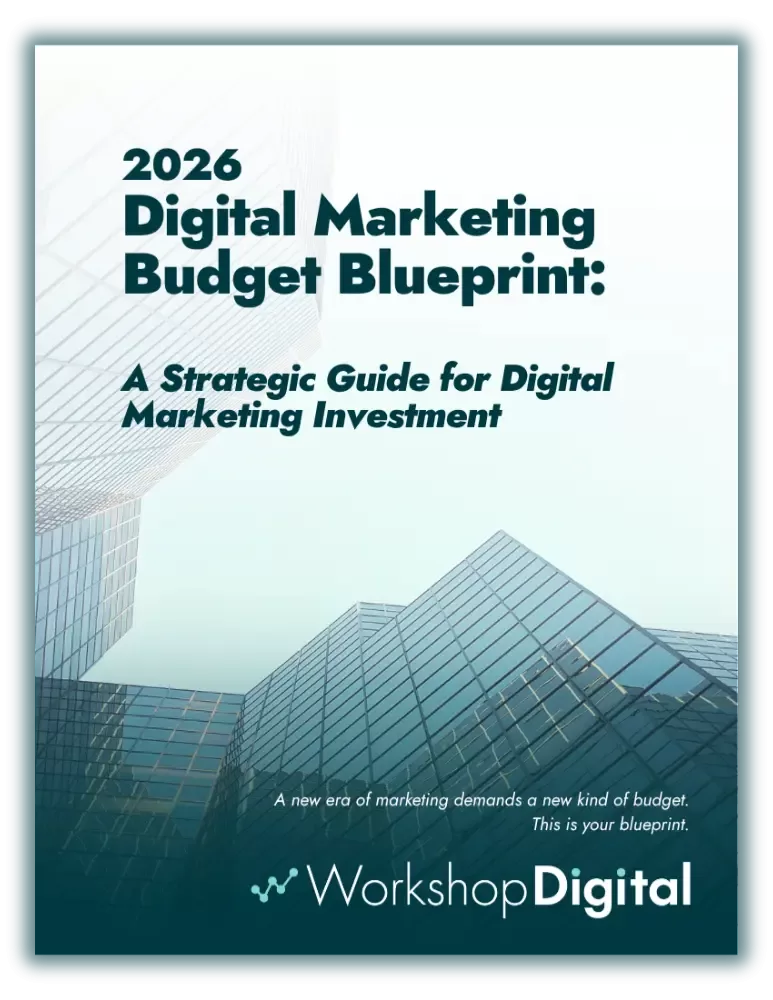
Take the Guesswork Out of Your 2026 Digital Marketing Budget
In 2026, the best marketing budgets won’t just track spend… they’ll adapt in real time, balance short-term wins with long-term growth, and prove their value across the organization.
Our 2026 Digital Marketing Budget Blueprint gives you:
Proven allocation ranges by function and company stage
Benchmarks to pressure-test your current spend
Frameworks for integrating AI and automation without overspending
A testing and optimization model you can put to work immediately
Your competitors are likely already rethinking their approach… don’t get left behind with a static plan in a dynamic year.
Not sure where to start when planning for next year? Feel free to reach out, and we can help guide your 2026 digital marketing approach.