
Artificial intelligence moves fast. Just when it feels like you've wrapped your head around one new development, another one takes its place. This year at MozCon 2026, one topic kept finding its way into presentations, hallway conversations, and discussions about the future of search and marketing: agentic AI.
At first glance, agentic AI sounds like another new term in an industry that's constantly introducing new ones. In reality, it describes a different way AI systems operate, shifting from simply responding to prompts to working toward a goal. Instead of simply generating content or answering questions, these systems are designed to work toward a goal by making decisions, using tools, and carrying out tasks with far less human guidance.
That might sound complicated, but the idea is actually pretty intuitive. Imagine the difference between asking someone to answer a single question versus handing them a project with a deadline and trusting them to figure out the steps along the way. That's the difference we're talking about.
Whether you're hearing the term for the first time or trying to understand why it's suddenly everywhere, this blog post will walk through what agentic AI is, how it works, where it's already being used, and what businesses should know before adopting it.
What is Agentic AI?
At its simplest, agentic AI is artificial intelligence that can work toward a goal instead of waiting for instructions after every step.
Think about giving someone directions to build a bookshelf. You could stand beside them and tell them which screw to pick up, where to place each board, and what to do next every few seconds. Or, you could hand them the instructions, point them to the toolbox, and trust them to figure out the process on their own.
That's the difference between traditional AI and agentic AI.
Most AI tools today are reactive. They wait for a prompt, generate a response, and stop until you ask for something else. Agentic AI takes a different approach. You give it an objective, and it determines how to achieve it. Along the way, it can gather information, use other software, adjust when new information becomes available, and make decisions that move it closer to completing the task.
That doesn't mean agentic AI thinks like a person or acts without limits. It still operates within the goals, rules, and tools it's given. The difference is that it can handle many of the steps between the starting point and the finished result without requiring constant human direction.
For businesses, that opens the door to automating more than individual tasks. Instead of asking AI to draft an email or summarize a meeting, organizations can use agentic AI to research prospects, qualify leads, monitor inventory, coordinate customer support requests, analyze performance data, or manage entire workflows that previously required someone to oversee every step.
It's one reason adoption is accelerating. Gartner projects that 40% of enterprise applications will include task-specific AI agents by the end of 2026, up from less than 5% in 2025.
The result isn't just faster work. It's AI that can take ownership of multi-step processes, allowing people to focus on higher-value work.
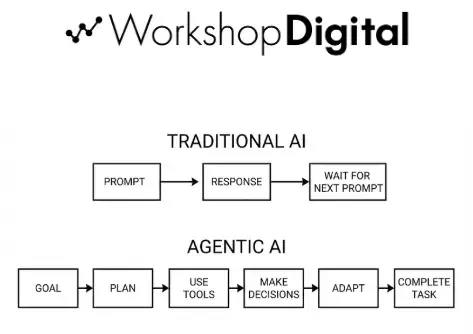
To see how this works in practice, look at how organizations are shifting from everyday software to true agentic AI systems:
The Travel Search vs. The Autonomous Trip Planner: In traditional trip planning, a standard chatbot or search engine can help you look up flight times or suggest hotels, but you still have to manually compare prices across tabs, check cancellation policies, pick seats, and book each part separately. Platforms like MindTrip use agentic workflows to change this. You give the agent a single, multi-layered prompt, such as, "Find me a flight to Chicago under $400, a boutique hotel near downtown for Thursday through Sunday, and make sure the return flight is in the afternoon", and the agent autonomously chains those actions together, querying live inventories, matching location filters, cross-referencing options, and assembling the final planning package.
Customer Service and CRM Workflows: In traditional support setups, a chatbot answers a basic FAQ, and if anything requires backend action (like processing a refund or updating an account), it hands off to a human. Platforms like Salesforce Agentforce change this by deploying autonomous agents directly inside enterprise systems. An agentic support tool doesn't just reply with a text answer; it independently verifies the user's purchase history, checks internal policy rules, executes the refund via backend APIs, and updates the customer record without requiring manual rep intervention.
These aren't futuristic concepts; platforms are rapidly deploying these autonomous, multi-step workflows to eliminate the tedious back-and-forth of everyday digital tasks.
Agentic AI vs. Generative AI
It's easy to confuse agentic AI with generative AI because both are powered by large language models (LLMs) and can perform many of the same tasks. The difference comes down to what they're designed to do.
Generative AI is built to create. Give it a prompt, and it generates text, images, code, or other content based on what you ask. Once it delivers a response, the interaction ends until you provide another prompt.
Agentic AI takes things a step further. Instead of focusing on a single response, it's designed to accomplish an objective. It can break a goal into smaller tasks, decide what to do next, gather information, use software and other tools, and continue working until the job is finished.
This shift is already underway. About 25% of organizations using generative AI launched agentic AI pilots in 2025, and that number is expected to reach 50% by 2027. As organizations move beyond experimentation, they're looking for AI that can complete workflows rather than simply generate content.
Think of it this way: if generative AI is a calculator, agentic AI is a project manager. One helps you complete an individual task. The other coordinates the steps needed to finish an entire project.
| Generative AI | Agentic AI |
| Responds to prompts | Works toward a goal |
| Completes one task | Completes workflows |
| Stops after generating a response | Continues until the objective is complete |
| Requires users to direct each step | Makes decisions within defined guardrails |
| Best for brainstorming, summarizing, and creating | Best for research, automation, planning, and executing multi-step processes |
That doesn't mean one is better than the other. In fact, many agentic AI systems rely on generative AI to complete parts of a workflow. An AI agent might use a generative model to draft an email, summarize a report, or write code before moving on to the next step in the process. In other words, generative AI is often one of the tools an AI agent uses to accomplish its goal.
What Are Examples of Agentic AI?
Agentic AI goes beyond answering questions by planning, making decisions, and completing multi-step tasks with minimal human intervention. Instead of simply generating information, it can take action to achieve a goal for you.
Some examples can include:
Researching vendors, comparing options, and recommending the best fit based on your criteria.
Scheduling meetings by checking calendars, finding available times, and sending invitations.
Monitoring inventory levels and automatically reordering supplies when stock runs low.
Managing marketing campaigns by adjusting bids, reallocating budgets, and optimizing performance based on real-time data.
Screen job applicants by reviewing resumes, ranking candidates, and scheduling interviews.
Book business travel by comparing flights and hotels, making reservations, and updating itineraries when plans change.
How Does Agentic AI Work?
At a high level, agentic AI follows a process that looks surprisingly similar to how people solve problems. Instead of reacting to one request at a time, it works through a series of steps that move it closer to a goal.
Let's say your goal is to plan a team offsite.
You wouldn't immediately book the first hotel you find. You'd decide on a budget, compare locations, check everyone's availability, research venues, make reservations, and adjust your plans if something changed along the way.
Agentic AI approaches work in much the same way.
Step 1: Understand the goal
Everything starts with an objective.
Instead of asking an AI to "write an email," you might ask it to onboard a new customer, research competitors, or identify qualified sales prospects. The AI understands what success looks like before deciding how to get there.
Step 2: Create a plan
Once it has a goal, the AI breaks it into smaller tasks.
For example, if it's researching competitors, it may decide to:
Visit company websites.
Review recent news.
Analyze pricing pages.
Compare products and services.
Summarize the findings.
Rather than waiting for instructions after each step, it determines the order of operations on its own.
Step 3: Gather information and use tools
Unlike traditional AI chatbots that rely primarily on the information they're given, agentic AI can interact with other systems to complete its work.
Depending on the task, it might search the web, retrieve documents, query a CRM, analyze spreadsheets, or connect with business applications through APIs.
Step 4: Adapt when something changes
Real work rarely goes exactly as planned.
If a website is unavailable, new information appears, or a task doesn't produce the expected result, agentic AI can adjust its approach instead of stopping altogether. It evaluates what's happening, decides on the next best step, and keeps moving toward the original objective.
Step 5: Complete the task
Once the work is finished, the AI delivers the results. That could be a report, a recommendation, a completed workflow, or another action ready for a person to review, approve, or build upon.
While every platform works a little differently, most agentic AI systems follow this same pattern: understand the goal, create a plan, use available tools, adapt as needed, and complete the work.
Benefits of Agentic AI
Businesses aren't interested in agentic AI simply because it's the latest advancement in artificial intelligence. They're exploring it because it has the potential to reduce repetitive work, improve productivity, and help teams accomplish more without adding hours to the day.
Here are a few of the biggest advantages organizations are seeing:
Increased efficiency
Many business processes involve dozens of small, repetitive tasks that take time but don't require much strategic thinking. Agentic AI can take on much of that work, allowing employees to spend less time switching between applications and more time solving problems, building relationships, and making decisions.
Better decision-making
Agentic AI can gather information from multiple sources, identify patterns, and surface recommendations in a fraction of the time it would take someone to do the same work manually. While people should still review important decisions, having relevant information organized and ready can make those decisions faster and more informed.
Greater consistency
Unlike people, AI doesn't get tired or forget a step in the process. When given clear instructions and guardrails, agentic AI can complete recurring workflows the same way every time, helping improve consistency across teams.
More time for strategic work
One of the biggest opportunities isn't replacing the human behind the work. It's removing the work that keeps people from focusing on what they do best. As agentic AI takes over routine tasks, employees have more time to develop ideas, collaborate with teammates, and tackle work that benefits from creativity, critical thinking, and experience.
The ability to scale
As organizations grow, so does the number of tasks that need to be completed every day. Agentic AI can help teams handle increasing workloads without requiring every new process to be managed manually, making it easier to support growth while maintaining efficiency.
When Should Businesses Use Agentic AI?
Not every task needs agentic AI, and not every workflow becomes better just because AI is involved. In many cases, a simple automation or a generative AI tool is more than enough. The real value of agentic AI comes from handling work that requires multiple steps, decisions, and the ability to adapt as new information becomes available.
Here are a few signs that agentic AI may be a good fit for your organization:
1. Your team spends too much time on repetitive workflows
Think about all the tasks that happen before the real work begins. Researching prospects, collecting data, updating spreadsheets, routing requests, or pulling reports might only take a few minutes each, but together they can consume hours every week. Agentic AI can take on many of these repetitive processes, allowing employees to focus on work that requires creativity, expertise, and human judgment.
2. Work requires information from multiple systems
Many business processes involve jumping between a CRM, analytics platform, project management software, email, and internal documentation. Rather than asking someone to gather information manually, agentic AI can connect those pieces, organize the information, and move the workflow forward.
3. Decisions follow a repeatable process
Some decisions still require human expertise, but others follow clear rules. If your team regularly works through the same checklist to qualify leads, prioritize support tickets, approve requests, or monitor inventory, agentic AI can help manage those processes while keeping people involved when additional review is needed.
4. You need to scale without adding complexity
As organizations grow, so do the number of tasks that need to be completed every day. Hiring more people isn't always the answer, especially when much of the work is repetitive. Agentic AI can help teams handle larger workloads while allowing employees to spend their time on higher-value initiatives.
When Agentic AI Might Not Be the Right Choice
Agentic AI is powerful, but it's not the answer to every problem.
If you simply need help drafting an email, brainstorming ideas, or summarizing a document, a generative AI tool like ChatGPT is often the better choice. Likewise, if a workflow is already handled well through traditional automation, introducing an AI agent may add unnecessary complexity without providing much additional value.
The best implementations start with a simple question: Is this a process that truly benefits from reasoning, decision-making, and adaptability? If the answer is yes, agentic AI may be worth exploring. If not, a simpler solution will often deliver better results.
Why Agentic AI Matters
Agentic AI is still in its early days, but the pace of innovation suggests it won't stay there for long. As these systems become more capable, businesses will have new opportunities to automate complex workflows, support faster decision-making, and rethink how work gets done across their organizations.
That doesn't mean every process should be handed over to AI. The most successful organizations will be the ones that understand where agentic AI adds value, where human expertise remains necessary, and how the two can work together. Technology may be changing, but strategy, creativity, and sound judgment still matter.
For marketers, this shift extends beyond internal operations. As AI agents become more involved in how people discover information, evaluate solutions, and interact with brands, understanding how they find, interpret, and recommend content will become increasingly important.
Whether you're just starting to explore agentic AI or evaluating how it fits into your business, building a solid understanding of the technology today will help you make smarter decisions as it continues to mature. Not sure where to start? Reach out to our team for a free consultation.