
Artificial Intelligence (AI) has quickly become the most talked-about tool in the content marketing stack. Every week, there seems to be a new platform, a new workflow, or a new claim about how AI is going to replace writers.
But most teams approaching AI are asking the wrong question.
The real question isn’t whether AI can write content. It’s where AI actually fits inside a modern content workflow without replacing the human thinking that makes content valuable in the first place.
After working with AI across drafting, research, and strategy work, a few patterns have become clear. AI can absolutely be useful within your content marketing plans, but only if teams understand what it’s actually doing, where it helps the most, and where it shouldn’t be trusted on its own.
In practice, AI is most effective when it plays a supportive role in the content process rather than attempting to lead it.
The two places where it consistently provides the most value are at the beginning and the end of the workflow: when you’re developing ideas and outlines, and when you’re refining a finished piece of content.
At the ideation stage, AI can help generate structure, surface related topics, and highlight angles that might otherwise be overlooked. When used well, it acts like a research assistant sitting next to the writer, helping expand thinking rather than replacing it.
At the other end of the process, AI can help strengthen a piece that already exists by identifying unclear phrasing, tightening language, or flagging areas where a point could be developed further.
What AI shouldn’t be responsible for is the core thinking behind the content itself. Original insights, strategic positioning, and brand voice still have to come from humans.
Why AI Is Often Misused in Content Workflows
A large part of the confusion around AI comes from how people think the technology works. Many marketers talk about AI as if it’s a creative system capable of generating new ideas on its own. In reality, most AI tools used in marketing are pattern recognition engines. They analyze massive datasets and predict the most likely response based on the prompt they’re given.
AI is predicting patterns rather than applying judgment; it can produce content that sounds confident and well-structured even when the underlying information is incomplete, inaccurate, or misaligned with a brand’s message or intent.
This is where many teams run into trouble. When AI-generated content looks polished, it’s easy to assume it’s correct. But without human oversight, AI can introduce factual errors, misinterpretations, or messaging that doesn’t match the intended strategy.
The role of the writer or strategist doesn’t disappear in an AI-assisted workflow. If anything, it becomes more important.
Someone still needs to evaluate the output, verify the information, and ensure the content reflects the brand’s voice and perspective. AI can accelerate parts of the process, but it cannot replace the human judgment required to produce content that is accurate, thoughtful, and genuinely useful to the audience.
Using AI Tools in the Research and Ideation Phase
While AI shouldn’t replace the thinking behind the content, it can be useful when it comes to gathering and organizing information. Below are a few ways I recommend using AI to help with your content creation workflows:
1. Competitor and Industry Research
One of the most important things when it comes to thinking of what content is going to be useful is analyzing how competitors approach similar topics: What’s ranking? How is the content structured? Are there pieces of content ranking in LLMs that differ from the traditional search results?
Traditionally, this kind of research involves manually reviewing dozens of web pages to understand how companies position their messaging, structure their content, and speak to customer pain points. AI tools can accelerate that process by pulling together patterns across multiple sources much faster.
For example, during early planning for a landing page or blog post, AI can analyze competitor content and surface common themes such as how pages are structured, what problems they emphasize, and how they frame their solutions. This gives teams a quick snapshot of the landscape before deciding how they want to differentiate their own content.
The goal isn’t to copy what competitors are doing. Instead, it’s to understand the broader conversation happening in the market so you can develop a stronger perspective of your own.
Example Prompts:
In these prompts, HVAC has been used as the example service and Richmond as the example location. When applying this to your own prompt, please substitute your specific industry and geographic area accordingly.
Create a table and provide a list of 20 companies that offer HVAC services in the Richmond area. Include their name, website, and core services in the table.
Note: Asking in groups of 20 tends to work well and avoids overloading the tool. You can also request additional columns of information. From there, you can copy and paste the data into a spreadsheet or, depending on the AI tool, have it generate the sheet for you.
- For the following three domains (domain 1, domain 2, and domain 3):
What are their core service pages, and how many do they have?
Are they publishing blogs, and if so, how frequently?
Is anyone discussing them on Reddit, and if so, what are they saying?
Note: You can add as many questions as you like, but I recommend grouping them in sets of 4-5 to avoid overwhelming the AI tool, as requesting too much information at once can reduce the quality of the results.
Please review XYZ.com and summarize the SEO tactics they are using on their core service pages.
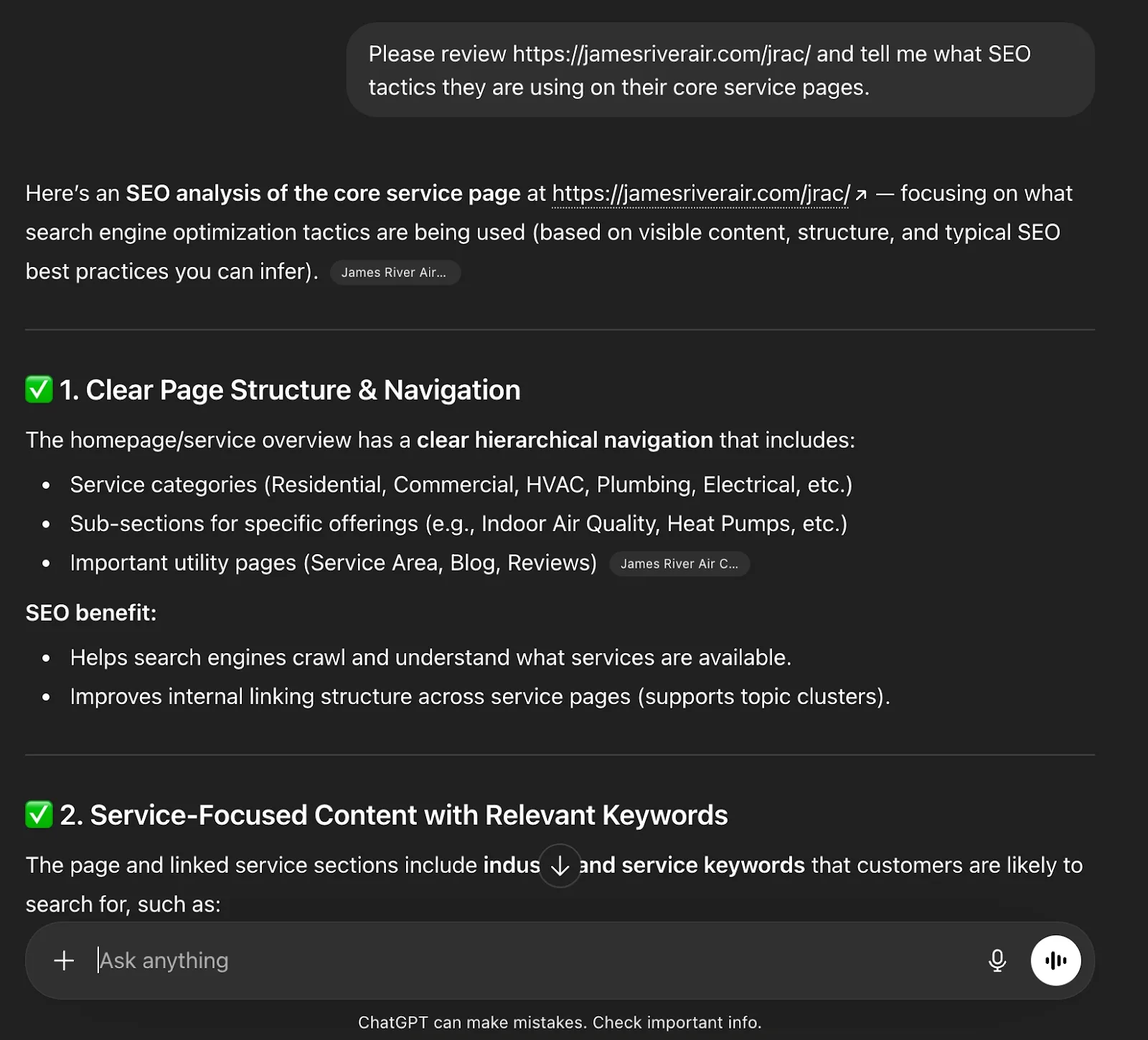
- Note: Compiling a list of tactics provides deeper insight into your competitors’ strategies and helps you develop a more effective plan to outperform them.
2. Supporting Ideation and Content Planning
AI can also be useful when brainstorming ideas or structuring new content.
When you’re starting from a blank page, AI can help generate topic angles, suggest supporting sections, or highlight related questions that audiences are likely searching for. Used correctly, it can help expand your thinking and surface ideas you might not have initially considered.
That said, the suggestions AI provides should always be treated as starting points rather than finished answers. The real value still comes from the strategist or writer shaping those ideas into a cohesive argument that reflects the brand’s voice and expertise.
When AI is used this way, it acts less like an automated writer and more like a research assistant, helping teams gather context quickly so they can spend more time focusing on the ideas.
Choosing the Right AI Tool for the Job
Another important thing teams discover quickly is that not every AI tool works the same way. While most models can perform similar tasks on the surface, each tends to excel in slightly different areas depending on how it’s trained and how it processes information.
Understanding these differences can make a significant impact on how effectively AI supports your workflow.
ChatGPT
ChatGPT is one of the most versatile tools for content teams. It performs well when used for outlining content, refining messaging, and reviewing drafts during the editing process.
For example, it can be helpful for stress-testing an outline, identifying areas where an argument may need additional support, or suggesting ways to clarify a section that feels overly complex. Many teams also use it to review finished drafts for readability and structure.
Claude
Claude tends to perform well when working with longer documents or more complex contexts. It’s particularly useful when reviewing large amounts of text and identifying patterns or themes within that information.
For content teams, this can make it helpful when analyzing research materials, reviewing long-form drafts, or synthesizing insights from multiple documents during the early stages of content development.
When the task requires digesting a large amount of written material and extracting the most relevant ideas, Claude can be a useful tool to incorporate into the workflow.
Gemini
Gemini is often useful when research involves pulling information from across multiple sources. Because of its integration with Google's ecosystem and strong search capabilities, it can help teams quickly gather background information or summarize industry topics.
This makes it particularly helpful during the early research phase when teams are trying to understand a topic, identify related questions, or gather context before beginning the writing process.
Like any AI tool, though, the information it surfaces still needs to be verified. AI can accelerate research, but it shouldn’t replace the evaluation process that ensures the final content is accurate and aligned with the brand’s perspective.
The Role of AI in Your Content Workflows
AI has quickly become a standard part of the marketing stack, but the way teams use it will determine whether it improves their work or worsens it. When AI is treated as a replacement for writers, strategists, or researchers, the results tend to be generic and unreliable. When it’s used as a supporting tool within an existing workflow, it can significantly improve efficiency without sacrificing quality.
AI can help teams move faster, but it cannot replace the thinking that makes content valuable in the first place. As more organizations integrate AI into their workflows, the teams that benefit most won’t be the ones trying to automate creativity. They’ll be the ones using AI thoughtfully to support it.
Not sure where to start with your content marketing strategy? Our team of strategists is here to help! Just reach out to us here!