
For a long time, content marketing has operated on a pretty simple assumption:
More content = more traffic
Publish new blog posts. Launch new landing pages. Expand keyword coverage. Repeat forever.
And to be fair, that strategy still works. Some of our biggest organic traffic gains over the last two and a half years came from net-new content.
But something else kept showing up in our data.
Some of the strongest organic lifts we saw weren’t coming from brand-new pages. They were coming from existing content: pages that were already live and strategically improved over time.
Sometimes the updates were major overhauls, and sometimes they were surprisingly simple:
Restructuring content for clarity
Updating outdated information
Improving internal linking
Tightening search intent alignment
Rewriting sections that felt vague, thin, or obviously written for a completely different time in SEO
Implementing or fixing schema markup
Over the past 2.5 years, the search landscape has changed dramatically. AI Overviews rolled out, AI Mode entered the picture, and platforms like ChatGPT, Claude, and Perplexity started reshaping how people discover information online. Search behavior became increasingly fragmented as users began getting answers directly inside search experiences instead of clicking through traditional blue links.
That changed the way we think about content refreshes.
We were no longer updating pages just to maintain rankings. We were updating them to make content clearer, more useful, easier to extract answers from, and more trustworthy for both users and AI-driven search systems.
So I decided to look at the data… Or more accurately: Claude pulled together the data, and I analyzed it.
The Methodology
Between January 2024 and mid-2026, I analyzed 273 content events across the Workshop Digital website, including both refreshed content and net-new launches.
For each page, we compared:
90 days before launch/update
vs. 90 days after launch/update
I also compared refreshed URLs to untouched control pages over the same period to isolate whether the refresh or broader SERP volatility drove performance changes.
The analysis included:
Organic sessions from GA4
Google Search Console clicks and impressions
Ranking-position changes
CTR shifts
Conversion indicators like quote requests and content downloads
A few important caveats:
Before we get too carried away with the numbers, there are a few important limitations worth calling out.
First, Google Search Console only gives us a 16-month historical lookback. That means some older refreshes have incomplete pre-launch GSC data, even though GA4 session data was still available.
Second, conversion volume on our own site is relatively low. We are not a massive publisher generating thousands of form fills per month, so smaller conversion swings at the individual-page level are directional rather than statistically definitive.
Third, net-new content naturally behaves differently from refreshed content. A brand-new page has no historical baseline, which means percentage growth numbers can look absurdly large because the “before” value was effectively zero.
And finally, not every refresh worked.
Some updated pages underperformed after launch. In a few cases, rankings dropped. In others, broader SERP volatility or shifting search intent likely outweighed the impact of the refresh itself.
That is part of what makes this analysis useful. The goal was not to prove that every content refresh succeeds. It was to understand whether refreshing content, as an ongoing strategy, compounds organic visibility over time.
And what we found genuinely changed the way I personally think about content strategy:
Net-new content helped us expand visibility
Refreshed content helped us compound it
And in many cases, refreshes turned out to be the more efficient investment.
What We Found
The biggest takeaway from this analysis was not that refreshed content magically replaced the need for net-new content. It was that strategically refreshed content consistently compounded over time.
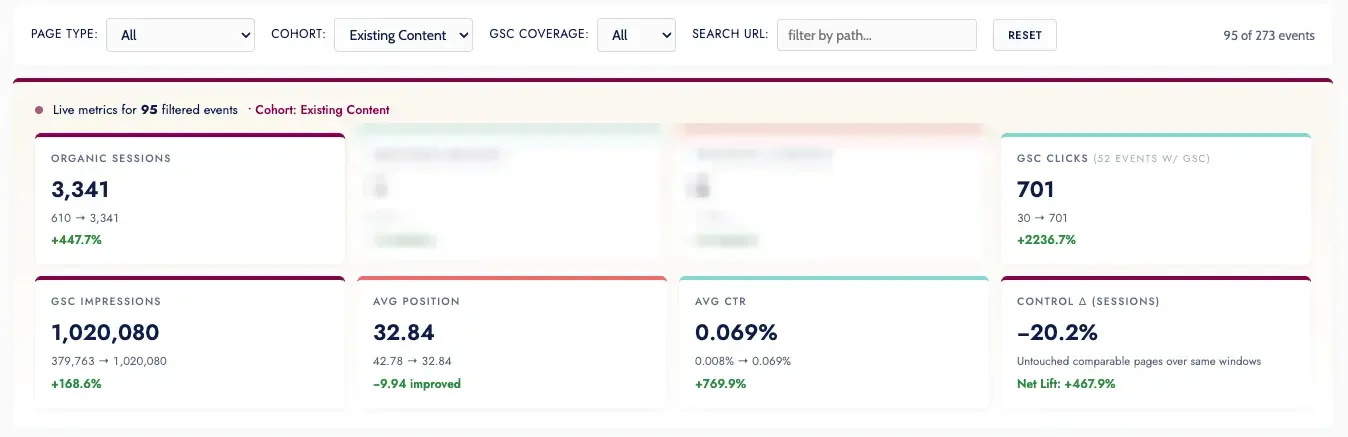
Across 95 refreshed-content pages, organic sessions increased from 610 to 3,341 in the 90 days following launch or refresh, representing a +447.7% lift.
At the same time:
GSC clicks increased +2236.7%
Impressions increased +168.6%
Average ranking position improved from 42.78 to 32.84 (-9.94 improvement)
Average CTR increased significantly across the cohort (+769.9%)
And perhaps most importantly, comparable untouched pages declined during the same periods.
The control cohort measured a -20.2% session decline, meaning refreshed pages achieved a net lift of nearly +468% against similar pages that were left untouched.
Between 2024 and mid-2026, search visibility was anything but stable. AI Overviews rolled out. SERPs shifted constantly. Organic click behavior changed across industries.
So if refreshed pages improved while everything else improved too, the takeaway would have been less impactful. But again and again, the refreshed cohort outperformed comparable untouched pages measured during the exact same windows.
That strongly suggests the updates themselves made a big impact. And the gains were not evenly distributed… Some page types benefited far more than others.
Blog Refreshes Were the Clear Winner
The strongest performance improvements came from refreshed blog content.
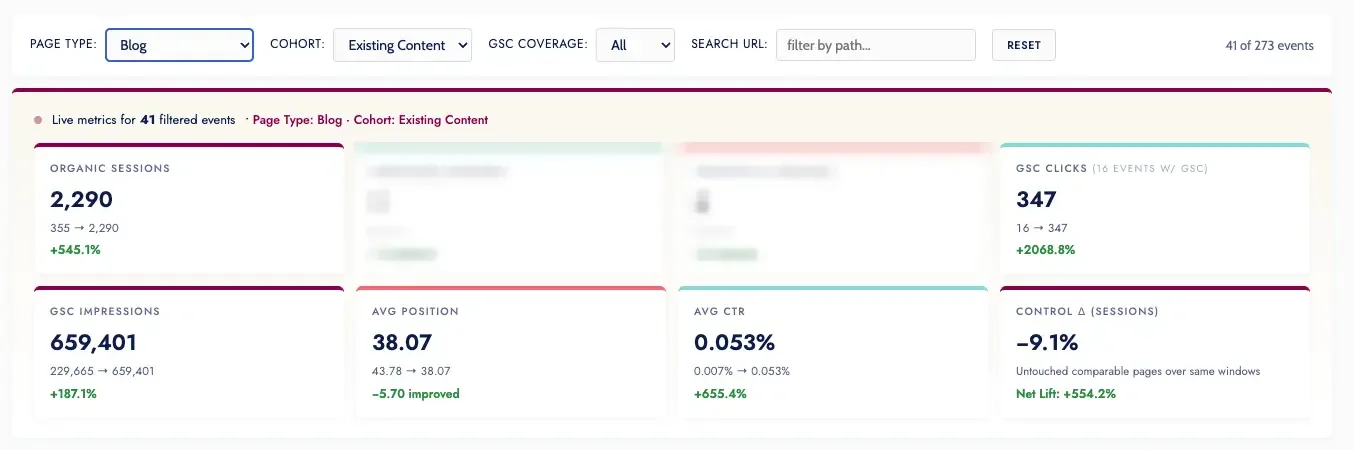
Across 41 refreshed blog pages:
Organic sessions increased +545.1%
GSC clicks increased +2068.8%
Impressions increased +187.1%
Average ranking position improved from 43.78 to 38.07 (-5.70 improvement)
Comparable untouched blog pages declined -9.1% during the same periods, resulting in a net lift of roughly +554% against comparable untouched content.
Honestly, this was one of the more surprising findings in the entire analysis. I expected refreshed blogs to improve. I did not expect them to consistently outperform untouched content at this scale, especially because most refreshes were not complete rewrites.
In many cases, the updates looked more like:
improving structure and readability
tightening topical focus
consolidating overlapping ideas
updating outdated examples or statistics
clarifying headings and answer sections
improving internal linking
removing filler that existed mostly for older SEO conventions
answering questions at the top of the blog post
implementing or fixing structured data
In other words: making the content genuinely more useful. And increasingly, that appears to align with the direction search is moving.
The blog refreshes that performed best were often the ones that became more focused, comprehensive, easier to skim, easier to extract answers, and more clearly aligned with search intent. Not necessarily longer, just better.
Core and Service Pages Improved Differently
The core/service-page data told a slightly different story.
The improvements were still substantial:
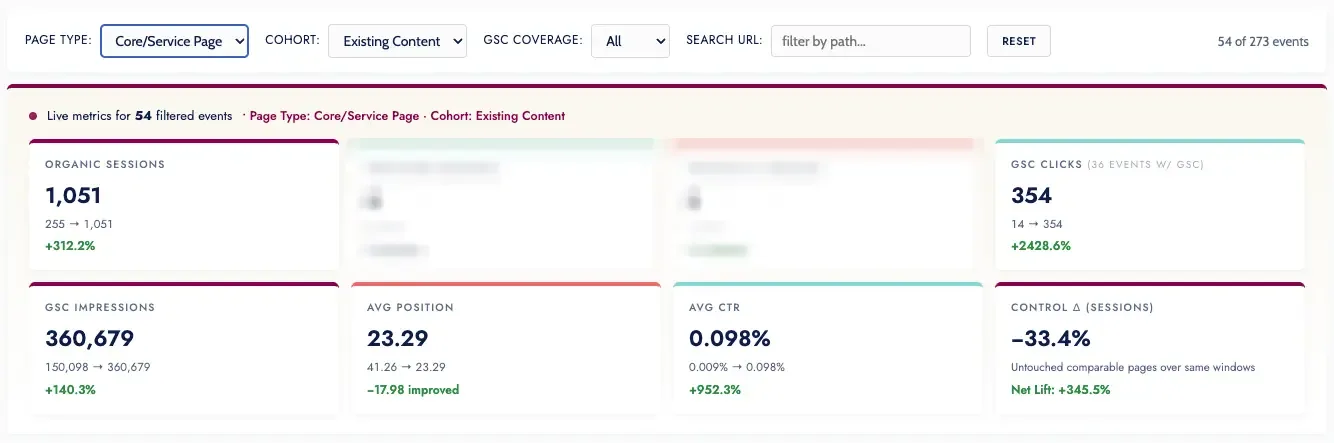
Organic sessions increased +312.2%
GSC clicks increased +2428.6%
Impressions increased +140.3%
Average ranking position improved dramatically from 41.26 to 23.29 (-17.98 improvement)
Comparable untouched service pages declined -33.4%, resulting in a net lift of roughly +346% against comparable untouched content.
But unlike blog content, service-page refreshes tended to produce steadier, more concentrated gains… Which honestly makes sense to me.
Service pages usually start with:
stronger commercial intent
higher baseline conversion value
clearer keyword targets
less content sprawl
The objective was rarely to simply publish more words. Most successful updates focused on clarifying positioning, tightening messaging, improving topical relevance, and strengthening supporting context throughout the page.
The interesting thing is that many of these pages did not need massive rewrites to improve performance. In several cases, smaller structural improvements produced outsized visibility gains. Because these pages often sit closer to conversion actions, even modest traffic improvements carried disproportionate business value.
How I’m Thinking About Content Refreshes Going Forward
The biggest thing this analysis changed for me was not whether net-new content still matters.
It absolutely does. New content is still how brands expand topical coverage, enter new conversations, and grow visibility into entirely new search spaces.
But for smaller marketing teams with limited resources and an existing content library, refreshing content may be one of the highest-leverage SEO investments available.
In many cases, the hardest part is already done. The page already exists, may already rank, and often already carries backlinks, topical authority, and historical engagement signals. Refreshing content allows teams to build on that foundation instead of starting from zero every time.
One of the more interesting findings from this analysis was that the biggest wins did not always come from massive rewrites. Some of the strongest-performing refreshes involved relatively focused improvements: clarifying page structure, improving search intent alignment, updating outdated information, strengthening internal linking, consolidating overlapping sections, and rewriting copy that felt vague or overly written for search engines instead of actual readers.
In other words, the pages improved because the experience improved.
That matters even more now than it did a few years ago. Search behavior is changing quickly. Users skim more aggressively, search journeys are becoming more fragmented, and AI-generated search experiences increasingly summarize or extract information directly from content instead of simply ranking pages based on keyword relevance alone.
The strongest-performing refreshes were usually the pages that became more focused, easier to navigate, and more aligned with what users were actually trying to accomplish.
The best-performing pages in this dataset behaved less like one-time publications and more like long-term assets that gained value over time because they were continuously maintained and improved.
Why This Matters Moving Forward
For years, content marketing conversations have focused heavily on publishing more: more blogs, more landing pages, more keyword coverage, more production.
But after looking at 2.5 years of refresh data across our own site, I’m increasingly convinced that sustainable organic growth comes from balancing new content creation with ongoing content maintenance.
Some of the best-performing pages in this analysis were not brand-new launches. They were existing assets that already had authority and relevance, but needed to be updated to align with the way people search today.
That does not mean brands should stop investing in net-new content. It means there is often far more value sitting inside existing content libraries than most teams realize.
As search continues shifting toward AI-driven experiences, I suspect that trend will only become more important.
If your team has been stuck on the “publish more” treadmill, it may be worth taking a closer look at the content you already have. In many cases, organic growth may come less from creating more content and more from improving the content that already exists.
If you’re not sure where to start, let’s chat! We can help you prioritize refresh opportunities with a full content analysis and roadmap.