
As more people turn to AI tools for answers, marketers want to know what kind of content gets cited. One of the best formats isn’t new at all: the FAQ.
Every search starts with a question. Even when someone types a simple three-word phrase into a search engine, there’s an underlying question driving that search.
FAQs have always been an effective SEO tactic because they answer those questions directly without forcing people to hunt through walls of text and fluff. In an AI-driven search environment, a direct Q&A structure enhances user experience while enabling AI tools to parse, extract, and cite your content easily.
Why Have FAQs Always Worked for SEO?
At its core, search optimization is about matching people to the content that answers their question. Long before AI Overviews and ChatGPT, FAQs were a reliable way to rank for the questions people actually search, delivering a direct answer up front instead of burying information inside dense body copy.
From a keyword strategy standpoint, FAQs naturally address long-tail and question-based queries. FAQs also provide answers to follow-up questions right when the searcher is thinking about them. By addressing topics at multiple stages of the search journey, you help readers take the next step without bouncing back to the search results.
What Makes FAQ Content Good for Real People?
SEO marketers often optimize for search engine crawlers, but high-performing content must resonate with real people, not just machines. FAQs are a great user experience tool when done right. Answers are easy to scan, helping people find what they need in seconds.
When you publish answers to hyper-specific, real-world questions, you show your audience that you actually understand their day-to-day concerns and can address them, which builds trust and demonstrates authority.
Why Do AI Search Tools Favor FAQ-Style Content?
Generative search engines and LLMs don't read web pages the same way traditional crawlers do. AI systems still rely on indexed pages, but instead of ranking a page as a whole, they pull smaller, self-contained passages to build an answer.
Google’s official documentation on AI features and your website explains that its AI features may run multiple related searches, a concept known as query fan-out, while determining how to best answer a prompt. Pages that answer several specific, related questions give AI models more opportunities to match with those additional searches.
Microsoft's official guidance on Optimizing Your Content for Inclusion in AI Search Answers recommends concise, self-contained Q&A formatting (along with lists and tables) for extraction into AI summaries.
A clean question-and-answer pair is about the most extractable unit of content you can write. The exact same quality that made FAQs great for traditional search intent makes them easily extractable for LLMs.
How Do You Write FAQs That Work for Search and AI?
The following points can help you craft FAQs that perform for both human searchers and AI bots.
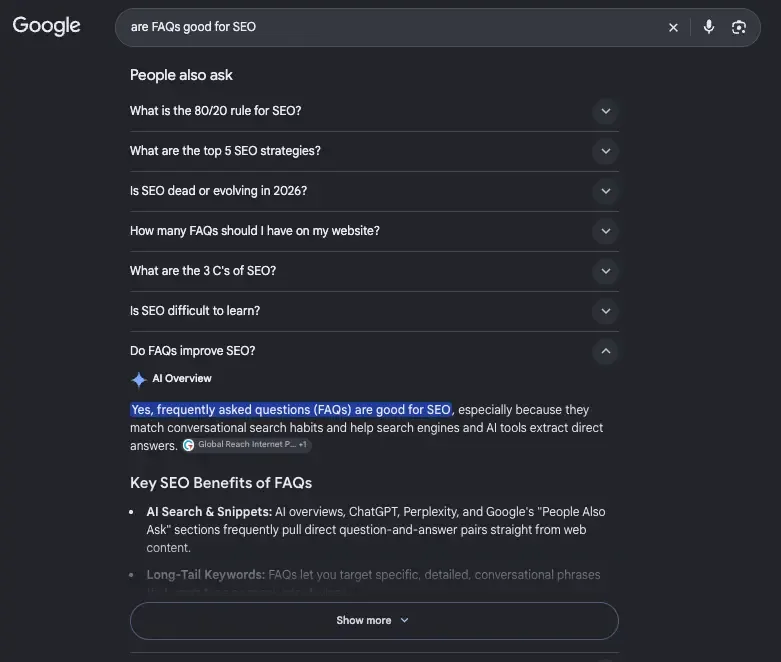
Also Ask results show the real questions searchers are asking, making them a good starting point for FAQ ideas.
- Start from real customer data: Pull questions directly from your sales and support teams, People Also Ask search results, and keyword research rather than inventing hypothetical topics.
Do: "How long does a technical SEO audit take to complete?" (Based on real sales and onboarding inquiries)
Don't: "Why is Workshop Digital the best SEO agency in Richmond?" (Self-serving, unsearched topic)
- Lead with the answer: Give the direct answer in the very first sentence, then use the rest of the paragraph to add necessary context. This makes sure the most important information is contained in an extractable format.
Do: “A Workshop Digital technical SEO audit is a custom review of your website covering 120+ key technical checkpoints, from crawl issues to sitemap indexing.”
Don’t: “Every website is different, and there are a lot of factors that affect technical performance, so our audits look at many areas of your site.”
- Make every answer stand alone: AI engines extract sentences and passages out of context. Avoid using phrases like "as mentioned above" or "see the section above," and opt for sentences that convey the full meaning on their own.
Do: "Workshop Digital provides developer-ready implementation guidance as part of every technical SEO audit."
Don't: "As mentioned in the audit deliverables section above, our team helps with implementation as well."
- Use explicit brand and product names: Name your specific product, service, or brand directly in the answer instead of relying on ambiguous pronouns like "it," "we," or "they."
Do: "Workshop Digital conducts custom technical SEO audits with over 120 key technical checkpoints for enterprise websites."
Don't: "We conduct custom technical audits with over 120 checkpoints for our clients."
- Stick to one question per FAQ: Keep each FAQ focused on a single topic so the response stays concise and on point.
Do: "What is llms.txt?" (Answers solely what the protocol is)
Don't: "What is llms.txt and how do I set it up on WordPress?" (Combines definitions and installation steps into one cluttered answer)
Keep information current: Regularly review your FAQs so pricing, policies, and product details remain accurate.
Add schema markup: Add FAQ schema that matches the visible content on the page, which gives search engines clear, machine-readable context.
Where Should FAQs Live on Your Site?
Where you place your FAQs depends entirely on the type of question you're answering:
On Service and Product Pages: Place targeted pre-purchase FAQs near the bottom of conversion pages to address buying pain points, pricing details, and logistics.
On Blog Posts: Use FAQs at the end of informational guides to address logical follow-up questions and capture long-tail People Also Ask queries.
On a Standalone FAQ Page: Reserve sitewide FAQ hubs for broad, company-level questions (like billing procedures, general support hours, or corporate policies), and keep topical Q&As on their respective pages.
What FAQ Mistakes Should You Avoid?
Bad FAQs waste users' time and send negative quality signals to search engines. Avoid these common traps:
Inventing fake questions: Writing unnatural questions solely to force targeted keywords onto a page frustrates readers and dilutes page quality.
Keyword stuffing: Over-optimizing text doesn't work for traditional rankings, and research on generative engine optimization found keyword stuffing offered little to no improvement in AI visibility.
Duplicating FAQs across pages: Copying and pasting the exact same FAQ block across dozens of service pages creates internal duplicate content issues.
Giving vague answers: If your answer doesn't actually answer the question in the first sentence, rewrite it.
The Bottom Line
FAQs work for AI search for the same reason they’ve always worked for SEO. Good FAQ content addresses your reader's questions and respects their time. By answering real questions directly, you create a better experience for human visitors while giving search engines and AI tools the exact, extractable information they need to recommend your brand.
Want to see how your website currently presents answers to AI search engines? Workshop Digital can audit your top-performing pages and ensure your content is clear, direct, and citable in AI search.
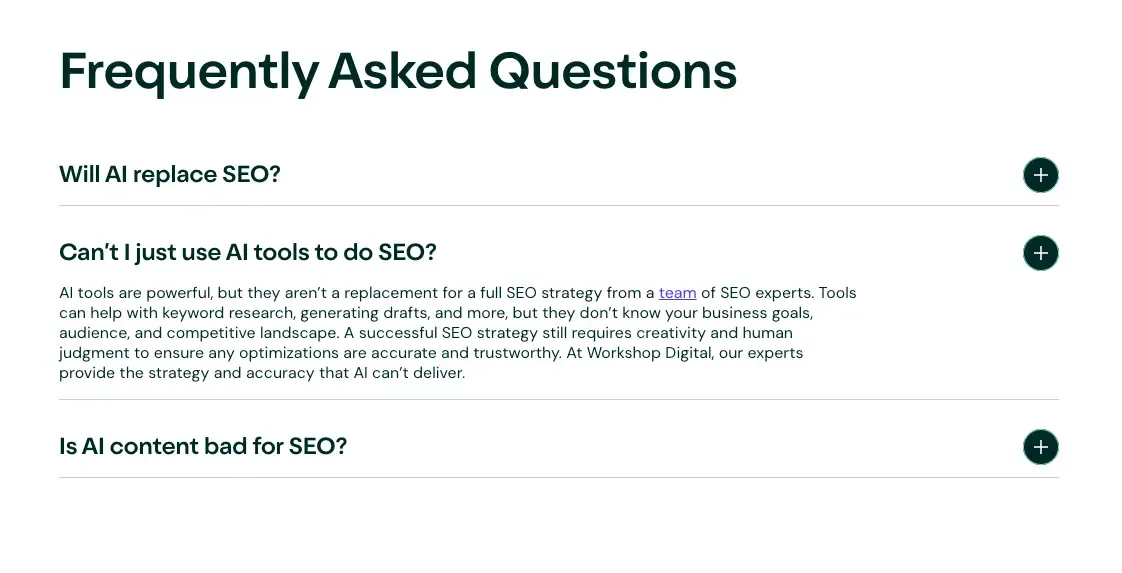
Frequently Asked Questions About FAQs, SEO & AI