
A few years ago, finding something online meant opening seventeen tabs, skimming three contradictory listicles, and eventually giving up and asking a friend. You pieced together an answer from whatever survived your attention span.
That still happens. But it‘s no longer the default.
Now you can just... ask. One question, one answer, done. No tabs, no scrolling, no "10 Best Things You Need to Know" articles written by someone who has clearly never tried the thing.
The numbers make this hard to ignore. ChatGPT now has over 900 million weekly active users, according to OpenAI's own announcement. Back in 2024, Gartner predicted that traditional search engine volume would drop 25% by 2026 as AI chatbots became substitute answer engines. We are now in 2026, and while that exact number is debated, the trajectory is clear -- AI search is capturing higher-intent queries, and brands tracking mentions and citations across ChatGPT, Perplexity, and Google AI Overviews are already repositioning themselves.
This is not a traffic dip. It is a structural change in how people find information.
Which brings us to generative engine optimization, or GEO. GEO is about making sure your content can be understood, selected, and used by AI systems when they generate answers. Not just indexed. Actually used, cited, and trusted… Part of the answer.
The goal is not to get someone to click your link anymore. It is to be the source that the AI reaches for when someone asks a question you should answer.
What is Generative Engine Optimization (GEO)?
Generative engine optimization (GEO) is the practice of creating and structuring content so it can be selected, summarized, and cited by AI systems when they generate answers.
Instead of trying to rank highly in search results, GEO focuses on something different: becoming part of the answer itself.
Think of it this way:
SEO helps you get discovered
GEO helps you get used
When someone asks an AI a question, the system does not just pull links. It pulls information, compares sources, and builds a response. Content that is clear, well-structured, and trustworthy is far more likely to be included.
Example: GEO vs. traditional SEO in practice
If someone asks, “What is generative engine optimization?”
A traditional SEO article might rank on page one
- A GEO-optimized article will:
Start with a clear, direct definition
Use simple, precise language
Include structured sections that are easy to extract and reuse
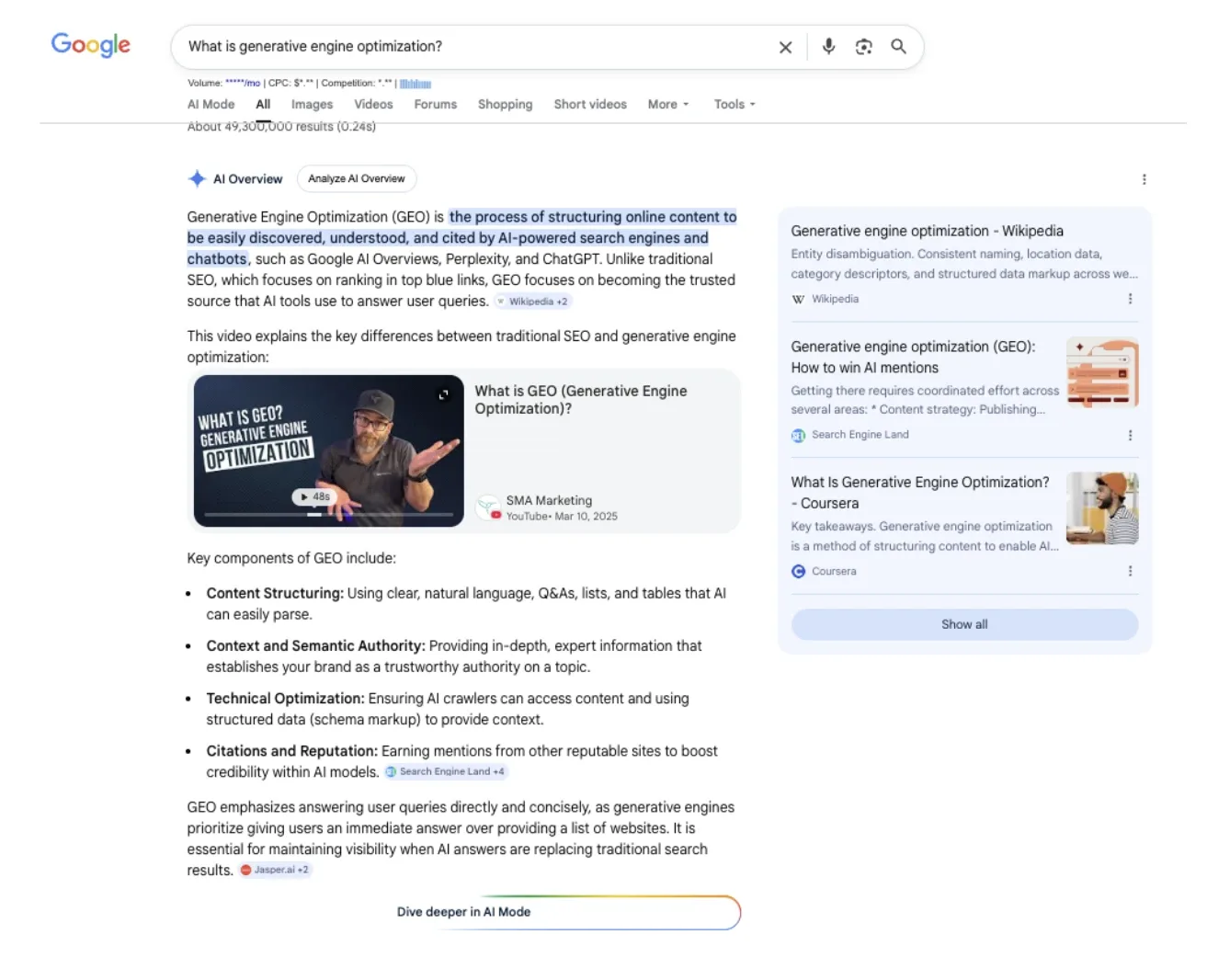
That second version is much more likely to be quoted or summarized inside the AI-generated answer.
Another way to look at it: SEO is about visibility in search engines. GEO is about visibility inside AI-generated answers.
Both matter. But they play different roles.
Why is Generative Engine Optimization (GEO) Important?
The way people find and interact with information is evolving. AI systems like ChatGPT and Google Gemini are becoming a larger part of the search journey, not replacing it.
That shift changes how visibility, traffic, and attribution work:
AI is becoming an additional layer in search: Users still search, but now they often interact with an AI-generated summary before deciding what to do next.
Clicks are becoming less predictable: Some queries that used to drive traffic now get partially answered in the interface, which can reduce clicks and sessions even if demand stays the same.
Attribution is getting murkier: When an AI summarizes multiple sources into one answer, it becomes harder to track which content influenced the outcome and where credit should go.
Visibility is no longer just about ranking: Showing up on page one of search engines like Google does not guarantee you will be included in the AI-generated response that users actually read first.
Inclusion drives influence: Content that is selected, summarized, or cited inside AI responses can shape user understanding even without a click.
Fewer sources are amplified: AI systems tend to rely on a limited set of inputs, which concentrates visibility among content that is clear, structured, and trustworthy.
- GEO helps you adapt without abandoning SEO: SEO still drives discovery and indexing. GEO increases the likelihood that your content is used once it is found.
Which brings us to the next challenge: all the new acronyms trying to explain this shift.
SEO vs. GEO vs. LLMO vs. AEO: What These Terms Mean
As AI becomes a bigger part of how people search, a wave of new acronyms has followed: SEO, GEO, LLMO, and AEO are often used interchangeably (think PPC = Paid Media), but they are not identical. They all point to the same underlying shift, but the difference is in what part of the system they focus on.
The simplest way to think about it:
SEO is about ranking and technical visibility in search engines
GEO is about being used in AI-generated answers
AEO is about answering specific questions clearly
LLMO is about how content performs inside language models
To break each one down further:
SEO (Search Engine Optimization): Optimizing both the technical foundation and content of a site to rank in search engines like Google. This includes indexing, site structure, performance, and content relevance. The goal is visibility and traffic from search results.
GEO (Generative Engine Optimization): Optimizing content so AI systems like ChatGPT and Google Gemini can select, summarize, and incorporate it into generated answers.
AEO (Answer Engine Optimization): Optimizing content to directly answer specific questions in a clear, concise way. Originally tied to featured snippets and voice search, it now overlaps heavily with AI-generated answers.
LLMO (Large Language Model Optimization): A broader and less standardized term focused on how content is interpreted, associated, and surfaced by language models. This can include brand signals, consistency across sources, and topical authority.
These interchangeable terms can get confusing because there is no universal definition for some of them, and different companies use them in slightly different ways. In many cases, people are describing the same thing from different angles.
This is important: you do not need four separate strategies.
SEO ensures your content can be found and accessible
Clear, structured content ensures it can be understood
GEO increases the likelihood that it gets used in AI responses
Call it whatever you want… SEO, GEO, AEO, or LLMO. The underlying goal is the same: create content that is technically sound, easy to understand, and easy to reuse. SEO best practices are still at the core; they just extend further now.
How to Optimize for Generative Engine Optimization (GEO)
Optimizing for GEO is about making your content easier for AI systems to understand, trust, and reuse. AI systems often look for content they can extract quickly. If your main point is buried in a wall of text, it is less likely to be used.
Below are some tips to keep in mind:
1. Structure content for easy extraction
GEO works best when your content is easy to understand at both the page level and the section level. AI systems need to identify what your page is about, locate the most relevant information, and understand how different ideas relate to each other. A clear structure makes that easier.
Use formatting that helps both readers and AI systems scan the page:
Descriptive headings that clearly explain what each section covers
Short paragraphs that focus on one idea at a time
Bullet points and numbered lists for definitions, steps, comparisons, and examples
Tables when comparing concepts, features, tools, or options
FAQ sections for common questions and direct answers
Internal links that connect related content and reinforce topical authority
Schema markup also plays an important role. Structured data helps search engines understand key details about your page, such as the article type, author, organization, FAQs, products, reviews, or how-to steps.
For GEO, schema does not guarantee inclusion in AI-generated answers, but it does make your content more machine-readable, which supports both traditional SEO and AI visibility.
The goal is to make every section easy to identify, extract, and reuse without losing context.
2. Start with a clear, direct answer
One of the most important changes with GEO is where and how you deliver value. Instead of building slowly to a point, you need to lead with it.
AI systems look for content they can quickly extract and reuse. If your core answer is buried halfway down the page, it is less likely to be selected. Start each page, and ideally each major section, with a concise answer that can stand on its own:
A 1-2 sentence definition for “what is” queries
A direct response to the main question
A clear summary before going deeper into detail
Think of this as your “extractable answer.” It should make sense even if it is pulled out of context and placed into an AI-generated response. After that, you can expand with supporting detail, examples, and nuance.
When your content mirrors real questions and answers them immediately, it becomes much easier for AI systems to match and extract. The goal is not only to inform the reader, but to make your answer easy to lift, summarize, and trust.
3. Write in simple, precise language
Clarity is a competitive advantage in GEO. AI systems are designed to interpret and summarize vast amounts of information. The easier your content is to understand, the easier it is to use it accordingly.
That starts with using language that is direct and unambiguous:
Avoid jargon where possible or define it clearly when you use it
Use specific terms instead of vague phrasing
Keep sentences focused on one idea at a time
Prefer plain language over clever or stylistic writing
For example, compare:
“Leverage synergistic content frameworks to enhance discoverability.”
“Create clear, structured content so it is easier to find and use.”
Both say something similar, but only one is easy to interpret and reuse.
Precision matters just as much as simplicity. If your wording is too broad or unclear, AI systems may misinterpret it or skip it entirely in favor of more direct sources.
This is especially important for:
Definitions
Step-by-step explanations
Comparisons
Key takeaways
4. Build topical depth
GEO is not just about optimizing one single article… It is about building a body of content that consistently covers a topic from multiple perspectives. AI systems look for patterns across sources. When your website addresses related questions, concepts, and use cases repeatedly, it strengthens your authority and makes your content more likely to be selected.
Instead of thinking in terms of isolated posts, think in terms of topical coverage:
A core guide that defines the main concept
Supporting articles that go deeper into subtopics
Pages that answer related questions and edge cases
Updates that keep content current and relevant
For example, in finance, instead of writing just one article on investing, you would build a cluster like:
What is investing
Types of investment accounts (401k, IRA, brokerage)
Stocks vs bonds vs ETFs
How to build a diversified portfolio
Risk tolerance and asset allocation
Common investing mistakes
Internal linking plays a key role here. Connecting these pieces helps reinforce relationships between topics and makes it easier for both search engines and AI systems to understand your expertise.
Over time, this creates a stronger signal than any single page can on its own.
The goal is to show consistent, comprehensive coverage so your content is seen as a reliable source across multiple related queries.
5. Reinforce trust and credibility
AI systems are selective about the sources they cite. It is not just about clarity and structure; it’s also about having content that is reliable. If multiple sources say similar things, systems are more likely to favor the ones that show stronger signals of trust.
You can reinforce credibility in a few ways:
Show clear authorship: Include author names, bios, and relevant expertise. Anonymous content is less trustworthy.
Demonstrate expertise: Go beyond surface-level explanations. Add depth, examples, and informed perspectives.
Be consistent across content: Cover topics thoroughly and avoid contradictions across pages. Consistency strengthens authority.
Cite reputable sources when appropriate: Referencing well-known or trusted sources can reinforce accuracy and context.
Keep content up to date: Outdated information is less likely to be used, especially for fast-changing topics.
Maintain accuracy and clarity: Incorrect or vague content is more likely to be ignored in favor of more precise sources.
AI systems are designed to reduce risk. Content that appears more trustworthy is more likely to be selected and summarized. The goal is to make your content not just usable, but dependable.
6. Make your content technically accessible
Even the best content will not be cited if it cannot be properly accessed, indexed, and interpreted. GEO depends on a strong technical foundation. AI systems and search engines still rely heavily on the same underlying infrastructure to discover and process content.
That means SEO fundamentals are what make everything else possible.
Important areas to focus on:
Crawlability and indexability: Ensure your pages can be discovered and indexed. This includes clean site architecture, proper use of robots.txt, and avoiding unnecessary blocks.
Site structure and internal linking: Organize content in a logical hierarchy and connect related pages. This helps systems understand relationships between topics.
Page performance: Fast-loading pages improve both user experience and how efficiently content can be processed.
Clean HTML and semantic markup: Use proper heading structure and meaningful HTML elements, so that content is easier to interpret.
Structured data (schema markup): Add schema where relevant, such as Article, FAQ, HowTo, Product, or Review. This helps search engines better understand the context of your content.
Mobile and accessibility standards: Content should be usable across devices and accessible to a wide range of users.
Avoid heavy reliance on JavaScript for core content: Important information should be available in the initial HTML whenever possible.
Technical SEO does not directly guarantee inclusion in AI-generated answers. But without it, your content may never be properly seen or understood in the first place.
GEO is Still SEO, Just Expanded
Generative engine optimization is not a replacement for SEO, but is an evolution of it. As AI becomes a larger part of how people search, the goal is not just to rank but to ensure your content can be found, understood, and used.
That requires a change in how you think about content:
From ranking → inclusion
From keywords → clear answers
From individual pages → topical coverage
The fundamentals have not changed. Technical SEO, strong structure, and high-quality content are still at the core of a good search strategy. What has changed is how that content is consumed.
The brands that adapt with the times are the ones that will be flying high in this new search space.
Ready to get started on your GEO or AI SEO strategy? Get in touch to get a conversation going. Or join our Shop Talk, our bi-weekly newsletter, for practical insights on AI Search, SEO, and everything in between.