
Contemporary SEO is challenging. The search landscape has evolved into a dynamic, cross-platform journey driven by widespread AI adoption. In this environment, search encompasses information from various sources across the web, making it important for a brand to be recognized as a distinct, authoritative entity.
Key Takeaways:
Shift from Keywords to Concepts: Modern search isn't just about matching words; it’s about proving your brand is a definitive "source of truth" within its industry.
Map Your Digital Ecosystem: Use existing search features and knowledge bases to identify the specific attributes and related topics that define your niche.
Formalize Your Identity: Utilize machine-readable structured data markup to explicitly define your entity’s relationships and credentials.
Connect Everything: Use strategic content hubs and internal linking to bridge gaps in your topical authority and show how your expertise is interconnected.
To understand how to optimize for entities, we have to first understand entities and how search engines and LLMs or AI tools understand them.
What Are Entities in SEO?
If you ask Google to define an entity, it will tell you that it is “a thing with distinct and independent existence”. That’s pretty vague, which makes sense as it encompasses virtually any singular node in a global web of information, ranging from tangible objects to abstract thoughts. Ultimately, an entity can be defined as a unique, well-defined, and distinguishable thing or concept, such as a person, brand, or idea.
Entities don’t exist in a vacuum; they are understood by connecting any related concepts or topics and how they relate to other entities.As an example of how entities relate to each other, let’s look at Disney. The “Disney” company entity encompasses a massive web of interconnected topics. The "Walt Disney World" theme park entity relates to the "Orlando" location entity, while "Disney+" connects to the streaming service concept and individual movie entities like "The Lion King" or "Star Wars." Each node then branches off into its own unique topics, creating a dense digital ecosystem of company information, intellectual property, physical locations, and more. This interconnected web allows the brand to be recognized as a consistent, verifiable entity that maintains its identity across search engines, LLMs, and conversational AI platforms.
A Timeline of Google, Context, and Entities
Optimizing for related topics and concepts is not new for SEO, as Google has been using AI systems to improve the search experience for well over a decade. With the mainstream explosion and adoption of LLMs and AI tools, it has become more important than ever to understand how search engines understand concepts and contextualize information. Let’s take a look at some of the milestones along the way:
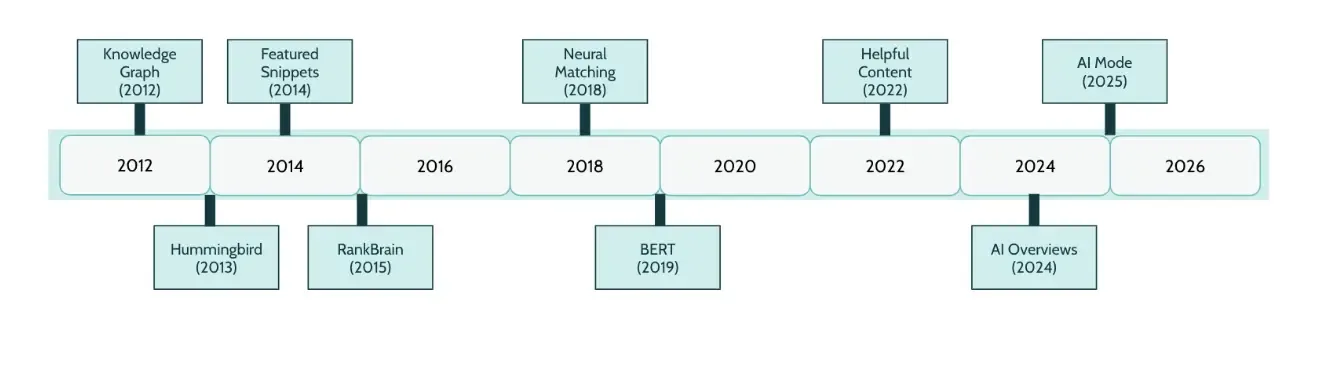
Google Knowledge Graph (2012)
Google’s Knowledge Graph is a database of entities and their relationships, largely sourced from Wikipedia and other reputable information shared across the web. This was the first major shift away from keyword-based SEO and toward establishing entities. Since its inception, it has amassed over 500 billion facts about five billion entities. The Knowledge Graph provided the framework for the semantic web, serving as the factual "dictionary" that modern Gen-AI systems use to verify relationships and ground their responses in reality.
Google Hummingbird Algorithm Update (2013)
The Hummingbird Update overhauled Google’s search algorithm by using Natural Language Processing (NLP) and Semantic Search systems to help recognize synonyms and intent. This was a major shift towards understanding the meaning and context of entire phrases, rather than individual keywords.
Featured Snippets (2014)
Google introduced Featured Snippets in search results, ushering in the era of “zero-click” searches, highlighting the importance of schema markup to help contextualize on-page content for search engines.
RankBrain (2015)
The first reported use of AI in Google’s search algorithm, RankBrain uses machine learning to more broadly understand and predict how words relate to different concepts, pivoting content strategy further from exact-match keywords towards holistic concepts.
Neural Matching (2018)
Building on the existing foundation, Google introduced a neural matching system, helping to connect more vague language and fuzzier concepts, further making topical authority more important than specific phrasing.
BERT (2019)
A major step in Google’s understanding of natural language, context, and nuance, BERT is a deep learning model that processes words in relation to all other words in a sentence. Instead of matching individual keywords, BERT comprehends how entire sequences of words express complex ideas, ensuring that even the smallest prepositions are used to accurately interpret user intent.
Helpful Content Update (2022)
The Helpful Content algorithm update promotes content that demonstrates real-world experience and expertise over content written for search engines using E-E-A-T signals to determine authority. This ties the authority of a piece of content to the credibility of the source, meaning the person or brand (or entity) behind the content.
AI Overviews (2024) & AI Mode (2025)
Today, we are in an era where Generative AI is integrated in search to provide conversational answers and maintain a persistent memory of a user’s multi-step search journey. Success now relies on an entity being so well-defined that it is considered a core “source of truth” in the AI’s training data.
Understanding Context Through Vectors
Google's framework for understanding context relies on vectors, or strings of numbers that mathematically represent the meaning of a word or phrase, to map how concepts relate to each other. Alongside algorithm and SERP updates, Google has spent over a decade making a concerted effort to refine the vector-matching process.
This evolution has progressed from the debut of Word2Vec (2013) and RankBrain (2015), which first introduced vector-based intent, to more recent milestones like ScaNN (2020) for speed and Multimodal Embeddings (2022) to bridge the meaning between text and video. Most recently, the development of TurboQuant (2026) acts as a powerful compressor for these "meaning maps," allowing for more efficient retrieval and marking a clear commitment to scaling search around user intent rather than just keywords.
How Is Entity Optimization Different From Traditional SEO?
Approaching SEO from strictly a keyword-matching perspective hasn’t been a viable strategy for some time, but as more and more search journeys happen across multiple platforms, including AI and LLMs, it’s more important than ever to make sure your brand is visible, consistent, and considered authoritative as an entity.
Traditional SEO focuses on ranking a web page for a specific set of keywords and demonstrating authority by earning high-quality backlinks from reputable sources. These pieces still matter, but they are only a small part of a modern strategy.
Entity optimization focuses on overall topical authority across connected concepts and looks for how well-connected an entity is, with signals from consistent citations, brand sentiment across the web, and how often a brand is mentioned alongside industry-leading concepts.
In the current search space, ranking #1 for a high-volume keyword is great, but it provides little long-term value if the brand lacks the established connectivity to be recognized within the broader digital ecosystem. To be successful in search, the strategy must move beyond owning a ranking to owning topical authority by proving your brand is the most relevant entity.
A Guide To Entity Mapping
To optimize for entities, it’s important to map what other topics, concepts, and entities are related to your own. Start by identifying the core entity and the essential attributes you associate with your entity.
Pro Tip: You can find connected attributes by looking in places like Google’s Knowledge Panel, Google Image tabs, “People Also Ask”, and “People Also Search For” sections of the search results to understand what Google already associates with your entity. You can also cross-reference Wikipedia’s sidebar categories, or even ask ChatGPT or another LLM what topics are related to your entity.
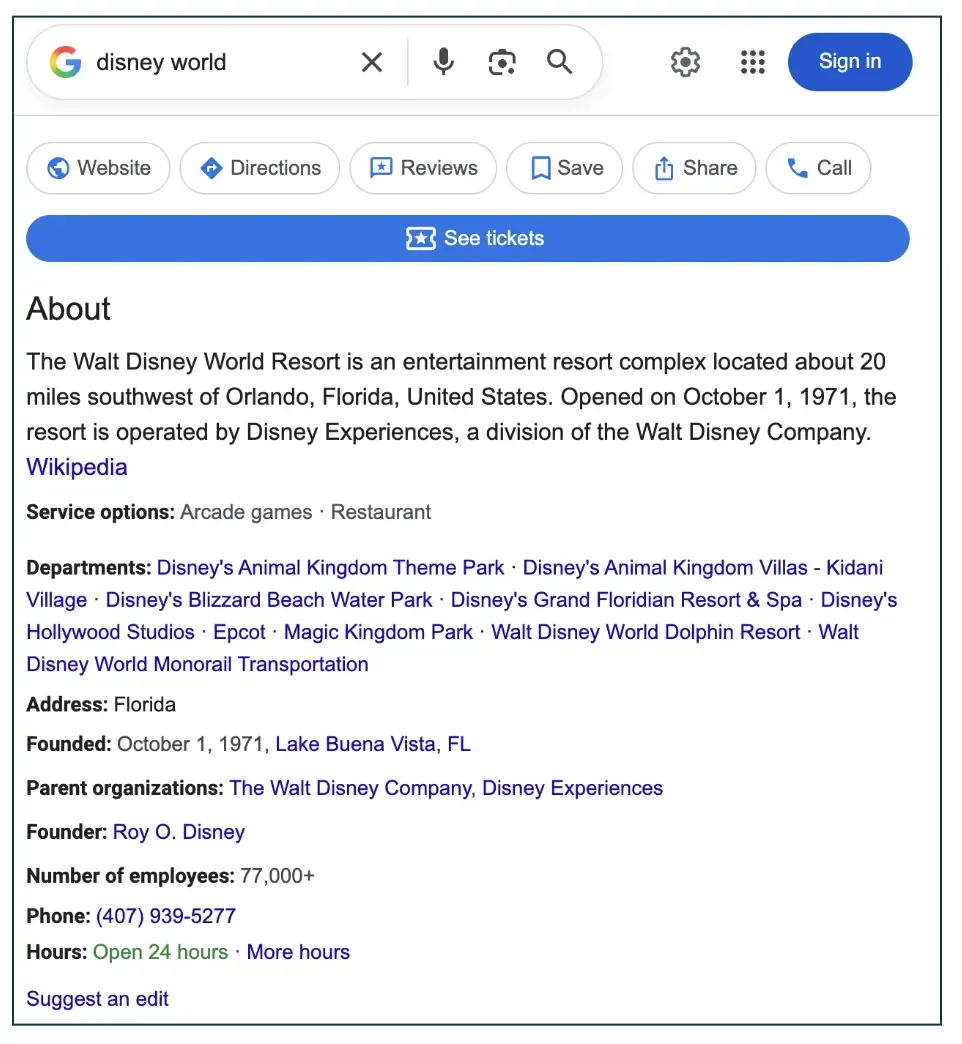
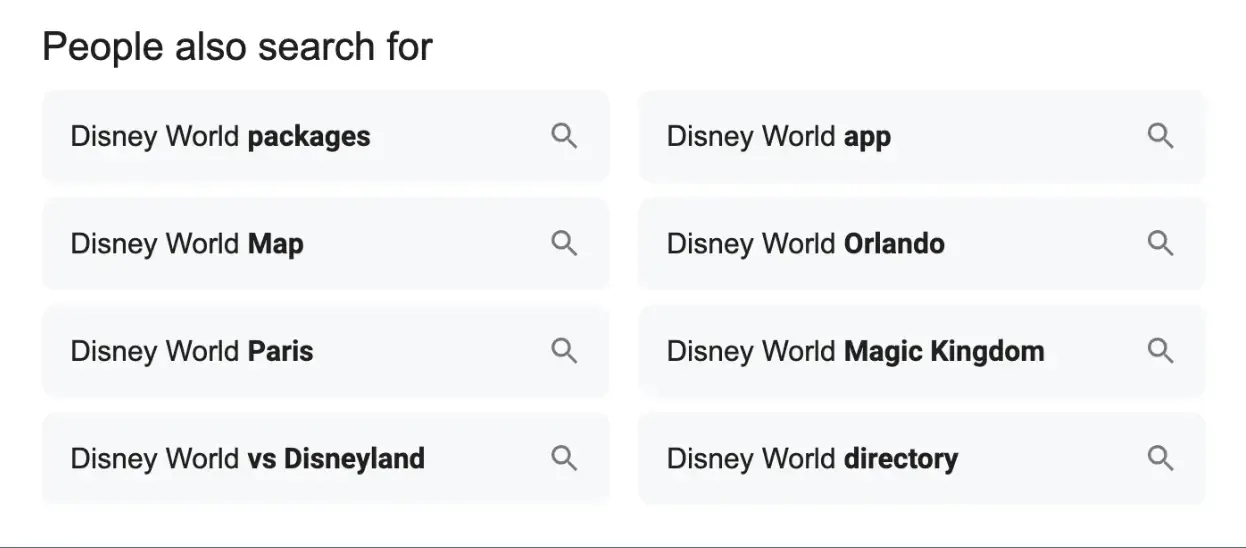
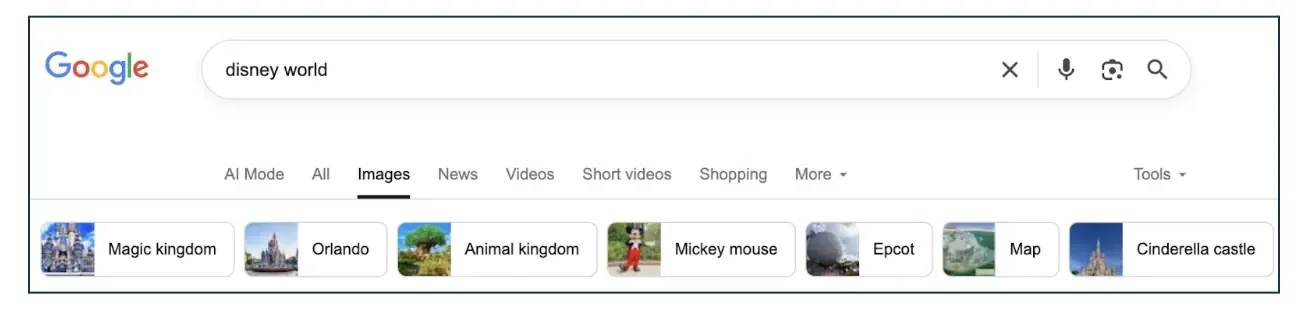
Once you have an idea of the related topics, you can start drawing connections between them. By visualizing these relationships, you can craft a strategy that establishes your brand as a comprehensive authority in your niche.
How To Optimize For An Entity
Once you’ve mapped out your entity and the related topics, you can build your strategy around establishing a strong, authoritative digital ecosystem. Beyond traditional SEO keyword optimization, you want to focus on how your brand is recognized, categorized, and woven into the overall topical fabric of the web.
Entity-Driven Content Strategy
A content strategy built on an entity map ensures that every piece of content reinforces topical depth.
Create Content Hubs: Build clusters of information related to the entity map to prove thorough expertise through an interconnected web of subtopics.
Close Entity Gaps: Identify "missing nodes" that competitors are associated with and create content to bridge those gaps.
Highlight Authorship & Bylines: Authors are entities too. Establishing clear bylines linked to dedicated author pages reinforces E-E-A-T by verifying the "who" behind the information.
Strategic Schema & Structured Data
Schema provides search engines with a clear, machine-readable road map of an entity’s identity and its factual relationships to other established nodes. Some important schemas in establishing your entity include:
Organization or LocalBusiness: Provide a single, authoritative source for legal names, addresses, and core services.
SameAs & MemberOf: Link the website to other recognized nodes, such as Wikipedia, social profiles, or professional associations.
Person: Connect author entities to their professional achievements, awards, and other recognized digital profiles.
Intentional Internal Link Structure
Internal links are semantic relationship markers that define the hierarchy and connectivity between different concepts.
Link Between Related Entities: Connect related topics within your content to show how the pieces relate to each other.
Use Contextual Anchors: Use anchors with descriptive text that helps search engines understand the nature of the relationship between two pages.
Monitor Brand Information & Perception
Monitor and maintain your brand’s factual standing and perception across the web to ensure accurate information and a persistent, positive presence.
Manage Your Knowledge Graph and Wikipedia: Search your brand regularly and assess the information in the Knowledge Panel. You can use the "Claim this knowledge panel" feature to suggest factual updates and monitor how Google represents the entity. Monitor entries on high-authority databases like Wikipedia and other areas that feed the Knowledge Graph
- Understand Brand Sentiment & Citations: Identify sources of brand mentions across the web and evaluate that the brand is consistently associated with the correct topics and that your audience has a positive sentiment.
The Entity Era & Owning the Digital Ecosystem
Entity-based SEO is not a replacement for traditional best SEO practices, but rather an evolution of what has been the industry standard for well over a decade.
In the age of AI search, the brands that thrive will be those that move beyond simple keyword rankings to become recognized authorities within their digital ecosystem. By focusing on topical depth, E-E-A-T and credibility signals, and structured data, your entity will excel in the modern search landscape.
Ready to take the next step? Get in touch, and let’s build your entity SEO strategy together.
Still exploring? Subscribe to our Shop Talk newsletter for practical insights on SEO, entities, the future of search, and more!