Artificial intelligence has already changed digital marketing. We use it for bidding strategies, content generation, forecasting, and reporting. But a new term is emerging everywhere: agentic AI.
So what is it really?
Agentic AI refers to AI systems that can pursue goals, make decisions, and take multi-step actions with limited human direction. Instead of simply completing a task, it works toward an outcome.
That sounds powerful. It is.
But here is the important part: powerful does not mean independent of people.
Agentic AI is not about replacing marketers. It is about removing friction, accelerating insight, and freeing humans to focus on strategy, creativity, and judgment. The companies that win will not be the ones who hand over the keys. They will be the ones who design smarter systems and guide them well.
Let’s break it down.
What is Agentic AI?
Agentic AI is artificial intelligence designed to pursue goals rather than just execute individual tasks. Traditional AI systems respond to instructions: Write this ad, adjust this bid, or generate this report. They complete the task and stop there.
Agentic AI works differently. It evaluates a defined objective, determines what actions support that objective, and can take multiple steps to move toward it.
In practice, that means it can:
Monitor performance data
Identify patterns or inefficiencies
Decide on a response within set boundaries
Execute, measure results, and adjust
The shift is subtle but important. Task-driven AI waits for direction, and agentic AI works toward outcomes.
Here is a simple marketing example:
If you ask a standard AI tool to write five paid search headlines, it writes them. Done.
If you give an agentic AI system a goal like “improve return on ad spend,” it could analyze campaign data, identify underperforming segments, adjust budget allocation within approved limits, test creative variations, and monitor performance over time.
That does not mean agentic AI operates freely.
Humans define the goals.
Humans set the guardrails.
Humans determine what success looks like.
Agentic AI increases speed and scale. It does not replace strategic thinking, brand judgment, or creative direction. And in digital marketing, those human elements still matter most.
Agentic AI vs. AI Agents
The terms AI agents and agentic AI are closely related, which can cause quite some confusion.
An AI agent is typically a system designed to perform a specific task on behalf of the user. It operates within a defined workflow: you give it instructions, and it executes them.
Agentic AI describes a broader capability. It refers to AI systems that can pursue goals, make decisions, and take multi-step actions with limited supervision.
Think of it this way:
An AI agent completes assignments.
Agentic AI manages progress toward an objective.
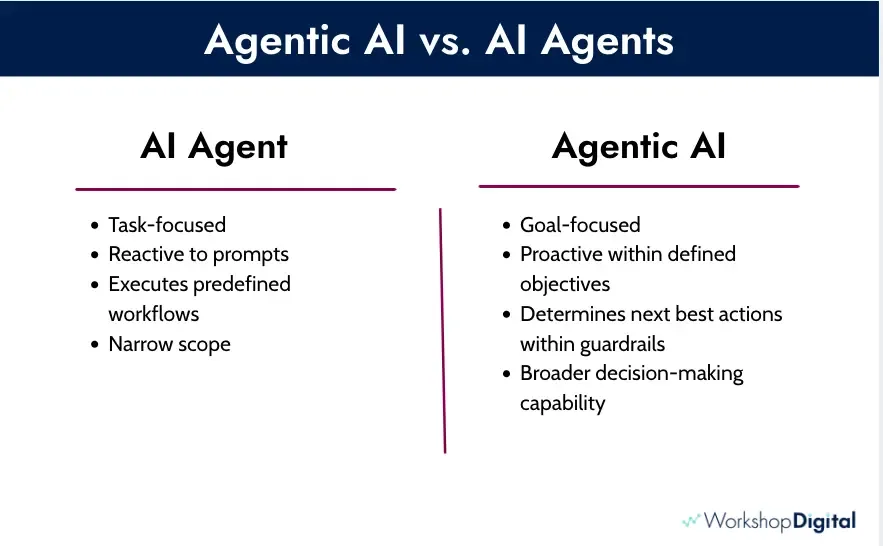
In marketing, that means that an AI agent might generate ad variations when prompted. An agentic system might monitor performance trends, recognize creative fatigue, launch new variations within approved parameters, and reallocate budget to higher-performing segments.
Both still require oversight; neither replaces marketing leadership. Agentic AI is less about handing over control and more about expanding what your team can manage at scale. In digital marketing, the objective is not just to automate tasks but to improve outcomes. AI agents help with execution. Agentic AI helps move the needle faster, with humans still steering the strategy.
Agentic AI vs. Marketing Automation
At first glance, agentic AI can sound like a more advanced version of marketing automation. The two are related, but they are not the same.
Marketing automation is rule-based. It follows logic that humans define ahead of time. For example, if a user downloads a guide, an email sequence is triggered. If the cost per acquisition rises above a set threshold, a campaign is paused. If a lead reaches a certain score, sales is notified.
These systems are incredibly useful. They improve efficiency and consistency. But they operate within fixed instructions.
Agentic AI introduces a different layer. Instead of simply executing predefined rules, it evaluates context, weighs multiple variables, and determines what action best supports a broader objective. As new data becomes available, it adjusts its approach.
In other words, automation executes playbooks. Agentic AI can adapt the playbook within defined boundaries.
Here is a practical example:
A marketing automation platform such as Account Engagement (Pardot) might trigger a nurture sequence based on user behavior. An agentic system could analyze engagement patterns across segments, identify which messaging themes are underperforming, test variations within approved guidelines, and shift investment toward audiences with stronger conversion signals, all in support of a larger performance goal.
It’s important to note that none of this removes the marketer from the equation.
A human still needs to define the objective. A human needs to determine acceptable tradeoffs between efficiency and brand perception. A human needs to interpret the broader market context that data alone cannot capture. Agentic AI strengthens operational intelligence. Marketers provide strategic direction.
Why Agentic AI Matters for Digital Marketing
Digital marketing is not simple anymore. Teams are managing paid media, organic search, content, analytics, attribution models, CRO testing, and lifecycle campaigns all at once. Each channel produces data. Each platform demands optimization. The challenge is rarely a lack of information. It is managing complexity fast enough to act on it. This is where agentic AI becomes meaningful.
Because it is goal-oriented, agentic AI can continuously evaluate performance signals and recommend or execute adjustments within defined limits. It can surface patterns that would take a human hours to identify. It can test, learn, and refine at a speed that matches the pace of modern campaigns.
That does not mean it replaces channel experts... it simply changes how they spend their time.
Instead of manually pulling reports, they focus on interpreting trends. Instead of reacting to performance shifts after the fact, they guide systems that are already optimizing in real time.
Here is what that can look like across disciplines:
Paid Media:
Paid media is already heavily automated, but most systems still require manual oversight and reactive adjustments.
An agentic approach could monitor performance across campaigns, audiences, and creative variations, then adjust bids or shift budget allocation within guardrails that your team defines. It might detect early signs of creative fatigue and initiate new tests before performance drops.
The strategist still defines target markets, messaging themes, profitability thresholds, and overall growth priorities. The AI supports execution and optimization. It does not replace the thinking behind it.
SEO:
Search performance shifts constantly due to algorithm updates (just had a major one in December 2025!), competitor movement, and changing user intent.
An agentic system could track ranking volatility, identify emerging keyword opportunities, flag technical issues, and prioritize actions based on potential impact. Instead of manually auditing data across multiple tools, your SEO team would receive prioritized, context-aware recommendations.
Editorial direction, brand voice, and long-term content positioning still require human judgment. The AI strengthens visibility and responsiveness, but it does not decide what your brand should say.
CRO and Personalization:
Conversion rate optimization depends on experimentation and pattern recognition.
Agentic AI can analyze behavioral signals in real time, detect friction points, and launch A/B tests within predefined constraints. It can also adjust personalization logic based on engagement trends.
What it cannot do is define your customer experience philosophy or determine how far you are willing to push urgency, messaging tone, or psychological triggers. Those decisions sit with marketers.
Analytics and Attribution:
Analytics is where many marketing teams feel overwhelmed. Dashboards multiply. Reports stack up. Attribution models conflict. Insights get buried in spreadsheets.
Agentic AI can help by continuously monitoring performance data across channels, identifying anomalies, and surfacing insights that require attention. Instead of waiting for a weekly report, teams could be alerted to meaningful shifts in conversion rates, rising acquisition costs, or unexpected traffic changes as they happen.
More advanced systems could also compare attribution models, evaluate contribution across touchpoints, and highlight where budget may be under- or over-credited. That kind of analysis is time-consuming for humans but well-suited to AI systems that can process large datasets quickly. What remains human is interpretation.
An analytics platform might flag that branded search conversions increased after a paid social campaign launch. A marketer still needs to determine whether that reflects incremental lift, brand momentum, or seasonal demand. Data reveals the patterns, but people assign the meaning.
Lifecycle and Retention:
In lifecycle marketing, timing and segmentation are everything.
An agentic system could identify churn signals earlier, adjust messaging cadence based on engagement behavior, and prioritize high-value segments automatically. That creates more responsive campaigns without requiring constant manual review.
Still, someone must define brand positioning, customer value propositions, and long-term retention strategy.
Across all of these channels, the pattern is consistent. Agentic AI increases speed and analytical depth. Marketers define direction, context, and boundaries.
When those roles are clearly defined, the technology enhances performance without compromising control.
Across all of these channels, the pattern is consistent. Agentic AI increases speed and analytical depth. Marketers define direction, context, and boundaries. When those roles are clearly defined, the technology enhances performance without compromising control.
What Agentic AI Looks Like in Practice
It is one thing to define agentic AI, but it’s another to picture how it can actually show up in a marketing team's day-to-day work.
Below are five scenarios where agentic AI can support performance without taking over strategy.
Proactive Budget Optimization in Paid Media
Instead of waiting for a weekly performance review, an agentic system continuously monitors cost per acquisition, conversion rates, and audience performance within each platform. When a segment begins to outperform others within predefined profitability thresholds, the system can adjust bids or reallocate budget within that channel.
At a broader level, it can also surface cross-channel performance trends and recommend budget shifts between platforms based on contribution and efficiency.
Execution still depends on the systems in place. Strategy and final approval remain human decisions.
Continuous SEO Opportunity Mapping
A content team publishes regularly, but keeping up with ranking changes, competitor movements, and emerging search trends is a full-time job.
An agentic system could track keyword volatility, identify pages that are close to page one, and recommend targeted optimizations based on performance signals. It might flag declining content that needs refreshing or surface new keyword clusters aligned with existing authority.
The SEO strategist still determines which opportunities align with business priorities and brand positioning. The AI reduces the time spent digging through data and increases the time spent making strategic calls.
Adaptive Landing Page Optimization
Your CRO team is running experiments, but bandwidth limits how many tests can be launched at once.
An agentic AI system could monitor engagement metrics, detect drop-off points in real time, and initiate pre-approved variations for headlines, calls to action, or layout elements. It tracks performance, pauses underperforming variants, and scales winners within defined parameters.
The CRO strategist still decides what hypotheses to explore and what experience best reflects the brand. The AI simply accelerates the testing cycle.
Early Churn Detection in Lifecycle Marketing
Retention often suffers because churn signals are spotted too late.
An agentic system could monitor behavioral patterns such as declining logins, reduced purchase frequency, or lower email engagement. When risk thresholds are reached, it triggers customized outreach sequences designed to re-engage the customer.
Lifecycle marketers define messaging, tone, and offer strategy. The AI identifies who needs attention and when.
Cross-Channel Performance Insights in Analytics
Marketers often struggle to connect activity across channels.
An agentic system could continuously analyze cross-channel performance, detect unusual spikes or drops, and surface correlations that might otherwise go unnoticed. For example, it may identify that a paid social push is influencing branded search growth or that organic traffic is driving assisted conversions in paid campaigns.
The system highlights the signal. The marketing team determines how to respond and whether to adjust strategy.
Across these scenarios, the pattern is consistent. Agentic AI handles monitoring, pattern recognition, and incremental execution. Marketers define goals, protect the brand, and make strategic tradeoffs.
It is less about handing over responsibility and more about upgrading your operating system.
I’m working on an agentic workflow to make handoffs between business development and client services faster and more thorough. It pulls in what we’ve learned during early conversations, synthesizes the key details, and builds a structured agenda for the first client services call. It saves time, improves alignment, and reduces the risk of missing something important. And this is just one example. The opportunities for agentic workflows are almost limitless!
Morgan Jarvis, Paid Media Director
The Opportunity with Agentic AI
It is easy to frame agentic AI as either a revolution or a threat… in reality, it’s neither.
Agentic AI does not automatically unify every marketing channel. It doesn’t magically connect disconnected tech stacks. And it doesn’t remove the need for experienced marketers to make judgment calls. What it does offer is a shift in how teams operate in their day-to-day.
When integrated thoughtfully into existing systems, agentic capabilities can handle monitoring, surface signals faster, and execute defined optimizations within guardrails. This will lead to scale increases and implementation improvements.
However, the architecture is still going to matter. True cross-channel orchestration requires integrated platforms, clean data pipelines, and clear governance. Without those foundations, even the most advanced AI system will be limited by the environment it operates in.
That is why the conversation should not be about replacement. It should be about design.
How are goals defined?
Where are the boundaries?
Who approves tradeoffs?
How is performance evaluated across channels?
The organizations that benefit most from agentic AI will be the ones that treat it as an operating layer, not a decision-maker. Marketing has always been part art and part science. Agentic AI strengthens science. It does not replace art.
The future of marketing is not fully autonomous; it is intelligently augmented.
If you’re ready to explore how agentic AI can increase efficiency while keeping strategy firmly in human hands, get in touch. We can help with integrating stronger workflows into your marketing strategy.