
Preparing Your Site for AI Agents and the Agentic Web
Traditionally, SEO has focused on optimizing web pages for human searchers. However, as AI advances, web optimization needs to adapt for autonomous agents. One emerging protocol, LLMs.txt, helps LLMs understand a website’s content more clearly and efficiently.
Key takeaways:
An LLMs.txt file is a simple, plain-text file that acts as a clean, intentional roadmap of a website’s content for AI search tools and large language models (LLMs).
Google explicitly notes that LLMs.txt is not required to appear in AI search and does not need to be prioritized. Studies show that current AI bots rarely check these files.
Deploying an LLMs.txt file serves as a foundational step for the shift toward agentic browsing, helping prepare your site for a future where autonomous AI agents may rely on structured website guidance.
While the protocol is a low priority today, it represents a low-lift, high-potential task that prepares your digital assets for an AI-driven web ecosystem.
What is LLMs.txt?
An llms.txt file is an emerging plain-text protocol designed to guide AI tools, or Large Language Models (LLMs), through a website. Hosted at yourdomain.com/llms.txt, it uses simplified markdown to point AI bots directly to a site's most important content and resources.
Similar to a robots.txt file, the llms.txt file lives in the root directory of a website. While a robots.txt file specifies which content search engine crawlers are allowed to access, the llms.txt file serves as a high-signal roadmap that may help AI systems identify and interpret important content. Instead of relying on AI bots to piece together data by scraping the entire website, the file delivers a highly structured, explicit summary of your business, products, and services.
Google’s AI Optimization Guide claims that llms.txt files are not necessary to appear in AI results, and recommends focusing on standard SEO best practices like building a clear technical structure and creating unique, valuable content. There’s no evidence to suggest that llms.txt improves performance in AI search, and some studies have even shown that AI crawlers are not even accessing these files at this point.
Defining the Agentic Web and Agentic Browsing
To understand llms.txt, it’s important to understand agentic AI. The terms "agentic web" and "agentic browsing" describe an ecosystem where AI “agents” perform autonomous operations online. Instead of a human clicking through links, an AI agent can independently research vendor choices, cross-reference pricing tables, or complete multi-step tasks like booking a rental or scheduling an appointment across different websites.
Real-World Examples of Agentic Browsing
B2B Vendor Selection: An AI agent scans technical documents and pricing pages across multiple platforms to find software that integrates with HubSpot and meets specific legal standards, delivering a clean comparison chart to the user.
Autonomous Booking: An agent finds and evaluates local venue calendars based on a user's schedule, confirms the price matches the budget, and fills out the reservation form automatically.
Automated Data Synthesis: An agent reviews a company's recent product updates and user guides to write a concise onboarding brief for a new client.
Regulatory Monitoring: An agent monitors state websites for policy changes, flags updates, and downloads the correct compliance forms without human intervention.
When an AI agent searches the web, it reads a page, decides what information is useful, and selects the next link to click. Because processing data costs money and computing power, agents operate on strict text limits, or “tokens”. If a website is cluttered with heavy code or complex layouts, the agent may run out of resources, misinterpret data, or leave the site entirely.
What Is The Benefit of Implementing an LLMs.txt File?
Although LLMs.txt files are rarely used by AI agents today, creating and uploading this file can be a relatively simple, low-lift foundational task to prepare as the landscape continues to shift towards autonomous agentic browsing.
Development trends also indicate a shift in engineering priorities. For example, Google's Lighthouse has introduced a check for the presence of an llms.txt file in experimental audits to evaluate a site's accessibility for AI crawlers and agentic capabilities, signaling that search engine infrastructure is preparing to evaluate websites based on how effectively they interface with AI agents.
The primary theoretical benefit of an LLMs.txt file is efficiency. If future AI agents choose to consume these files, they could locate key information without processing every page on a website, potentially reducing cost, latency, and context-window constraints. Providing a structured text file also reduces the likelihood that an autonomous agent will misinterpret or hallucinate when creating an output.
How to Create an LLMs.txt File
The llms.txt file is hosted in the root directory of a website at yourdomain.com/llms.txt and uses specific Markdown syntax rather than JSON or XML. This allows the file to be parsed by classical programming tools, such as regex, while remaining readable by language models.
Per the official specification at llmstxt.org, the file must follow a specific structural order:
(Required) H1 Header: The name of the project or website.
(Optional) Blockquote Summary: A brief description providing the essential context an AI needs to understand the rest of the file.
(Optional) Detail Paragraphs: Optional markdown elements (such as paragraphs or lists, excluding headings) that offer deeper project context or instructions on how to interpret the files.
- H2 Headers and File Lists: Optional sections divided by H2 headers that group lists of relevant URLs. Each bullet point must include a markdown hyperlink formatted as [Link Title](URL), followed optionally by a colon and descriptive notes about the file.
The Optional Section: A specific H2 header titled ## Optional. Any URLs listed under this heading inform the AI agent that these files can be skipped if the agent is operating under a strict token budget or a narrow context window.
If we wanted to include this blog post in an llms.txt file for Workshop Digital, our llms.txt might look like this:
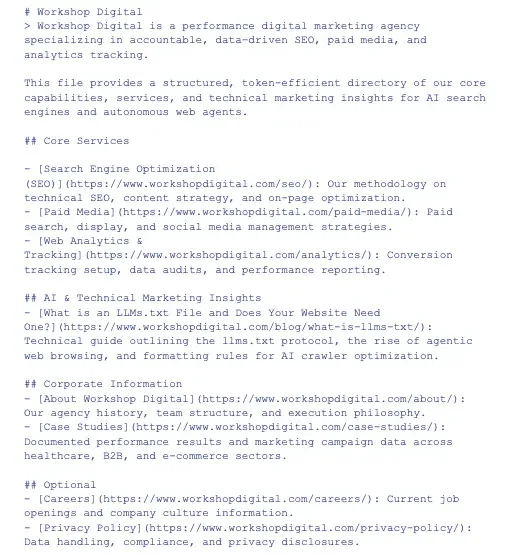
An llms.txt file should not be a copy of your sitemap.xml file. Sitemaps are designed for broad search engine discoverability and contain every indexable URL. An llms.txt file focuses on curated comprehension of your most important content for agentic browsers.
When auditing a website to select pages for inclusion, prioritize high-signal URLs:
Core business offerings, product specifications, and pricing matrices.
Technical documentation, APIs, and implementation guides.
Detailed case studies, service level agreements, and operational policies.
Preparing Your Digital Presence for AI Search
While an llms.txt file will not increase your presence in AI search outputs, it represents a strategic investment in the future of web discovery. By formatting your site’s most critical documentation into a token-efficient roadmap, you ensure that tomorrow’s AI agents can easily find, understand, and recommend your business.
Preparing for AI search goes beyond just implementing an LLMs.txt file. From technical SEO and content strategy to site architecture and analytics, a strong digital presence will help your brand stay discoverable in search. Reach out to our team if you’re looking to increase your brand's visibility in search! If you’re not ready to get started today, stay up to date with our bi-weekly newsletter.