
The search landscape is undergoing its most significant shift since the invention of the keyword.
As of early 2026, AI in advertising has moved from theory to reality. AI-driven answer engines and large language models (LLMs) are no longer just neat parlor tricks; they’ve become the primary discovery tools for millions of users. Instead of clicking through lists of links, users are increasingly relying on AI-generated answers and recommendations to guide their decisions.
This shift is fundamentally changing how digital advertising works. New ad formats are emerging directly inside AI-powered experiences, blurring the lines between organic visibility, paid media, and brand authority. For advertisers, this moment presents a clear divide: brands that move early can gain advantages, while those that wait risk losing visibility in environments where traditional keyword strategies no longer apply.
Here’s how we are approaching testing across paid media, SEO, and Generative Engine Optimization (GEO). Our team is actively monitoring new formats and beta opportunities and is eager to raise our hand to test where early participation can create competitive advantages.
The Current State of LLM and AI in Advertising
We have officially entered the early testing and limited availability phase of advertising within LLM and AI-powered platforms. The wait-and-see period is officially over. Major technology companies have established clear entry points for brands, even as the mechanics and measurement of these formats continue to evolve.
Today, AI advertising is not a single channel or platform. It is an emerging layer that sits across search, shopping, and conversational discovery. Some formats are already broadly available, while others remain restricted to closed beta programs. The common denominator is a movement towards more context-driven, intent-based advertising experiences.
Ads in Google AI Overviews (AIO) and AI Mode
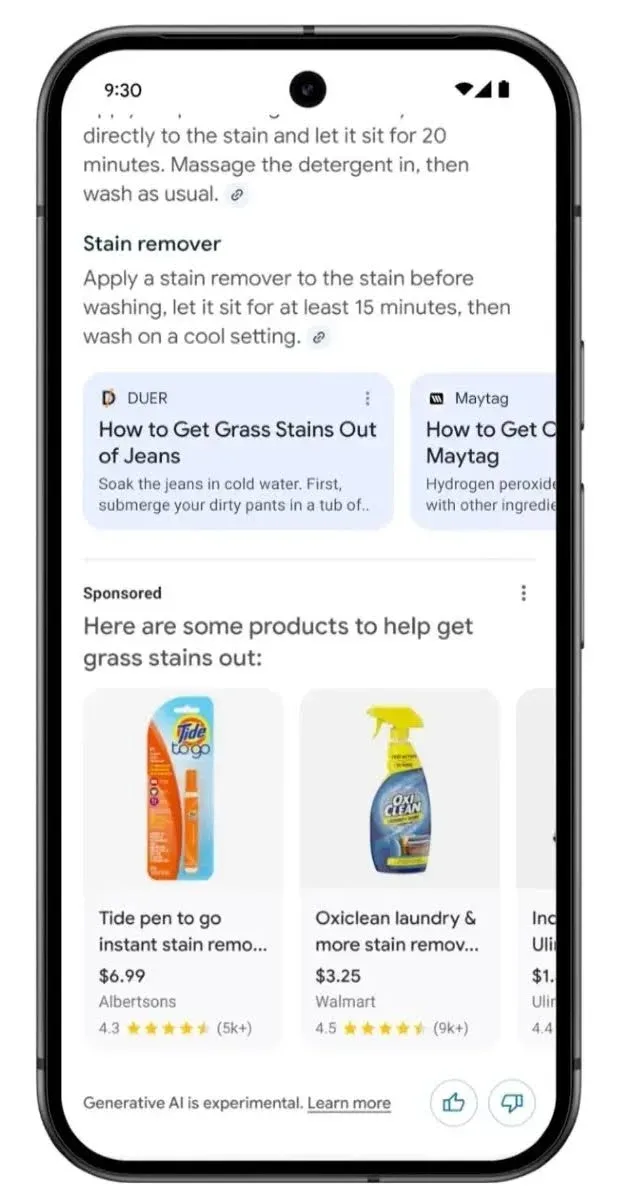
Google has integrated text and shopping ads directly into AI-generated overviews at the top of the search results page, as well as within the more in-depth experience of AI Mode. These ads are triggered by a combination of existing Search campaigns using broad match, Performance Max, AI Max, and Shopping campaigns.
At this time, advertisers cannot specifically target AI Overviews or AI Mode placements. Instead, eligibility is determined by Google’s broader push toward more flexible, automated campaign types that rely on signals beyond keywords. These campaigns are designed to reach users across a wider range of devices and surfaces, including AI-powered search experiences.
From an advertiser's perspective, this reinforces an important shift. Success in AI Overviews and AI Mode is less about exact keyword control and more about audience inputs, high-quality feeds, and clear signals that allow Google’s systems to match ads to user intent within AI-generated contexts.
Actions advertisers can take now:
Loosen overly restricted campaign structures: AI Overviews and AI Mode favor broader, more automated campaigns. Advertisers should reassess tightly constrained keyword strategies and test across Search, Performance Max, AI Max, and Shopping campaign types.
Improve feed quality and core signals: Strong product feeds, accurate pricing, clean titles, and reliable conversion signals increase eligibility and relevance within AI-generated search experiences.
Coordinate paid media with SEO and GEO: Paid visibility in AI Overviews works best when paired with strong organic authority. Align paid media, SEO, and Generative Engine Optimization to increase the chance of appearing as both a sponsored result and a cited source.
Shift measurement expectations: AI-driven interactions often happen early in the funnel. Focus on incrementality, assisted conversions, and downstream impact rather than strict keyword-level or last-click performance.
ChatGPT Ads and Sponsored Suggestions
OpenAI announced its first native advertising format for ChatGPT in January 2026 and officially began rolling Sponsored Suggestions into the live experience on February 9, 2026.
At this stage, ChatGPT ads are only available through a tightly controlled, invite-only closed beta. The test is limited to logged-in adult users in the United States on the Free and Go tiers. Users on Plus, Pro, Business, and Enterprise plans do not see ads.
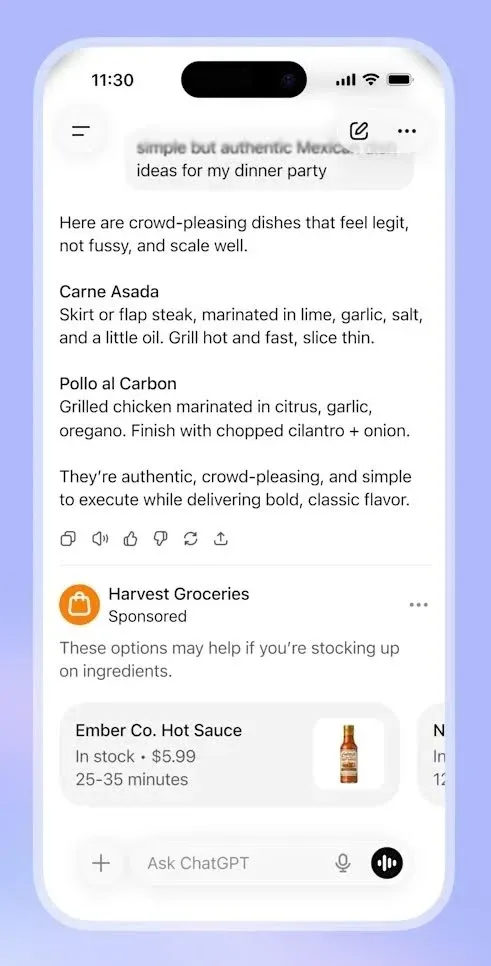
Sponsored Suggestions appear at the bottom of the chat interface as contextually relevant next steps, clearly separated from the AI-generated response. Ads are matched to conversational intent rather than keywords and are designed not to influence or alter the AI’s answers.
Access to the beta is intentionally constrained. OpenAI is prioritizing larger advertisers and reportedly requires substantial upfront commitments, with early estimates ranging from $200,000 to $250,000. Pricing is currently CPM-based, with reported rates around $60 CPM, significantly higher than most traditional paid social environments. There is no self-serve buying platform available at this time.
From a data and privacy perspective, OpenAI has drawn a firm line. Advertisers do not receive access to user memories, chat history, or personally identifiable information. Reporting is limited to high-level performance signals such as impressions, clicks, and views. While this approach protects user trust, it also means advertisers must rethink how success is measured in a conversational, high-intent environment.
Actions advertisers can take now:
Determine if ChatGPT ads are even a fit: This beta is designed for a small set of advertisers with high-value products or services and clear top-of-funnel objectives. Brands should evaluate whether they can justify premium CPMs, limited reporting, and large upfront commitments before pursuing access. While the program is currently invite-only, I expect access to expand once early testing concludes.
Focus on foundational work while access remains limited: Even without direct access, brands can prepare by strengthening SEO, Generative Engine Optimization, shopping feed organization, and top-of-funnel messaging. These efforts improve visibility and relevance in AI-driven experiences and position advertisers to move quickly if beta access becomes available.
Google Gemini Ads
Google Gemini currently does not support advertising, and Google has publicly confirmed that there are no plans to introduce ads within the Gemini chatbot experience. Instead, Google is monetizing Gemini through paid subscriptions, including Google One AI Premium.
From an advertiser's perspective, this distinction matters. While Gemini represents a growing share of conversational AI usage, Google’s ad monetization strategy for AI remains concentrated within Search, specifically through AI Overviews and AI Mode.
For now, Gemini should be viewed as an organic and brand exposure surface rather than a paid media channel. Visibility within Gemini is driven by content authority, technical SEO, and Generative Engine Optimization, not ad spend.
AI Ads Feature Comparison Chart
While AI-driven discovery is expanding quickly, advertising support varies significantly by platform. Some environments already offer scaled ad inventory, while others remain closed, paused, or intentionally ad-free. The table below reflects the current state of AI and LLM advertising as of early 2026.
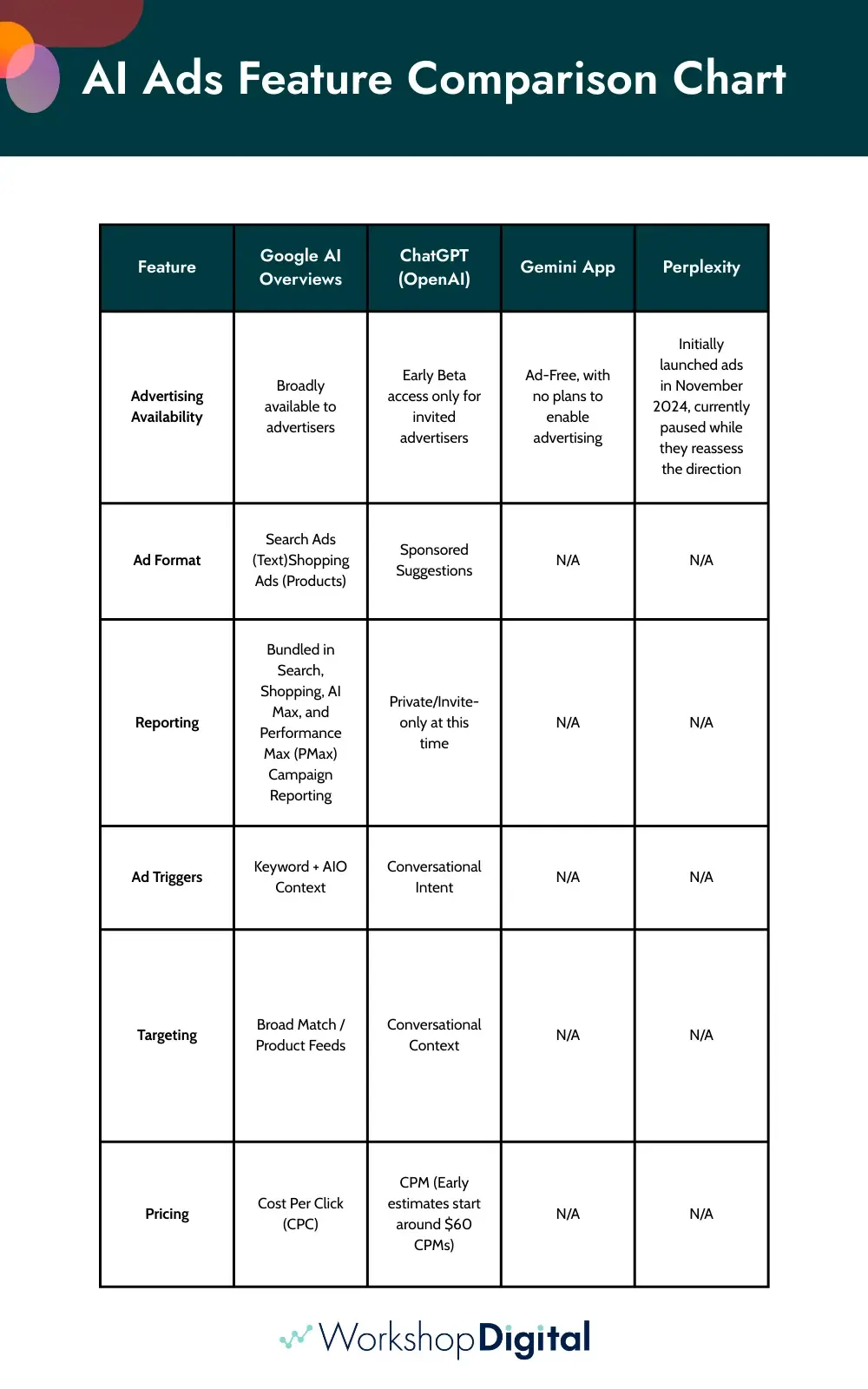
Today, the most scalable and measurable AI advertising opportunities still live inside Google’s search ecosystem. Conversational ad formats like ChatGPT Sponsored Suggestions are emerging, but access, cost, and measurement constraints mean they remain a selective, early-stage opportunity rather than a core channel.
Identifying Opportunities & Measuring Performance
LLM and AI-driven advertising will require a shift in how we measure performance. As ads move into AI-generated search results and conversational experiences, traditional keyword-level attribution becomes less reliable. These environments often influence decisions earlier in the funnel, well before a user is ready to convert.
Our approach focuses on understanding incrementality, leading indicator metrics, and overall business impact rather than isolating performance to individual keywords or placements. To do this, we rely on a three-tiered measurement framework.
Ad platform optimization
Where supported, we structure campaigns to align with AI-driven environments, including AI-forward configurations within Google Ads and, over time, OpenAI’s advertising platform. The goal is to ensure campaigns are eligible to appear in AI-generated experiences while maintaining clear optimization signals tied to business outcomes.
AI visibility and monitoring
We track how and where brands appear within AI-generated responses, including mentions, recommendations, and citations. This helps us understand visibility beyond paid placements and evaluate how paid media, SEO, and Generative Engine Optimization work together within AI-driven discovery.
Attribution and downstream impact
Because AI tools often act as research assistants rather than direct conversion channels, we focus on downstream performance. Using analytics platforms (such as GA4) and AI referral segmentation, we evaluate how exposure within AI-driven experiences contributes to assisted conversions, return visits, and eventual revenue rather than relying solely on last-click attribution.
Taken together, this framework allows us to identify where AI-driven advertising is creating real value today, while building the foundation for more advanced measurement as platforms mature and reporting capabilities expand.
What Comes Next with AI Advertising
AI and LLM-driven advertising are still early, but the direction is clear. Discovery increasingly happens in AI-generated experiences, and advertising is following quickly behind. While access, formats, and measurement will continue to develop, the opportunity for early-mover brands is already taking shape.
Our focus is on monitoring platform updates closely, raising our hands for beta opportunities, and evaluating where testing can drive stronger insight. When new ad formats or capabilities reach a point where testing makes sense, we will bring those opportunities to our clients.
In the meantime, we’re helping brands prepare by strengthening the foundations that matter most in AI-driven environments. That includes ensuring paid media structures are sound, SEO and GEO strategies are in place, and measurement approaches account for how AI influences decisions across the funnel.
If you are interested in exploring how AI and LLM-driven advertising may impact your business, reach out to our team. We are happy to talk through where these platforms are today, what testing could look like for your brand, and how to measure impact as this space continues to change.