
The hype around "AI Search" has been building for over a year, but for digital marketers, the question remains: Is this actually driving traffic to my site, and can I even track it?
This isn’t just a curiosity question; it’s an optimization, reporting, and budgeting problem. Our clients’ marketing leaders are asking us if AI is impacting SEO performance, influencing discovery, or warranting investment. We need real data to provide concrete answers. If AI-driven traffic isn’t being measured accurately, it’s easy to underestimate the value or dismiss it entirely.
To cut through the hype, I analyzed 2025 Google Analytics 4 (GA4) data from 22 high-volume clients across B2B and B2C industries. We had 12 full months of data, totalling 181.6 million sessions from US-based users. By isolating traffic from "Known AI Sources" (specifically ChatGPT, Perplexity, Claude, and Gemini), we’ve uncovered a clearer picture of how these platforms drive traffic to our clients’ websites.
The takeaway? LLM tracking and attribution in GA4 is still the Wild West. While the "AI hype" may be cooling, the need for smart measurement has never been higher.
Our Findings
1. The Attribution Problem: AI Traffic is "Leaking"
One of our most significant findings is that GA4 still struggles to identify where AI traffic is coming from. If you’re looking at your standard referral reports, you’re likely missing a chunk of the story.
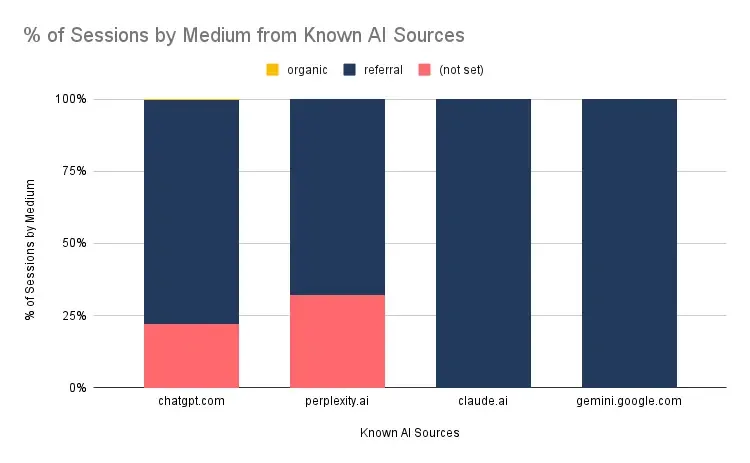
ChatGPT & Perplexity are the biggest offenders: Roughly 22% of ChatGPT sessions and a staggering 32% of Perplexity sessions are dumped into the “(not set)" medium.
The "Organic" Mirage: A tiny sliver (0.5%) of ChatGPT traffic is actually classified as "organic," further muddying the waters between traditional search and AI-driven discovery.
The Gold Standard: Interestingly, Claude and Gemini were perfectly behaved in our data set, with 100% of their sessions correctly attributed to the "referral" medium.
The Marketer’s Move: Don’t trust your default channel groupings blindly. Without custom filters to catch that "(not set)" medium data, your LLM ROI will look lower than it actually is.
2. The Summer AI Peak and the "Cooling" Effect
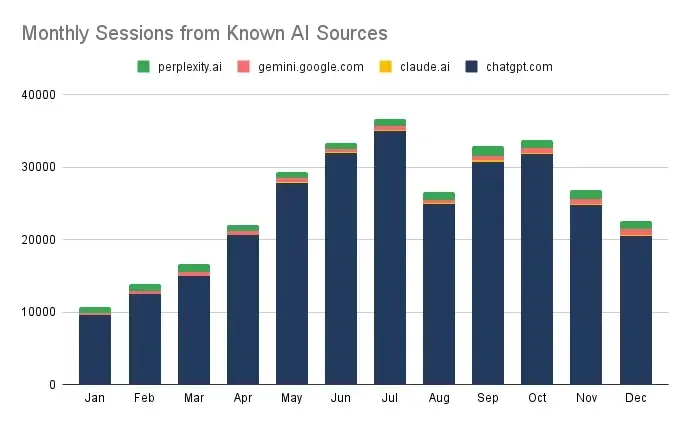
Our data shows a distinct "hump" in AI-driven sessions in June and July 2025. Traffic from these sources peaked during the summer and has seen a steady decline through Q4.
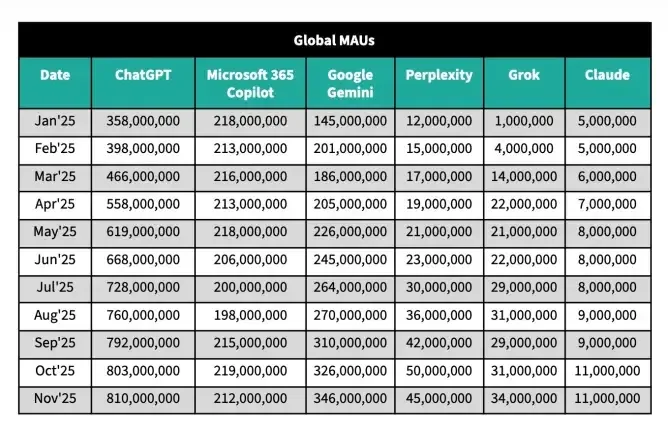
This mirrors broader industry trends. While initial user adoption was explosive, recent reports suggest that ChatGPT's growth is beginning to level off. As the novelty wears off and AI users develop new habits, the fight for new users heats up.
The chart below shows a slower growth rate in Monthly Average Users (MAUs) for the most common LLMs in Q3 and Q4 2025. The analysis below is from Sensor Tower as reported in TechCrunch.
3. Perspective: AI vs. Organic Search
It is easy to get lost in the "AI is killing SEO" narrative, but the data tells a much more grounded story.
At their absolute peak in July, Known AI Sources accounted for only 1.1% of total organic traffic. Since then, that number has stabilized at approximately 0.3% - 0.4%, slightly ahead of where it was before the summer spike.
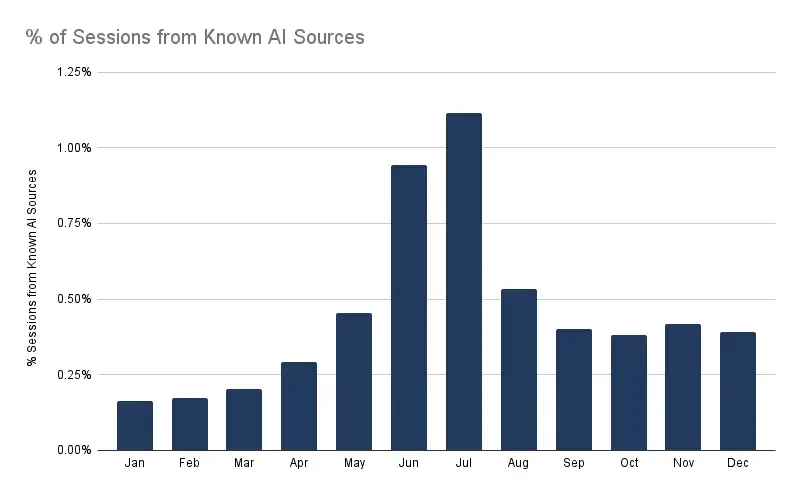
While LLMs are a growing piece of the pie, traditional organic search is still the 800-pound gorilla. AI is a supplement to your discovery strategy, not a replacement, at least for now.
What Should You Do Next?
These findings mirror many of the conversations we’ve been having internally and with our clients over the past several months. AI-driven discovery is showing up in more places, but rarely in clean, report-ready ways.
From a strategy perspective, the next step isn’t to overreact to AI traffic, but to get your data and measurement strategy in order:
Pressure-test your GA4 data, especially sessions falling into the “(not set)” buckets, where AI referrals most often hide.
- Build intentional reporting views or explorations that isolate known LLM sources so their impact isn’t diluted by default channel groupings.
Reframe success metrics for AI traffic. Volume alone is less important than understanding how and where it assists discovery and awareness goals.
Establish an AI traffic and conversion baseline now, even if it feels small. Having clean historical data will matter as attribution improves and adoption patterns evolve.
Consider adding AI-tracking tools into your marketing mix, such as Semrush’s AI Visibility Toolkit, to complement GA4 and provide additional context around how your brand appears in AI-generated responses.
AI traffic doesn’t need to rival organic search to be strategically relevant. But without clearer measurement, it’s impossible to have a meaningful conversation about its true impact within your marketing mix.
The Road Ahead: From Hype to Data
The current state of AI attribution is inconsistent, but we expect this to change. Optimistically, LLMs will eventually standardize how they pass referral data (much like social media platforms eventually did), and Google will likely update GA4’s default channel groupings to include "AI Sources" officially.
Until then, smart marketers shouldn't rely on opinions or headlines. Dig into your own GA4 data, build custom explorations to unmask the "(not set)" traffic, and look for the real insights beneath the noise.
If you’re not sure where to start, contact us! We’re here to help unravel your data to provide you with stronger insights that will inform your marketing strategy.