
Everyone here has likely faced that internal divide between sales teams and marketing teams. Sales wonders why the leads coming in aren’t converting. Marketing wonders why follow-up feels inconsistent or why campaigns aren’t getting the credit they deserve. But pointing fingers at lead quality or close rates isn’t the way to grow your business (and it never has been).
The truth is simple: growth only happens when sales and marketing stop operating in their own worlds and start working in the same one. That means shared goals, shared definitions, and a shared understanding of what today’s customer actually needs. It means breaking down the silos that lead to miscommunication, inconsistent messaging, and opportunities slipping through the cracks.
When your sales and marketing efforts are aligned, everything improves: lead quality, conversion rates, customer experience, and even the speed at which deals move through the pipeline. Instead of guessing which efforts are working, both teams can rely on clear data, real insights, and a unified strategy that ties activity directly to revenue.
Bridging the gap between sales and marketing is one of the most powerful drivers of sustainable business growth, and it starts with getting everyone on the same page and speaking the same language.
Common Disconnects Between Sales and Digital Marketing Teams
Even in the best organizations, it’s easy for sales and marketing to drift out of sync. Both teams are busy, both have goals to hit, and both see the customer or prospect from very different angles. That gap creates several familiar disconnects that slow growth and complicate the customer journey.
Different goals and success metrics
The marketing team might be focused on generating traffic, impressions, or MQLs, while the sales team is focused on quote requests, pipeline value, and closed deals. When the goals don’t align, neither do the work (or the results).
Confusion around lead quality
Marketing believes they’re bringing in strong leads. Sales feels those same leads aren’t ready (or aren’t the right fit). Without shared definitions of what makes a lead qualified, frustration can build on both sides.
Limited communication
Many teams only connect when something goes wrong. Without regular conversations, feedback gets lost, insights get buried, and both sides end up guessing instead of collaborating. At Workshop Digital, I meet with our sales team weekly, and our broader divisional teams meet monthly to discuss lead quality, pipeline health, and what prospects are saying. This ongoing dialogue ensures our marketing speaks directly to the real pain points sales hear every day.
Technology silos
Marketing tools and CRM systems don’t always talk to each other. That means incomplete data, missed handoffs, and a lack of real visibility into what’s working… and what isn’t. Bringing these insights into every sales–marketing meeting helps ensure both teams understand how marketing activities support pipeline velocity and deal progress.
Misalignment of the customer persona
Marketing may be targeting one type of buyer while sales is regularly closing deals with someone completely different. If both teams don’t align on who the customer really is, campaigns and conversations can quickly feel disconnected.
Inconsistent messaging
When sales says one thing and marketing says another, prospects notice. Inconsistent positioning creates confusion, and confusion slows down conversions. As mentioned earlier, it’s imperative to listen to your sales team. They’re on the front lines. Ensuring your marketing messaging (whether it’s your website content, blogs, emails, or social media) speaks to what prospects are asking about makes your entire strategy more cohesive and effective.
These disconnects aren’t about finger-pointing. They’re just symptoms of two teams that haven’t been set up to collaborate the way they need to. The good news? Every one of these gaps can be addressed with intentional alignment.
How to Connect Sales and Digital Marketing Efforts
Fixing the disconnect between sales and marketing isn’t about a big, one-time initiative. It’s about building habits, structure, and shared visibility over time. Below, I’ve outlined a few practical ways to get started.
Start with shared definitions and goals
Before you talk tactics, ensure you’re all speaking the same language.
Define what a lead, MQL, SQL, and opportunity mean for your business.
Agree on what “good fit” looks like: industry, company size, budget, timeline, job title, and key pain points.
Set at least one shared revenue, close rate, pipeline goal, and closed won ARR that marketing and sales both own.
This alone can significantly reduce friction. When everyone agrees on what “good” looks like, it’s easier to build campaigns and follow-up that actually support each other.
💡 Tip: Ensure this is clearly outlined and shared with both teams, so everyone is consistently on the same page. It’s also worth noting, this may change over time! Don’t be attached to what you’ve defined at the beginning of the year; your target may be a moving one.
Map the buyer journey together
Instead of sales mapping their process and marketing mapping theirs, put it all in one place.
List out the main stages: awareness, consideration, evaluation, and decision.
- Under each stage, note:
What prospects are asking
What content or campaigns they’re seeing
What sales touchpoints happen (calls, demos, emails, form fills)
This kind of shared mapping makes it much easier to see where marketing can warm up prospects before a sales conversation, and where sales can use digital content to keep deals moving.
Build a simple communication rhythm
You don’t need a complicated operating model. You just need consistency.
Weekly: Short sales–marketing touchpoint. Quick review of lead quality, what’s in the pipeline, and any trends sales is hearing on calls.
Monthly: Deeper review. Look at campaign performance tied to the pipeline and closed won deals.
Ad hoc or Async: Create a clear way for sales to flag patterns (a Slack channel, shared doc, Basecamp Campfire, or CRM notes on the prospect or opportunity itself).
The key is ensuring that those meetings consistently inform campaign decisions and messaging.
Connect your tools and your data
Even basic connections between systems can make a significant difference.
- Ensure your CRM and marketing platforms are integrated so you can see:
Which campaigns, channels, or referrals generated those MQLs or opportunities
Which content is touched in closed-won deals
- Pull a few key reports into shared dashboards:
MQL → SQL conversion
Opportunities by source or campaign
Win rate and deal size by channel
You don’t have to track everything. Begin with a small set of metrics that tell a clear story about how digital marketing supports sales.
Define what “sales-ready” really means
Lead quality debates usually come down to unclear expectations.
- Work with sales to create a lead scoring model that includes:
Fit (job title, company size, industry)
Behavior (pages visited, content downloaded, events attended)
Agree on a score or combination that signals:
“This is ready for a sales touch,” vs. “Keep nurturing this lead.”
Once you agree, document it. This makes it easier to adjust your campaigns, workflows, and follow-ups over time.
Use marketing to support real sales conversations
Instead of creating content in a vacuum, build it around what sales is hearing during their calls with potential prospects.
- Ask sales questions such as:
What questions come up on every call?
Where do deals stall out?
What objections keep showing up?
- Turn those questions into:
Blog posts
Case studies
One-pagers that sales can use
Email nurtures
Landing pages you can link to from follow-up emails
Then, make sure the sales team knows what exists and where to find it. A simple internal “content for sales” folder or resource hub can go a long way. We use Google Drive as our internal resource, which is an effective way to control permissions and folders for sales to navigate and find easily.
Close the loop with post-sale insights
The connection between sales and marketing shouldn’t stop once a deal closes.
- Review closed-won and closed-lost deals regularly:
Which campaigns or touchpoints show up most often in closed-won deals?
Are there patterns in who closes vs. who drops off?
What is the reason for closed-lost deals?
Did seasonality impact any of the deals?
- Use those insights to refine:
Targeting
Channel allocation
Messaging and positioning
Qualification criteria
Build assets to re-enage quiet prospects
This is where you move from “we think this is working” to “we know this is driving revenue.”
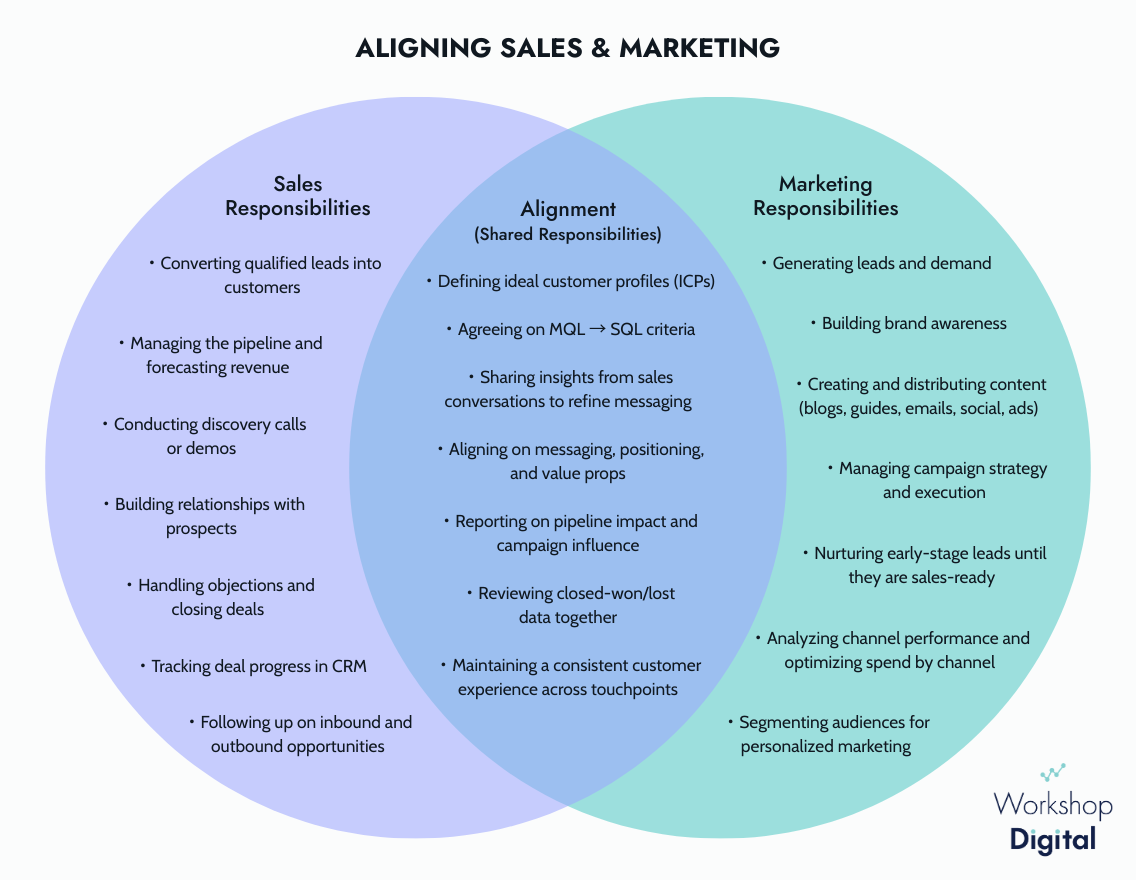
Benefits of Sales and Digital Marketing Alignment
When sales and marketing operate as one team instead of two separate functions, the impact becomes obvious almost immediately. Alignment directly improves performance across the entire revenue cycle.
Stronger lead quality
When both teams agree on what a good lead looks like, marketing can focus on generating the right prospects instead of just more prospects. That means fewer wasted conversations for sales and a more efficient use of your marketing budget.
Higher conversion rates
With aligned messaging, smoother handoffs, and shared expectations, prospects move through the funnel with less friction. Sales has warmer leads, and marketing can see how their efforts influence the entire journey—not just the top of it.
Shorter sales cycles
When marketing addresses early-stage questions and pain points, prospects show up to sales conversations more informed and further along in their decision-making. This naturally shortens the amount of time it takes to move from first touch to closed deal.
Clearer ROI and attribution
Alignment gives you a cleaner line of sight into what’s actually driving revenue. Marketing can see which campaigns or channels influence the pipeline, and sales can see how digital efforts are supporting their conversations. It becomes much easier to justify the budget, adjust the strategy, and double down on what works.
Consistent customer experience
Prospects feel the difference when the brand story is the same from the first ad click to the final sales conversation. No surprises, no confusion—just a cohesive experience that builds trust.
More accurate forecasting
Better data and shared tools give both teams a more realistic sense of what’s coming. Marketing knows what types of leads are converting, and sales has a clearer picture of which channels tend to produce deals, not just inquiries.
Stronger long-term strategy
Instead of running campaigns in isolation or reacting to what’s happening in the moment, both teams can plan based on insights from the full customer journey. This creates a more predictable, scalable, and sustainable growth model.
When Sales and Marketing Work Together, Growth Comes Faster
Connecting sales and digital marketing isn’t a quick fix; it’s an ongoing commitment to shared goals, clear communication, and a unified view of the customer. When both teams operate with the same definitions, the same expectations, and the same understanding of what prospects need, everything becomes more efficient. Leads improve, conversations improve, and the path from first touch to closed deal becomes smoother and more predictable.
The truth is, no single team can drive sustainable growth on its own. Sales needs the insight and momentum that digital marketing creates, and marketing needs the real-world feedback sales provides. When those two pieces finally come together, your business isn’t just aligned; it’s positioned to grow faster, smarter, and with far less friction.
Ready to see how we can help bridge the gap between your sales and marketing teams? Contact us today to hear how we can help!
Prefer to just stay in the know? We publish a bi-weekly newsletter, where we share insights like these along with timely digital marketing trends to help you stay ahead. Get those insights directly into your inbox!