
Website tracking is not as reliable as it used to be, and most teams are already feeling the impact, whether they realize it or not.
Over the past few years, browsers like Safari and Google Chrome have rolled out stricter privacy protections, and third-party cookies have started disappearing. Google also spent a long time talking about removing them entirely before walking that plan back, which did not exactly make things less confusing for anyone trying to plan ahead.. On top of that, regulations such as GDPR have absolutely changed the rules around how user data can be collected and shared.
All of this has created a perfect storm for marketers and analytics teams, where conversion tracking quietly breaks without warning, attribution models become less trustworthy over time, and different platforms start reporting completely different numbers for what is supposed to be the same user journey.
If you’ve ever compared your analytics platform with your ad platform and wondered which one is lying, the uncomfortable answer is that neither is entirely right, because each platform is working with incomplete and increasingly restricted data.
As a result, companies are moving away from relying purely on browser-based tracking and are beginning to adopt more controlled, first-party approaches that give them greater ownership over how data is collected, processed, and distributed.
This is the point where Google Tag Gateway comes into the picture, offering a way to route tracking data through a controlled layer before it reaches external platforms which helps improve reliability, maintain compliance, and bring a bit of sanity back to your data.
What Exactly is Google Tag Gateway?
Google Tag Gateway is a way to route your website’s tracking data through a controlled, first-party layer before it gets sent to tools like analytics platforms, advertising platforms, or other third-party services.
Instead of your website sending data directly from the browser to multiple destinations, which is how traditional tracking setups work, Google Tag Gateway introduces an intermediary step where that data is first processed, managed, and then forwarded on.
At a high level, this means your data flow changes from something fragmented and browser-dependent into something more centralized and controlled.
Basically, Google Tag Gateway helps you:
Decide what data gets sent and what doesn’t
Reduce reliance on browser-side tracking
Improve how consistently data reaches different platforms
It’s important to clarify what Google Tag Gateway is not, because this is where most of the confusion comes from.
It's not the same thing as Google Tag Manager, which is primarily used to deploy and manage tags on your website. It is also not a standalone analytics tool or a replacement for platforms like Google Analytics.
A better way to think about it is this: Google Tag Manager helps you place and trigger tags, while Google Tag Gateway helps you control how the data from those tags is routed and delivered. Below is an image from Google documentation to help illustrate this better:
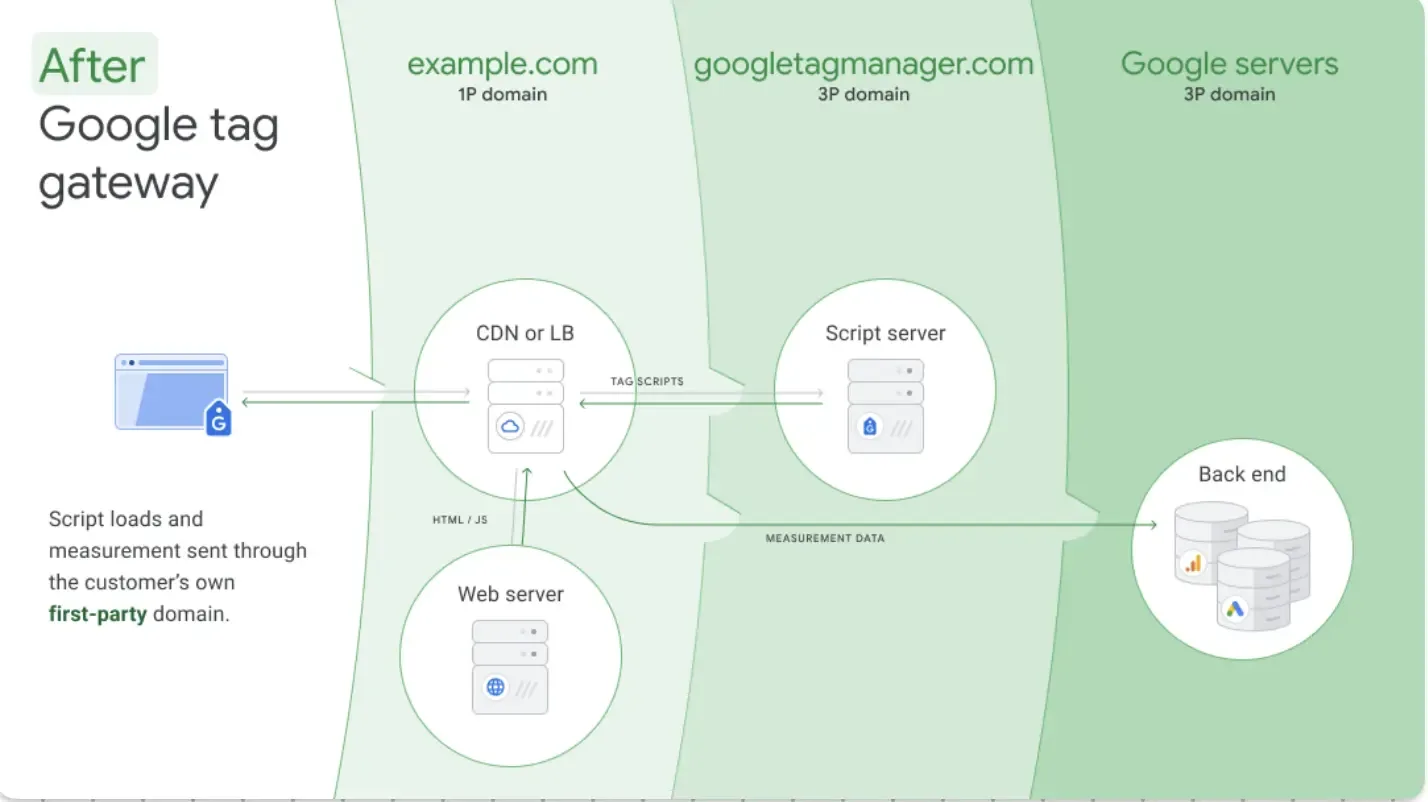
That distinction might sound subtle, but it is exactly what makes this approach increasingly important as browser-based tracking continues to lose reliability.
Why Google Tag Gateway Exists
Google Tag Gateway is largely a response to how quickly the tracking space has been changing.
Browsers like Safari introduced features such as Intelligent Tracking Prevention, which limits how long cookies can live and how they can be used, while Google Chrome has been steadily moving toward reducing support for third-party cookies altogether. At the same time, ad blockers have become more aggressive and widely adopted, meaning a growing portion of tracking requests never even leave the user’s browser.
On top of browser changes, regulations such as GDPR and similar privacy laws have forced companies to be more deliberate about what data they collect and where it gets sent, which adds another layer of complexity to already fragile tracking setups.
The combined effect of all of this is simple but painful: traditional, browser-based tracking is losing signal.
Data gets blocked, shortened, or dropped entirely, which leads to gaps in reporting and analysis, inconsistent attribution, and less confidence in decision-making. This is especially noticeable in areas like conversion tracking, where even small amounts of lost data can significantly impact how performance is measured.
Google Tag Gateway exists to address this shift by giving companies a way to move tracking closer to a first-party, controlled environment, where they are less dependent on the browser and more in control of how data is handled.
Instead of sending data directly from the browser to multiple third-party endpoints, the gateway approach allows that data to be routed through a layer you control, which helps reduce data loss, improve consistency, and align better with modern privacy expectations.
In short, it exists because the old way of doing things is steadily breaking, and this is one of the ways the industry is adapting.
How Google Tag Gateway Works
The easiest way to understand how Google Tag Gateway works is to focus on what actually changes behind the scenes, not just the extra step in the data flow.
In a traditional setup, tracking requests are sent directly from the user’s browser to multiple third-party platforms. Each tool receives its own request, which means each one is equally exposed to browser restrictions, ad blockers, and data loss.
With Google Tag Gateway, that process is slightly restructured, but the impact is notable.
Instead of sending data directly to each platform, the browser sends tracking data to a single endpoint that you control. This endpoint acts as the “gateway”, receiving the data first before deciding what happens next.
From there, the gateway can:
Process or clean the data
Filter out anything you do not want to send
Forward the remaining data to the appropriate platforms
What makes this approach different is that the request now originates from a first-party context, meaning it is sent through your own domain rather than directly to third-party domains.
That point is important because first-party requests are generally less likely to be blocked or restricted by browsers and ad blockers, which improves the chances that your data actually reaches its destination. It is also worth noting what does not change…
You are still tracking the same events, such as page views, clicks, and purchases, and your analytics and advertising platforms still receive that data. The difference is simply how that data gets there.
Instead of multiple fragile, browser-dependent requests, you now have a more controlled and consistent delivery path.
Benefits of Google Tag Gateway
Google Tag Gateway does not magically fix tracking, but it does remove a lot of the things that are currently breaking it. The benefits come directly from shifting how data is collected and delivered, not from adding more complexity.
More reliable data collection: Because tracking requests are routed through a first-party endpoint instead of being sent directly from the browser to third-party platforms, they are less likely to be blocked by ad blockers or restricted by browser privacy features. In practice, this means fewer dropped events, more consistent conversion tracking, and smaller gaps between platforms.
Greater control over what gets sent: Instead of blindly sending everything from the browser to multiple tools, you now have a layer where you can decide exactly what data is passed along. This gives you more ownership over your tracking setup and makes it easier to standardize how different platforms receive data.
Stronger alignment with privacy requirements: Having a controlled layer between your website and external platforms makes it easier to manage data responsibly. You can filter, adjust, or limit what gets shared, which helps when working within frameworks like GDPR and similar privacy regulations.
More consistent data across platforms: When each platform receives data directly from the browser, discrepancies are almost inevitable because requests get blocked or lost at different rates. Routing everything through a single gateway creates a more uniform delivery path, which helps reduce mismatches between analytics and advertising tools.
A more maintainable tracking setup over time: Centralizing how data is processed and routed reduces the need for scattered, platform-specific logic across your site. While it does require an initial setup, it typically leads to a cleaner and more manageable system as your tracking needs grow.
If your tracking data is already showing inconsistencies, it is usually not a platform issue… it is a data flow issue. Our team helps marketing teams audit, fix, and future-proof their tracking setups so you can trust your data again.
When You Should Use Google Tag Gateway
Google Tag Gateway is not something every website needs, at least not right away. It becomes valuable when tracking accuracy and data control start to directly impact your business decisions.
You should consider using it if:
You rely heavily on conversion tracking for paid ads: If you are running campaigns on platforms like Google Ads or paid social, even small amounts of data loss can affect how performance is measured and optimized.
You are seeing discrepancies between platforms: If your analytics platform, ad platforms, and internal numbers rarely match, it is often a sign that tracking requests are being lost or blocked at different points.
You want more control over your data: If you need to decide exactly what gets sent to each platform, rather than relying on default browser-based behavior, a gateway approach gives you that flexibility.
You are moving toward a first-party data strategy: Many companies are shifting in this direction as privacy requirements increase, and this setup fits naturally into that approach.
At the same time, you probably do not need Google Tag Gateway yet if:
Your tracking setup is simple and working well enough: If you are not heavily dependent on precise attribution, the added complexity may not be worth it.
You are early-stage or not running paid campaigns: In these cases, the impact of data loss is usually less critical.
You do not have the resources to maintain it: While the concept is straightforward, it still requires ongoing ownership to manage properly.
In short, Google Tag Gateway becomes more relevant as your tracking needs become more important, not just more complex.
How to Implement Google Tag Gateway
Implementing Google Tag Gateway can range from relatively simple to more involved, depending on your tech stack.
In some environments, such as when using platforms like Cloudflare, parts of the setup can be handled through existing infrastructure, making it feel closer to flipping a switch. That said, even in these cases, the underlying data flow still needs to be configured correctly.
For most organizations, implementation includes:
Creating a first-party endpoint to receive tracking data
Defining how that data is processed and routed
Integrating with tools like Google Tag Manager
Aligning with consent and privacy requirements
Where things become more complex is not in turning it on, but in making sure it is working correctly.
Questions like:
Are all platforms receiving consistent data?
Is anything being unintentionally filtered or duplicated?
Does this improve attribution, or just shift discrepancies?
These are the details that determine whether the setup actually improves your tracking or just adds another layer to manage.
The Shift Toward First-Party Tracking
Website tracking is going through a shift, and it is not going to slow down anytime soon. The old model of sending data directly from the browser to multiple third-party platforms is becoming less reliable as privacy restrictions tighten, browser behavior evolves, and users gain more control over what gets tracked. As a result, the gap between what actually happens on your site and what your tools report is only getting wider.
Google Tag Gateway is part of a broader move toward a more controlled, first-party approach to data collection, where businesses take a more active role in how their data is routed, processed, and shared.
It does not change what you track, and it does not magically fix every tracking issue, but it does change how that data reaches its destination, which is where many of today’s problems actually occur.
For teams that depend on accurate data to make decisions, that shift can make a big difference. And as the environment continues to move in this direction, approaches like this are likely to become less of an advantage and more of a standard.
If you are evaluating how to improve your tracking infrastructure, we would be happy to help you think it through - reach out to us! If you are not ready yet, our Shop Talk newsletter shares helpful insights to keep you in the loop in this crazy marketing world we’re in.