
It’s hard to get started, and even harder to maintain. This is a common feeling shared by many financial marketing teams as they attempt to incorporate SEO into their broader marketing strategy. And it’s no wonder. The financial world is tightly governed by a complex web of rules, regulations, and compliance requirements, all of which companies are legally obligated to follow. Beyond that, financial content falls into Google’s YMYL (Your Money or Your Life) category, meaning even small errors can have serious consequences for users and, by extension, the business itself.
Having worked with clients across the finance industry, we have seen firsthand the unique challenges marketing teams face, from balancing regulatory compliance with engaging content to building trust and authority in a highly scrutinized digital landscape. Understanding these challenges is the first step toward creating an SEO strategy that not only drives traffic but also establishes credibility, fosters trust, and ultimately supports long-term growth.
Why Financial Services SEO Is Judged Differently
When speaking with financial companies, many are surprised to learn that when it comes to rankings, the financial industry is held to a different standard than, say, your local HVAC company. That’s partly because financial services are under what Google considers Your Money, Your Life content (YMYL).
When content falls under YMYL, Google doesn’t simply rank it based on relevance and basic SEO signals. It applies stricter quality thresholds because inaccurate or misleading information could seriously harm users.
Our outline below explains YMYL content in a few concise points:
Trust becomes a gatekeeper, not a tiebreaker: Without well-established trust signals, your site won’t rank well.
E-E-A-T signals have more impact: Experience, Expertise, Authority, and Trust are weighted heavily in financial services SEO. These signals carry significantly more influence in YMYL categories.
Accuracy and fact-checking are required: Incorrect or outdated information can trigger ranking drops or even legal issues.
Content depth and intent alignment matter more: Thin or overly promotional content is more likely to underperform because it adds little real value for users.
Brand reputation influences rankings: Domain-level trust can impact how all pages of your site perform.
Risky SEO tactics carry higher penalties: YMYL categories have less tolerance for manipulative or black-hat SEO tactics.
Google evaluates the factors above first. Traditional SEO signals only begin to matter once these high-quality thresholds are met.
E-E-A-T Explained for Financial Services
E-E-A-T is part of how Google evaluates and ranks websites. It was introduced to help ensure users receive content that best matches their search intent. These aren’t signals you can fake with shady or low-quality tactics.
To help enforce these principles, Google employs approximately14,000 Search Quality Raters around the world. For financial services companies, effective SEO starts with understanding how E-E-A-T impacts the business.
The section below highlights real-world examples specific to the financial industry:
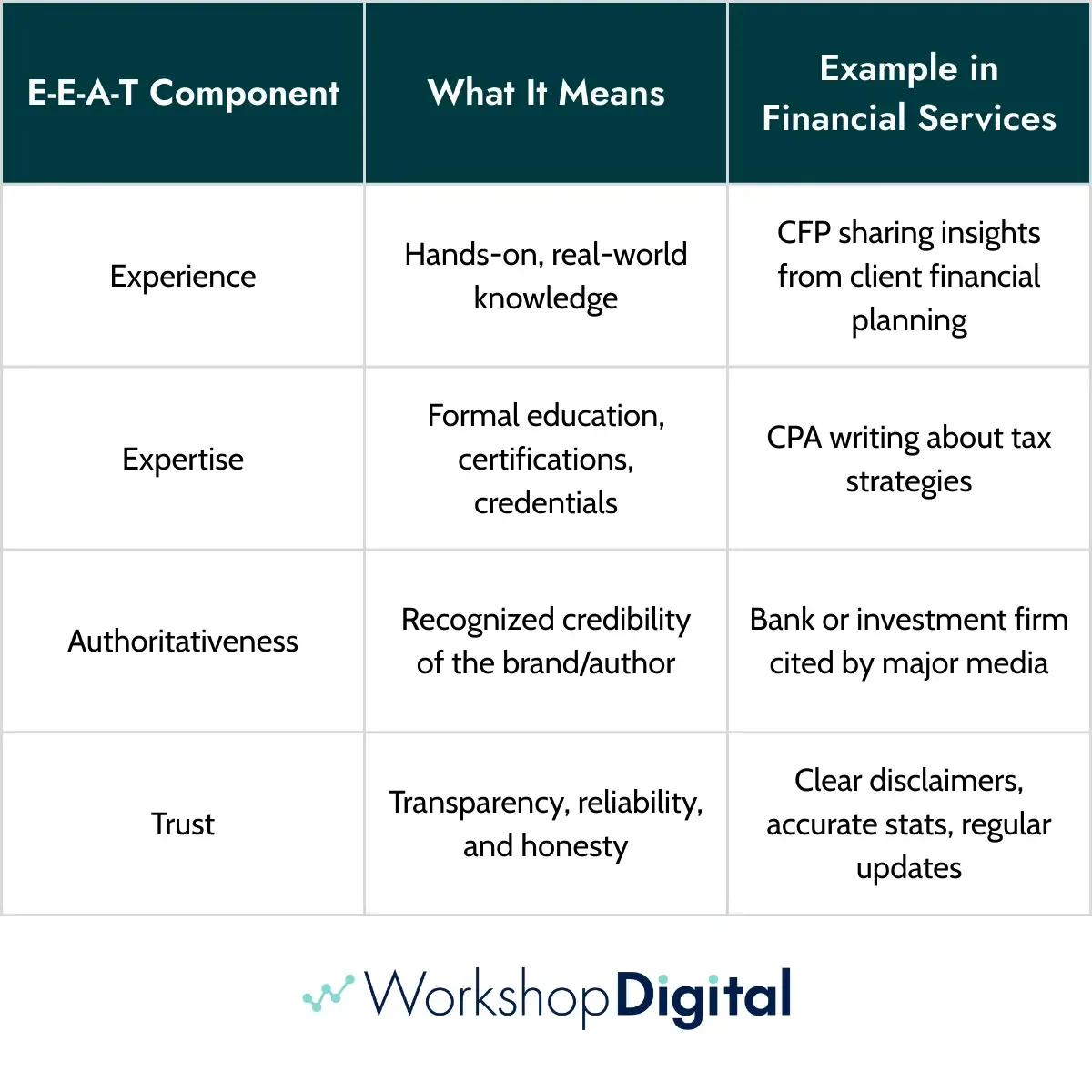
All of these signals are evaluated at the page, author, and domain level, meaning they need to be aligned and working in the same direction. This is where a comprehensive SEO strategy matters most, ensuring every level of your site is working to your advantage.
Working with E-E-A-T and YMYL: Turning Principles Into Strategy
While balancing E-E-A-T and YMYL can seem arduous, their purpose is straightforward: to ensure users receive the most trustworthy and helpful information possible. These principles didn’t originate with Google. Users had been applying them long before to assess credibility and risk.
As Alan Greenspan once observed, “Trust is the single most important element of any financial system.” His statement reflects a long-standing reality, one that Google now incorporates to deliver more meaningful and reliable search results.
But how do we turn these principles into a strategy? It begins with a thoughtful approach to keywords, content, and on-page optimization. In this section, I’ll break down the components of an SEO strategy to keep your financial business compliant and credible.
Keyword Strategy in a YMYL Environment
The single most important takeaway for financial marketers about keyword strategy in a YMYL environment is to choose the right keywords carefully. If I’m managing a client's portfolio, impulsively buying stock won’t help. Instead, you weigh the options and select the best ones.
Vetting keywords takes time, and there are a myriad of tools available to help. But tools aside, the steps below will help you get started.
Step 1: Make your list - List all the terms you would like to rank for. It’s common to end up with over 100 keywords at this stage.
Step 2: Refine your list - Identify high-volume, low-conversion keywords. Not all popular phrases drive results. Some may be irrelevant, non-compliant, or even risky.
Step 3: Map Keywords to User Intent - Every user has an intent behind their keywords. Usually, that intent is to learn, to buy, or to navigate. Understanding the intent behind each keyword and what you want to rank for helps to further clarify and refine your list.
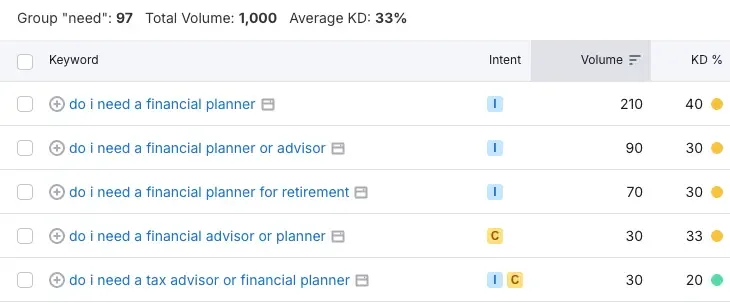
Step 3: Identify target keywords - This process often results in a focus on lower-volume, lower-difficulty, highly specific phrases that your audience actually uses. Leveraging customer interactions, such as sales conversations and client questions, can further refine which keywords deserve priority.
Content Strategy Built for YMYL & E-E-A-T
A well-structured SEO content strategy for a financial services company needs to be accurate, reliable, and consistent. Put differently, the information needs to be factually correct, come from credible sources, and be published consistently. These are the foundations of a content strategy built for YMYL & E-E-A-T. But no content strategy can begin without first deciding what kind of content you want to produce.
Choosing the right content to include depends on two primary factors: your resources & your audience's preferences. When we talk about resources, we are referring to budget and time. For example, video production typically requires more investment than a blog post. But is video even what your audience actually wants?
Most effective content strategies include multiple formats, structured in a way that delivers information in the user’s preferred format.
No matter the content format, there are a few key elements that you will want to include in your content:
Author information up front: Google and users want to know who is providing financial advice. Clearly displaying authorship helps demonstrate who the author is, what their experience is, and whether they can be trusted to speak on the topic.

Example of upfront authorship
Make sure to use data from authoritative sources: Expertise is reinforced when it is supported by evidence-based, authoritative sources. In the financial industry, examples include organizations such as the SEC or the Federal Reserve. Not every citation needs to come from a government body, but the more authoritative the source, the stronger the credibility.
Include real-world examples and case studies: Every financial company has success stories. You do not need to disclose private client details to demonstrate results. Even explaining how you helped a certain number of clients achieve measurable outcomes can strengthen trust. If you have detailed case studies available, that is even better.
Make advice actionable: To truly demonstrate expertise, provide step-by-step guidance showing how specific processes work. Actionable content allows users to follow along and apply what they are learning, which builds trust and reinforces your authority.
Highlight your affiliations and credentials: Showcasing awards, degrees, certifications, and professional affiliations, both for the author and the company, helps reinforce to Google and users that you are experienced and qualified in your field.
Quick Note about AI:
Many companies attempt to use AI to create their content and content strategies. In a YMYL industry, that approach comes with significant risk. Relying solely on AI-generated content can result in inaccurate or misleading information, and in some cases, ranking issues that may take months or longer to recover from.
At the end of the day, AI is just a tool. It can be helpful for tasks like creating outlines or generating initial ideas, but financial content should always be reviewed and validated by a qualified human. In a highly regulated industry, oversight is not optional.
E-E-A-T-Optimized On-Page SEO
Proper on-page SEO for a financial services company should be focused on building trust, demonstrating expertise, and ensuring compliance within financial content.
For those unfamiliar, on-page SEO refers to optimizing the content, images, layout, and other elements of a single web page so that it aligns with user expectations and Google's best practices. The practices below apply to all page types, including core service pages, author pages, and blog content.
This is not intended to be a tutorial on how to execute on-page SEO. There are many in-depth resources available for that. Here, we want to focus specifically on what is most critical when optimizing webpages for a financial services company.
Trustworthy titles and meta descriptions: Ensure your title tags and meta descriptions build trust rather than rely on generic sales language. These elements are often the first impression users see on a SERP, search engine results page, so every word should communicate credibility and authority.
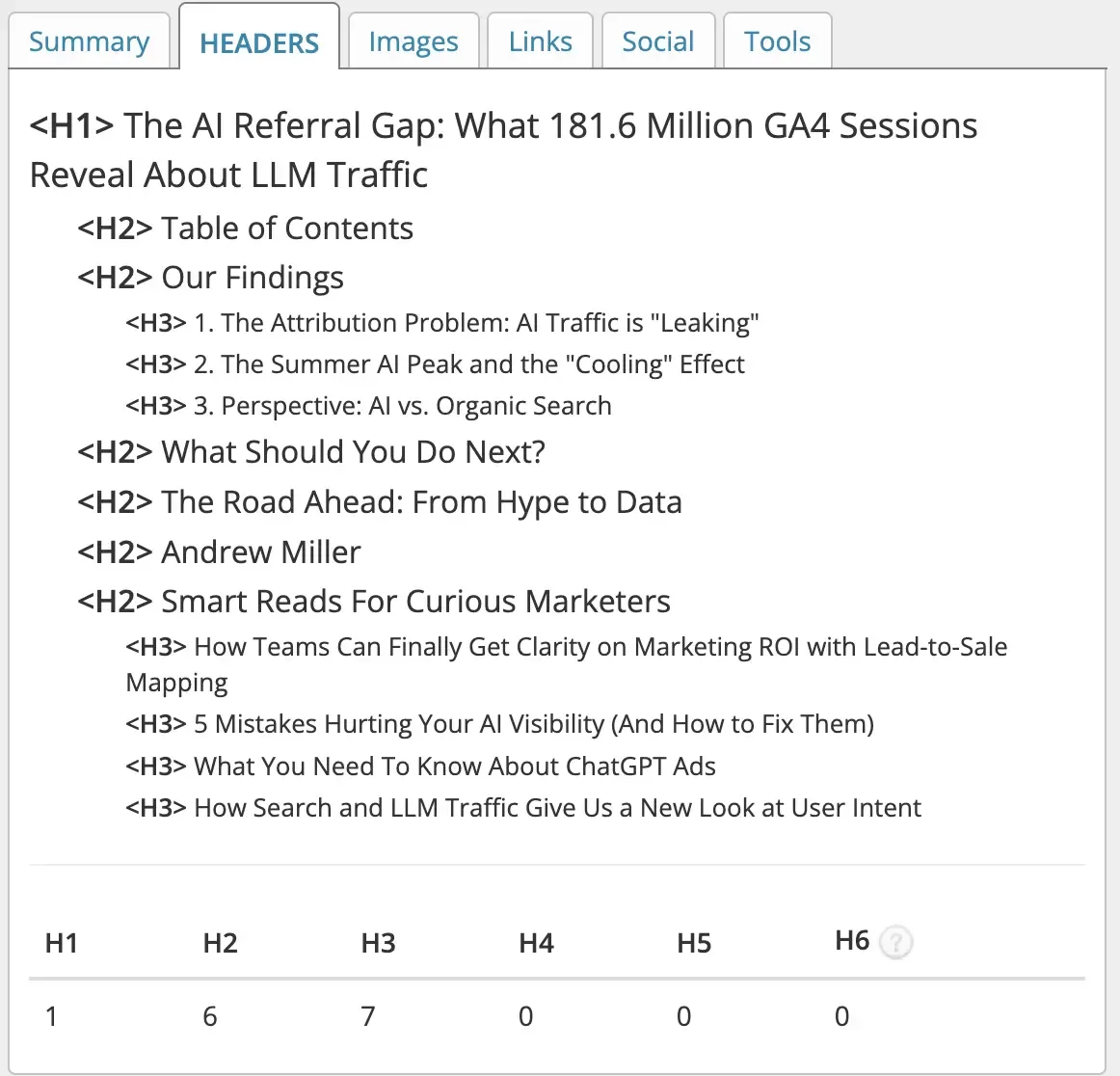
Proper heading structure: Just like a pyramid, your content should be structured with the most important headings first, followed by supporting subheadings. A clear hierarchy helps demonstrate to both users and Google that your content is logically organized and thoughtfully presented.
Detailed authorship: To properly demonstrate expertise, users need to know who the expert is. This is where authorship plays an important role. While this primarily applies to blogs, each post should explain who the author is and, if possible, have a short bio outlining their experience and credentials. For reference, look at blog posts written by a new station or media outlets. You will see author information displayed at both the top and bottom of the article.
Helpful internal linking: Here, we are referring to the links that guide users to other relevant resources on your site. This could include a call-to-action, a service page, or another helpful blog. A well-structured internal linking strategy not only directs users to valuable content but also signals to Google that your site contains a connected network of authoritative resources.
Good user experience (UX): A site with a broken or difficult-to-use interface does not build trust. It creates digital friction, resulting in users leaving. Imagine researching a financial advisor and landing on a website that looks outdated or unprofessional. That experience does not inspire confidence, and the likelihood of conversion drops significantly.
Proper schema markup: Schema markup is structured data on the backend of a webpage that helps search and AI systems understand what is most important on the page. When implemented correctly, schema can improve visibility in search results and reinforce trust through clear, consistent data signals.
Technical SEO as a Trust Signal
Technical SEO addresses the behind-the-scenes elements that help to establish credibility and trust with users. While marketing teams can typically manage keywords, content, and on-page optimization, the technical side of SEO often presents additional challenges. It frequently involves working with code, servers, and other specialized components.
Website security (SSL): Ensure your site has a valid SSL certificate. A secure website is essential for building trust, reinforcing user confidence, and improving search rankings. Without it, your site is unlikely to rank well or convert visitors effectively. Essentially, your site needs to show HTTPS rather than HTTP
Page speed optimization: Fast-loading pages improve user experience and search performance. Use tools to test and optimize speed, and leverage CMS plugins or out-of-the-box solutions where available.
Website structure: Think of your site like a pyramid: the homepage at the top, with content branching naturally beneath it. A well-organized structure signals authority to search engines and makes it easier for users to navigate your content.
-
Managing deprecated content: Regularly audit old content to prevent outdated or misleading information from undermining trust. Update, consolidate, or remove content that no longer reflects current policies, regulations, or best practices.
Authority Building in a YMYL Category
Building websites and brand authority in YMYL industries is the result of sustained effort. When done correctly, it becomes a valuable and enduring pillar of trust.
At its core, this means your website and brand become widely recognized across the internet and within your industry. Consider Fidelity Investments. It is instantly recognizable, well-known throughout the financial sector, and consistently publishes high-quality content that reinforces its authority.
When it comes to building authority, this often takes the form of backlinks or brand mentions. A backlink is a link from a site you don’t own that points to your own domain. The more authoritative the referring site, the more value the backlink carries. For example, if Forbes links to your website, that endorsement will carry significantly more weight than a link from a small personal blog. This is because it comes from a well-established and trusted publication in the eyes of both users and Google.
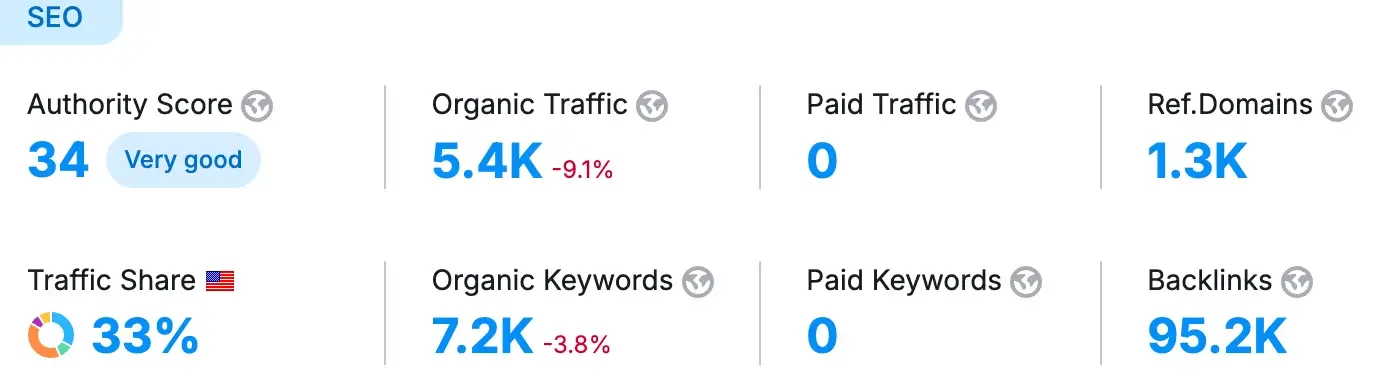
Backlinks are often earned through industry associations, social media platforms, directories, and other relevant sources. All of these contribute to building authority naturally over time.
Brand mentions also play a role, though not as directly as backlinks. A brand mention occurs when someone mentions your name without providing a link. This can happen in a blog post, video, podcast, or even offline. While it does not pass direct link equity, it still reinforces brand recognition and helps users connect with your business.
It's worth noting that building authority often takes years. Trust is slow to build and can be damaged quickly if not managed carefully. This is one reason to avoid risky link-building strategies, including buying backlinks. While that tactic may have produced results many years ago, it is not a sustainable or effective strategy in 2026 or beyond.
Common E-E-A-T & YMYL Mistakes in Financial Services SEO
When it comes to SEO for financial companies, the stakes are high, both in terms of attracting the right audience and building trust. Many firms make common mistakes that can limit traffic, reduce credibility, and slow down content production. In our experience, we have seen many of these issues firsthand and found successful workarounds to drive results while maintaining authority and compliance.
Almost universally, the most common mistake with financial clients is chasing keywords without aligning them to audience intent. This results in wasted time, money, and energy on underperforming content. As discussed earlier, it is far more effective to target terms that align with user intent and strike the right balance between search volume and difficulty.
Another common issue is publishing content without proper attribution, whether to credible sources or to the author. Missing these opportunities weakens the entire content effort and prevents authors from building their own authority within the domain. Remember, trust is evaluated at the page, individual, and domain level. Whenever possible, you should actively work to build authority not only for your brand, but also for the experts behind the content.

Then there is the issue of internal resources and management. This challenge is especially common in the financial industry because content must be reviewed from a regulatory and compliance perspective. You can write all the content you want, but it still has to move through an approval process, which often creates a bottleneck.
It is not uncommon to have weeks or even months of content sitting in the queue, waiting for review before it can be published. When setting up your content strategy, it's vitally important to communicate with all stakeholders, whether internal or external. Make sure you understand the workflow, timelines, and where additional resources can be added to keep content moving forward.
Measuring SEO Success in a Trust-Driven Environment
Before putting any strategy into place, you need a clear understanding of what your KPI’s will be. What defines success for your organization? Is it reaching a specific traffic threshold, or is it generating a certain number of qualified leads?
We have worked with many financial companies, and it's very common for a client to receive a handful of leads without knowing where a majority of them originated. This can be frustrating because it makes it difficult to clearly demonstrate ROI.
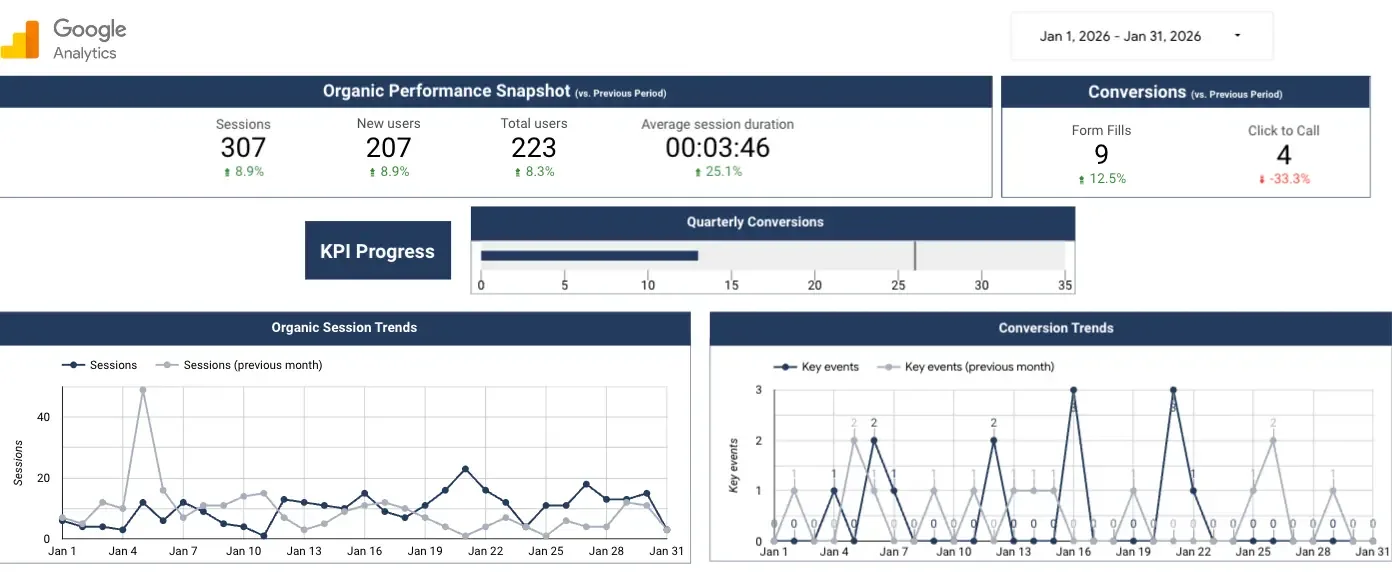
Connecting those dots is a core part of our SEO strategy. It allows us to identify what is working, what is underperforming, and where adjustments need to be made. We have included an example of a client report below, where we review key monthly metrics and break down lead performance. Having a strong reporting process helps us keep a clear pulse on performance so we can pivot when necessary.
If you don't have a marketing agency or are not in a position to hire one, taking advantage of free Google tools is a great place to start. We are not going to walk through how to use each tool in this guide, as there are many detailed resources available online. However, we will highlight a few that can help you begin measuring and understanding how your content is performing.
Google Analytics: Provides insight into website traffic, user behavior, conversions, and engagement metrics.
Google Search Console: Helps you monitor search performance, keyword visibility, indexing issues, and technical errors that may impact rankings.
The Future of E-E-A-T & YMYL in Financial Services SEO
Executing an effective SEO strategy in the financial industry is about earning trust and demonstrating authority at every level, from individual page content to site structure and overall brand reputation. By focusing on E-E-A-T principles, aligning keywords with user intent, producing accurate and actionable content, and maintaining a secure, user-friendly website, financial companies can meet Google’s strict YMYL standards while delivering real value to their audience.
As we move into 2026 and beyond, several trends will continue to shape financial services SEO:
Increasing scrutiny on financial content
Greater emphasis on AI oversight, authorship verification, and trust signals
Ongoing algorithm updates and ranking volatility
Stronger governance and compliance frameworks over short-term growth tactics
Ultimately, success in financial services SEO is a long-term commitment, one that prioritizes credibility, compliance, and consistent excellence over shortcuts. In 2026 and beyond, trust-driven strategies will separate industry leaders from the rest.
If you are interested in getting your financial institution set up for SEO success, we would welcome the opportunity to connect and discuss next steps!