
Put yourself in the shoes of a potential client in the finance industry. They need financial services; they have accumulated wealth, inherited it, or are looking for an expert to help them manage it. They are doing research, comparing, and reading content. Those firms that show up with clear, helpful, trustworthy content during that research phase often earn the conversation.
Even as an advisor or financial expert, you consume content yourself; it’s foundational for making informed decisions, and Google knows this. Under its Your Money or Your Life (YMYL) guidelines, financial content is held to a higher standard of quality, accuracy, and trustworthiness than most other industries. The bar is higher, but so is the reward. Firms that meet it earn both organic visibility and genuine client trust.
This post is a companion to our Guide to SEO for Financial Services. While that guide covers the technical and strategic SEO foundations, this one focuses on what to create, how to plan it, and how to ensure it drives results. Whether you’re a bank, RIA, fintech, or insurance company, the strategies below will help you build a content strategy that earns trust, generates leads, and compounds over time.
Why Content Marketing Is Different in Financial Services
Before diving into tactics, it’s worth understanding why content in financial services plays by different rules.
YMYL and E-E-A-T: The Quality Standards That Matter
Google classifies financial content under its YMYL (Your Money or Your Life) framework, meaning it can directly impact a reader’s financial stability. Because of this, Google expects financial content to demonstrate Experience, Expertise, Authoritativeness, and Trustworthiness (E-E-A-T). This means your blog posts, service pages, and educational resources need to be written or reviewed by credible professionals, cite reliable sources, and provide genuinely useful information, not just generic, undifferentiated content that lacks original insight. Elevating your content to meet EEAT standards means your content needs signals like:
Author bylines with relevant credentials and bio pages
Firsthand experience (case studies, examples, or original insights)
Credible expert sources and transparent citations
Strong internal linking to related, supportive content
Clear disclaimers distinguishing education from advice
Content freshness (publish/update dates) and factual accuracy
External validation (backlinks, reviews, or mentions)
When your content clearly reflects real-world expertise (using data, quotes, or your unique tone), it creates a competitive advantage that generic competitors can’t replicate. Inaccurate or misleading financial content doesn’t just underperform; it can harm users and expose firms to regulatory risk.
Compliance as a Structural Advantage
There are real regulatory considerations for finance companies' content, including marketing claims, disclosures, and testimonials, from FINRA (Financial Industry Regulatory Authority) and the SEC (Securities and Exchange Commission) to state-level regulations. Many content creators see compliance as a bottleneck, and it can absolutely be one if it’s not managed well (we have seen this with clients in the past). However, compliance guardrails push your content toward transparency, accuracy, and clarity, the same qualities Google rewards and the same qualities that build trust with prospects.
Effective financial content strategies clearly distinguish between general educational information and personalized financial advice, ensuring compliance while still delivering value.
Firms that embed compliance into their content workflow from day one, rather than treating it as a last-minute review hurdle, produce better content faster.
How to Use AI in Financial Services Content Marketing
AI is a tool to accelerate productivity, but it is not a replacement for human oversight, expertise, and connection.
That distinction matters more in financial services than in almost any other industry. When your content touches topics that can affect someone’s financial health, accuracy and accountability aren’t nice-to-haves. They’re non-negotiable.
Where AI Accelerates Your Work
Used thoughtfully, AI can dramatically speed up the parts of content creation that don’t require deep subject-matter expertise:
Ideation and research: AI can help you brainstorm topic ideas, identify gaps in your content library, and summarize industry trends or competitor approaches.
First drafts and outlines: Instead of staring at a blank page, use AI to generate rough drafts or structured outlines that your subject-matter experts can then refine and personalize.
Content repurposing: Turn a long-form whitepaper into a blog series, distill a webinar and email sequence, or run your video through an AI clip generator to get unique social videos (Opus Clip, Choppity, Riverside all offer tools for this). AI makes this kind of reformatting significantly faster.
Persona development: Building audience personas used to be a multi-hour exercise. Today, you can start by recording a conversation with your sales team or client-facing advisors, uploading that transcript to an AI tool (Notebook LM, Claude, ChatGPT), and generating a solid persona draft in minutes. It still needs refinement, but the starting point is dramatically better than a blank template. Data-sharing considerations are covered in more detail later in this guide.
Important Note: Companies should also establish clear guidelines around what data can be shared with AI tools, particularly when working with sensitive client or proprietary information.
When AI Should Not Be Used in Financial Content Marketing
While AI can support efficiency, there are scenarios where it introduces more risk than value. In these cases, content should be created directly by subject matter experts:
Personalized or client-specific guidance: AI should never be used to generate content that resembles individualized financial advice. Effective financial content strategies clearly distinguish between general educational information and personalized financial advice, ensuring compliance while still delivering value. Anything that could be interpreted as tailored guidance should come directly from a qualified professional.
Regulatory or legal interpretations: AI should not be used to interpret regulations, compliance requirements, or legal language. Guidance from regulators like FINRA (Financial Industry Regulatory Authority) or the SEC (Securities and Exchange Commission) often depends on context, nuance, and firm-specific policies. Misinterpretation can lead to real legal and compliance exposure, so this type of content should come directly from compliance or legal professionals.
Performance claims: Any content referencing investment performance, projections, or outcomes should not be generated by AI. These claims are heavily regulated and require precise wording, proper disclosures, and full context. AI increases the risk of overgeneralization or unintentionally misleading statements, which can create both compliance issues and reputational damage.
Where Human Oversight is Non-Negotiable
AI-generated financial content must be treated as a draft, never as a finished product. Here’s where human review is essential:
Accuracy of financial claims: AI models can hallucinate, presenting confident but incorrect information. Any content that references rates, regulations, performance data, or financial strategies needs to be fact-checked by a qualified professional.
Compliance review: No AI tool understands the nuances of your firm’s specific regulatory obligations. Every piece of content that goes public needs to pass through your compliance workflow, whether that’s FINRA’s advertising rules, SEC marketing guidelines, or state-level requirements.
E-E-A-T signals: Google evaluates whether content reflects genuine experience and expertise. AI can approximate expertise, but it can’t provide it. Your advisors, analysts, and leadership need to contribute original insights, commentary, and professional judgment to make content truly authoritative.
Brand voice and client connection: Financial services is a relationship business. Content that reads like it was generated by a machine—no matter how polished—won’t resonate the same way as content that reflects your team’s actual perspective and personality.
The Regulatory Landscape Around AI
It’s also worth noting that financial industry regulators are paying attention to how financial firms use AI. FINRA and the SEC have signaled increasing scrutiny of AI-generated marketing materials, and several states are enacting legislation with direct implications for financial services (more to come). Colorado’s AI Act, for example, takes effect in mid-2026 and requires firms using high-risk AI systems (e.g., systems used for decision-making, profiling, or recommendations) to provide disclosures, conduct impact assessments, and take reasonable care to prevent algorithmic discrimination.
Firms should avoid inputting personally identifiable information (PII), client financial data, or proprietary investment strategies into public AI tools unless proper safeguards are in place.
The takeaway: use AI to work smarter, but build your process around human accountability. Document your AI usage, maintain clear review workflows, and ensure a qualified human signs off on anything that reaches your audience.
How to Build a Financial Services Content Strategy Around the Buyer Journey
A list of blog topics isn’t a content strategy. A real strategy maps content to the stages your prospective clients move through, and the people you’re trying to reach at each stage.
Financial Content by Stage
Awareness: Prospects recognize a need or start researching a broad topic. Content at this stage should educate without selling. Think blog posts that explain financial concepts, guides that demystify jargon, and articles that address common questions like “How much do I need to retire?” or “What’s the difference between a traditional and Roth IRA?” This does not mean you can’t have a CTA or internal links; it means not emphasizing heavy sales language.
Consideration: Prospects are evaluating their options. This is where comparison guides, interactive calculators, detailed service explainers, and case studies earn their keep. Content here should help prospects understand how different approaches (including yours) stack up.
Decision: Prospects are ready to choose. Case studies with real results, clear CTAs to schedule consultations, testimonials, and “what to expect” content help reduce friction and give people the confidence to take action.
Don't Skip the Persona Work
It’s tempting to skip persona development, but understanding who you’re writing for makes every piece of content more effective. The good news is this process doesn’t have to take hours anymore. As mentioned in the AI section above, you can jumpstart persona creation by recording a conversation with your sales team or advisors about the types of clients they work with most often. Upload that recording to an AI tool, and you’ll get a structured persona draft that captures demographics, goals, pain points, and objections.
Practical Tip: Most meeting software (Zoom, Google Meet, MS Teams) can record and transcribe your meetings.
From there, refine the personas:
What pages do your best clients visit before converting?
What questions do they ask on intake calls?
What objections come up most frequently?
Layer this data onto your AI-generated draft, and you’ll have personas that are both practical and grounded.
Content Ideas That Work for Financial Services Firms
If you’re not sure what to create, start by listening. Your clients and prospects are already telling you what they need through their questions. You don’t need expensive SEO tools to find content ideas (though they help). Client intake forms, sales call notes, support tickets, and even your Google Business Profile reviews are goldmines for understanding what your audience actually wants to know.
With that foundation in place, here are content formats that consistently perform well for financial services firms:
Educational Blog Content
This is the backbone of most financial services content strategies. Topics that demystify jargon, explain regulatory changes, and address seasonal financial planning concerns tend to earn consistent organic traffic by targeting high-intent search queries, especially from users actively researching financial decisions.
Educational blog content plays an important SEO role by capturing long-tail keywords (e.g., specific questions and scenarios) and building topical authority over time. As your library of content grows, it signals to search engines that your site is a credible resource within financial services, improving rankings across related topics.
Examples include explainers on tax-loss harvesting, guides to understanding your credit report, or posts about what changes during open enrollment season. The key is writing in a way that’s genuinely accessible, not dumbed down, but clear enough that a non-expert can understand and take action.
Financial Thought Leadership
Creating content like market commentary, collecting and presenting original research, and expert perspective pieces are a few ways to position your firm as a trusted authority. This content doesn’t just attract organic traffic; over time, it builds the kind of credibility that drives referrals and earns media coverage. Thought leadership works best when it reflects a genuine point of view, not when it restates what everyone else is already saying. Have your advisors or analysts share their actual take on market trends, policy changes, or industry shifts.
To maximize impact, this content should be distributed through channels where your audience already consumes financial insights:
Your firm’s blog or resource center
Email newsletters to clients and prospects
LinkedIn (organic posts and employee amplification)
Webinars and virtual events
Guest contributions to industry publications or media outlets
PR outreach to journalists covering finance and investing
Video platforms like YouTube for commentary and explainers
Podcast appearances or hosting your own series
This ensures your expertise doesn’t just live on your site, but reaches a broader audience and reinforces your authority across multiple touchpoints.
Interactive Tools
Calculators, self-assessments, and financial quizzes add additional value as they provide immediate value to prospects while also generating engagement data and leads. A retirement readiness calculator or a “Do I need a financial advisor?” quiz can be among the highest-converting pages on your site. These assets often attract high-quality backlinks, improving domain authority and search rankings.
Video and Webinars
Video content is particularly effective in financial services because it humanizes your team. Short explainer videos, advisor introductions, and live webinars on timely topics like market outlooks or tax planning can build familiarity and trust in ways that written content alone can’t. Webinars, in particular, create a two-way interaction that prospects value; live Q&A sessions generate significantly more engagement than static content. Video content also tends to increase conversion rates by building familiarity before a prospect ever speaks with your team.
Email Nurture Sequences
Financial decisions take time. Email nurture sequences keep your firm top-of-mind during long consideration cycles by delivering relevant content at a steady cadence. A well-structured sequence might walk a prospect through a complex topic over several weeks, starting broad, then getting progressively more specific and action-oriented. The goal is to be helpful, not salesy. The most effective sequences are segmented based on persona and stage in the buyer journey.
Many firms use this tactic to provide market insights to their client base.
Each content type should map to a specific conversion goal, whether that’s capturing an email, scheduling a consultation, or encouraging deeper engagement.
Optimizing Content for Search and AI Visibility
Creating content is exciting, but it’s only the first step. Making sure search engines and users can find it is t’s discoverable is the second. For a deep dive into the technical SEO side, refer to our Guide to SEO for Financial Services. Here, we’ll focus on the content-level optimizations that make the biggest difference.
Pillar and Supporting Content Architecture
One of the most effective structures for financial content is the pillar-and-cluster model. Create a comprehensive pillar page on a broad topic, “Retirement Planning,” then build supporting blog posts that go deep on subtopics like Roth conversions, Social Security timing, or required minimum distributions. Link the supporting posts back to the pillar page and to each other. This architecture signals topical authority to search engines and creates a natural path for readers to explore related content.

Optimizing Financial Content for AEO (Answer Engine Optimization)
Search is changing. Beyond traditional Google results, your content now needs to be structured for AI-generated answers, featured snippets, and voice search results. Practically, this means writing clear, direct answers to common questions, using structured headings, and implementing schema markup where appropriate. Content that’s concise, authoritative, and well-organized has a better chance of being surfaced by AI-driven search tools, which is increasingly how prospects encounter financial information for the first time.
Measuring What Matters
Traffic and page views are nice to see going up, but they don’t tell you whether your content is actually driving business results. For financial firms, the metrics that matter connect content performance to lead quality, pipeline, and revenue. Think: form submissions, consultation requests, qualified lead volume, and the content touchpoints that appear in your highest-value conversion paths.

For a more detailed framework on this, see the “Measuring SEO Success in a Trust-Driven Environment” section in our Guide to SEO for Financial Services. It covers the measurement foundations in depth. Here, we’ll call out three common pitfalls that we see financial firms fall into:
Common Financial Content Marketing Mistakes to Avoid
Failing to track leads from content: If you can’t trace a lead back to the blog post, whitepaper, or email that influenced them, you’re flying blind. Set up proper attribution, UTM parameters, goal tracking in GA4, and CRM integration, so you can see which content actually contributes to your pipeline.
Avoiding a larger strategy because of cost: Some firms never move beyond ad hoc blog posts because a comprehensive content strategy feels expensive. The reality is that an uncoordinated approach wastes more money over time than a well-planned one. Start with a focused strategy around a few key topics and build from there. It takes time, but it’s supposed to.
Compliance bottlenecks: In financial services, content often needs to be reviewed for legal and disclosure requirements before it can be published. If this review step isn’t structured, it becomes the single biggest delay in your content workflow. Designate someone, whether internal counsel, a compliance officer, or an outside reviewer, and set a regular review cadence, even if it’s just once a month. Without this, content stalls and your publishing calendar falls apart.
Example Content Strategies for Financial Firms
To make this more concrete, here are three example strategies tailored to different types of financial firms. Each one starts with a brief scenario and follows with practical action steps.
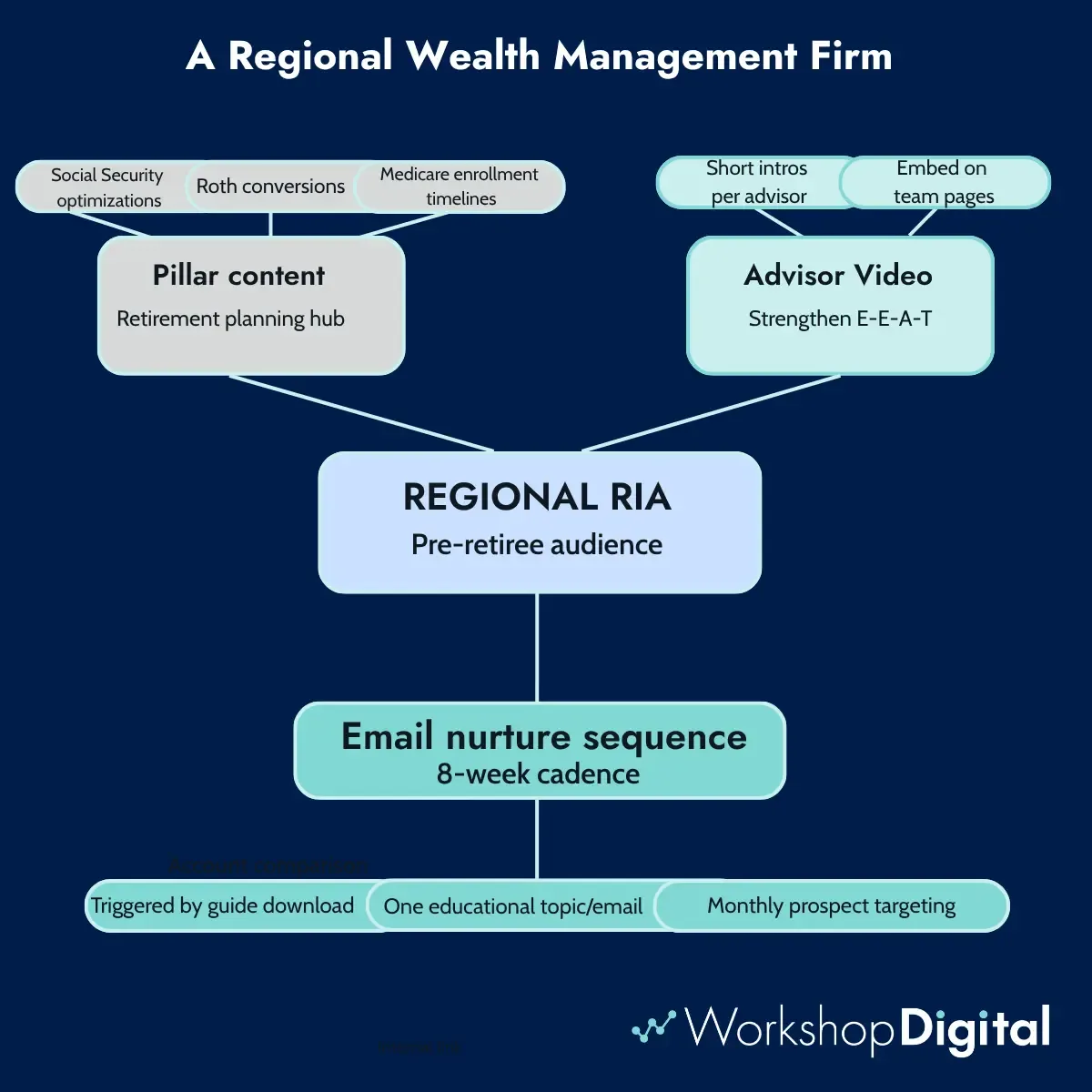
Example 1: A Regional Wealth Management Firm
A mid-sized RIA wants to attract pre-retirees in their geographic market who are actively researching retirement planning options. Their advisors have deep expertise, but the firm’s website has minimal blog content and no structured content strategy.
Build a pillar page on “Retirement Planning in [Region]” with supporting posts on topics like Social Security optimization, Roth conversions, and Medicare enrollment timelines (add more topics if you find them relevant).
Record short video introductions for each advisor and embed them on team pages and relevant blog posts to strengthen E-E-A-T.
Launch a monthly email nurture sequence targeting prospects who download a retirement readiness guide, delivering one educational topic per email over eight weeks.
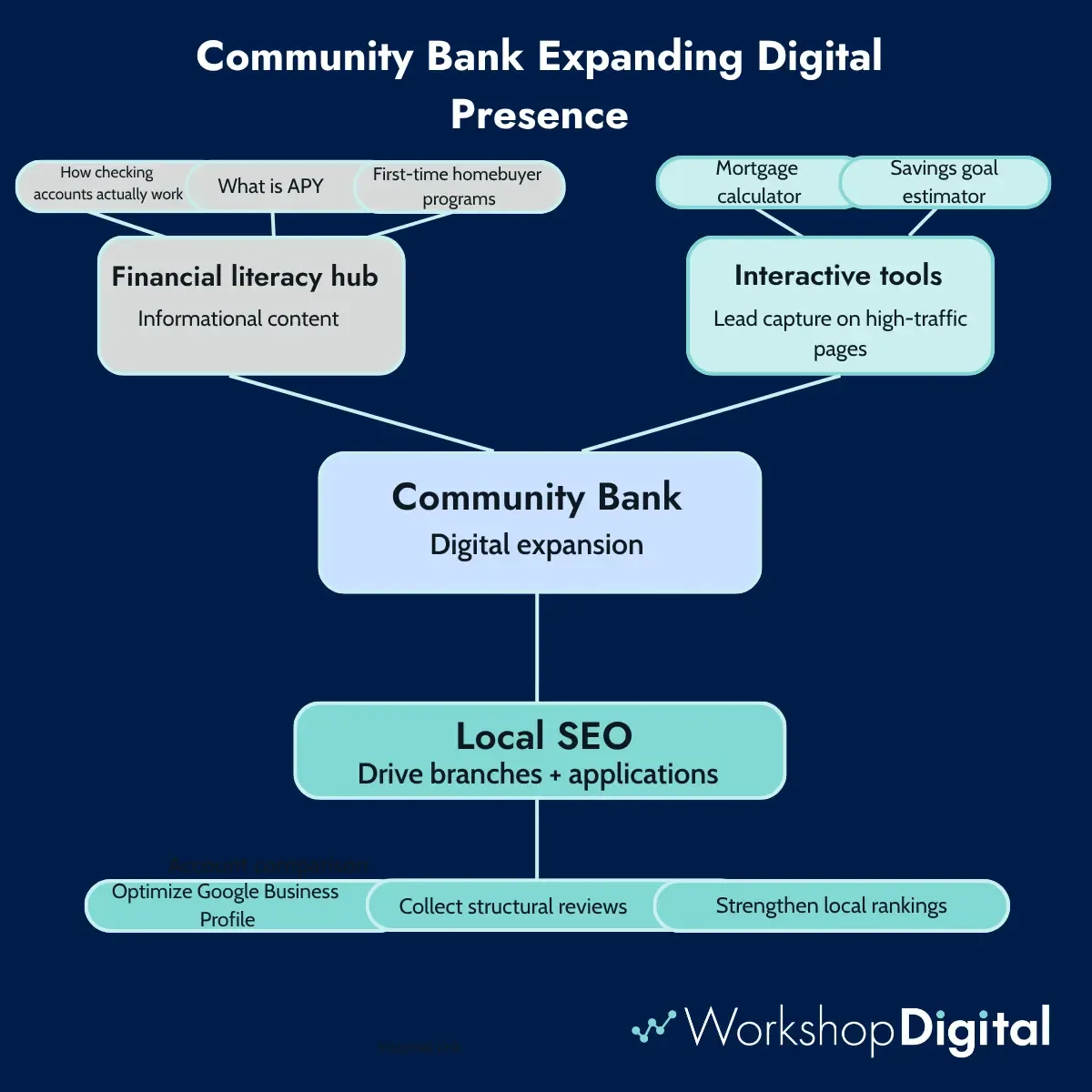
Example 2: Community Bank Expanding Digital Presence
A community bank has strong local brand recognition but is losing digital market share to national banks and fintech competitors. Their existing website content is product-focused and doesn’t rank for educational or informational queries.
Create a financial literacy content hub with explainer posts on topics like “How checking accounts actually work,” “What is APY?,” and “First-time homebuyer programs in [State].”
Add interactive tools: a mortgage calculator, a savings goal estimator, to high-traffic pages, and use them as lead capture opportunities. With AI, these tools are easier than ever to create.
Optimize Google Business Profile content and collect structured reviews to strengthen local SEO, which drives branch visits and online applications alike.
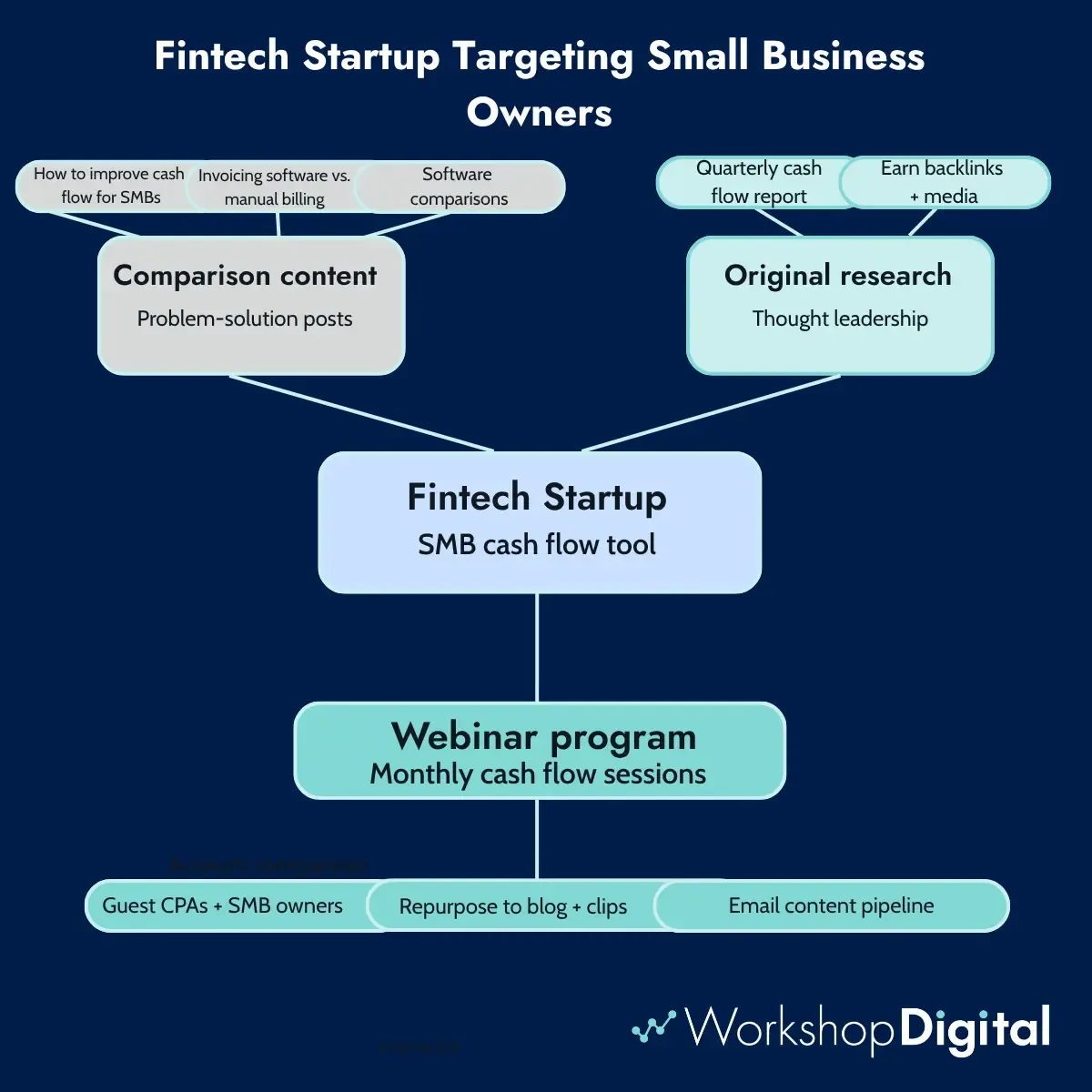
Example 3: Fintech Startup Targeting Small Business Owners
A fintech company offers an automated invoicing and cash flow tool for small businesses. They’ve built a solid product, but struggle with organic visibility. Their target audience searches for solutions to cash flow problems, not for specific software.
Develop comparison content and problem-solution posts around queries like “how to improve cash flow for small businesses” and “invoicing software vs. manual billing.”
Publish original research, a quarterly small business cash flow report, for example, to earn backlinks, media coverage, and thought-leadership positioning.
Host monthly webinars on cash flow management with guest CPAs or small business owners, then repurpose the recordings into blog posts, short social clips, and email content.
Build a Content Strategy for Your Financial Firm
Content marketing in financial services isn’t about publishing more; it’s about publishing smarter. The financial companies that win are the ones that understand the unique dynamics of financial content (YMYL, E-E-A-T, compliance), map their content to the buyer journey, use AI as a productivity accelerator without sacrificing accuracy, and measure what matters to their business.
Start with a clear strategy, build around your team’s real expertise, and invest in the content infrastructure that compounds over time. If you haven’t already, read our Guide to SEO for Financial Services for the technical SEO foundations that make your content work harder.
Ready to build a content strategy that drives strong results for your financial services firm? Let’s talk.